Visiting Fréjus, France: Top Sights on Foot
Things to do in Fréjus: Roman Ruins, Medieval Heritage and Provençal Character
The best things to do in Fréjus include exploring Roman ruins, discovering the medieval cathedral complex, and visiting places that reflect the town’s religious and military history. Fréjus, once known as Forum Julii, brings together ancient monuments, Provençal streets and landscapes reaching towards the Esterel massif. Neywo offers a free audio guide for Fréjus with 18 narrated places, available in 11 languages.
What to see in Fréjus
Roman amphitheater of Fréjus
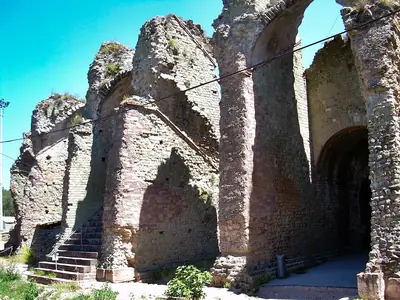
The Roman amphitheater of Fréjus, or Arènes de Fréjus, is one of the clearest reminders of the ancient city of Forum Julii. Built in the first century, the arena measured 113 metres long and 85 metres wide and could accommodate between 10,000 and 12,000 spectators.
The amphitheatre has been listed as a historic monument since 1840. Its appearance has changed considerably: between 2009 and 2012, the structure was extensively altered and covered by a modern concrete structure. Even so, its scale remains an important clue to the significance of Roman Fréjus.
Roman Theatre of Fréjus
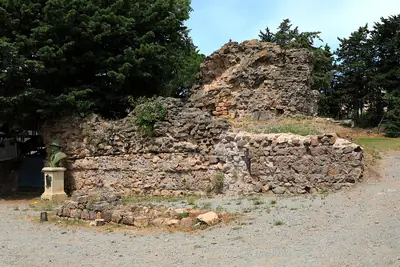
The Roman Theatre is another surviving trace of antiquity in the city. Its remains offer a glimpse of the cultural life of the ancient settlement and help place the amphitheatre within the wider Roman landscape of Forum Julii.
Together, the theatre and arena show that Fréjus was more than a military or commercial centre: it was also a city with public spaces designed for large audiences.
Aqueduct from Mons to Fréjus
The Roman aqueduct from Mons to Fréjus, also known as the Aqva Foroivliensis, connected Mons and Montauroux with Fréjus. Its route formed an important part of the city’s water supply.
The aqueduct has been protected as a historic monument since 1886. Its remains reveal the engineering behind the development of the Roman city and add another dimension to Fréjus’s archaeological heritage.
Fréjus Cathedral
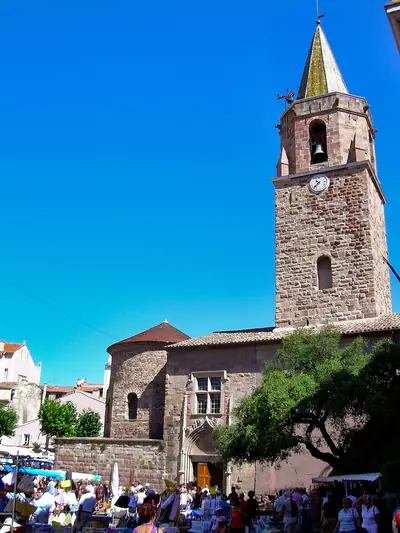
Saint-Léonce Cathedral, or Fréjus Cathedral, stands in the historic centre as part of a medieval cathedral complex shaped by centuries of religious life. The complex includes a parish church and a cathedral, originally two adjoining churches brought together under one roof.
Its most remarkable features include a medieval cloister, a thirteenth-century bell tower and an early Christian baptistery. The fifth-century baptistery has an octagonal form, angled sides, small apses and eight corner columns. These Corinthian columns were reused from a Roman building.
The baptistery is considered one of the oldest Christian structures in France. It was rediscovered in 1925 by the French architect Jules Formigé after later rebuilding had concealed it. The cathedral was the seat of the Bishop of Fréjus from the fifth century. Although the diocese was abolished in 1801, it was restored in 1822 and united with the Diocese of Toulon in 1957. Saint-Léonce has been a co-cathedral of the Diocese of Fréjus-Toulon since then.
Chapelle Saint-François de Paule
The Chapelle Saint-François de Paule is a modest Catholic chapel dedicated to Saint Francis of Paola. Built in 1560, it is one of Fréjus’s protected historic monuments and has held that status since 1987.
Its smaller scale offers a contrast with the cathedral complex and the large Roman remains, while continuing the story of the town’s religious heritage.
Villa Aurélienne
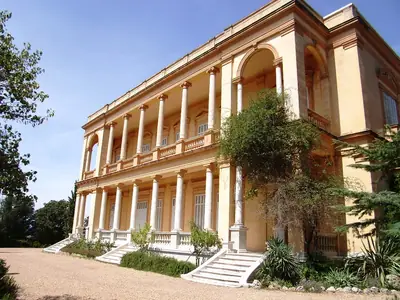
Villa Aurélienne, also known as Château Aurélien, stands on Bellevue hill between the Reyran valley and the Valescure district. The elegant residence is surrounded by a 24-hectare park.
The building’s neo-Palladian architecture is only part of its appeal. The park has a distinctly Mediterranean character, with a variety of Mediterranean trees and plants shaping the setting. It is a place where architecture and landscape are closely connected.
Couvent des Dominicaines de Fréjus
The Couvent des Dominicaines de Fréjus, also known as the Couvent Saint-Félix, is a religious site associated with reformed Cistercian nuns. Its history reflects the role of religious communities in the development of Fréjus and adds another layer to the town’s medieval and spiritual heritage.
Chapelle Notre-Dame-de-Jérusalem
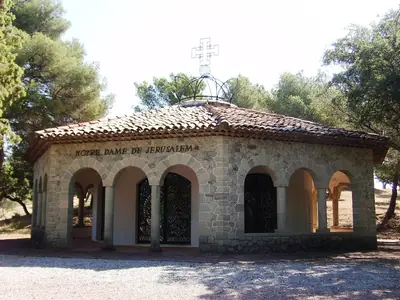
The Chapelle Notre-Dame-de-Jérusalem, also called the Chapelle Cocteau, is a Catholic chapel belonging to the Diocese of Fréjus-Toulon. It was the last work of the French poet Jean Cocteau.
Its name means Our Lady of Jerusalem. The chapel offers a different perspective on Fréjus’s religious landmarks, connecting the town’s older traditions with the work of a major twentieth-century French poet.
Mémorial des guerres en Indochine de Fréjus
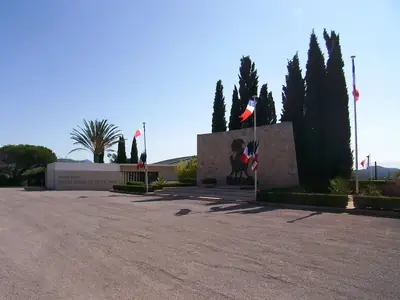
In the Gallieni sector, the Mémorial des guerres en Indochine is a national necropolis and place of remembrance for soldiers who died for France. The memorial was inaugurated on 16 February 1993 by François Mitterrand, then President of France.
The bodies resting here belonged to soldiers who died between 1940 and 1945 and, for the most part, between 1946 and 1954 during the First Indochina War. It is one of the city’s most significant memorial sites.
Pagode Hông Hiên Tu
The Hông Hiên Tu Pagoda, also known as the Gallieni Pagoda, is a Buddhist place of worship in Fréjus. It was built in 1917 on the initiative of Captain Delayen and Colonel Lame.
The pagoda originally stood within the Gallieni camp, in the area now called Les Évêques. Its presence adds an unexpected cultural dimension to Fréjus and forms part of the city’s wider military and overseas history.
Musée des troupes de marine de Fréjus
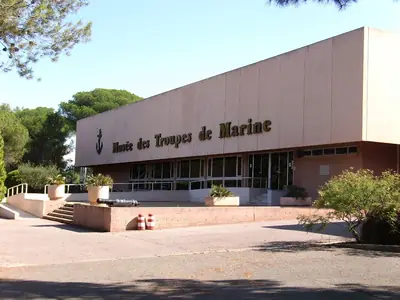
The Musée des troupes de marine de Fréjus, also known as the Musée des Troupes de Marine, is another stop connected with the town’s military history. Its name and collection place Fréjus within the story of France’s marine troops.
Pont des Esclapes
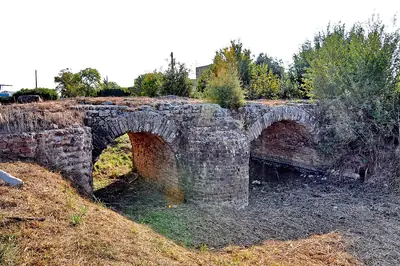
The Pont des Esclapes is a simple bridge landmark in Fréjus. It is a minor stop compared with the cathedral or Roman monuments, but it belongs to the city’s historic and urban landscape.
Mont Vinaigre
For a change of scenery, Mont Vinaigre rises to 614 metres as the highest point in the Esterel massif. Forest, scrubland and exposed rock shape its mountain landscape near Fréjus.
The summit can be reached from the west by a forest road that comes within a few hundred metres of the top, followed by a track and footpath. The marked route forms part of the GR 51 long-distance trail, which crosses the mountain from west to east. Another path approaches from the north, from the settlement of Logis de Paris.
At the summit, an old lookout tower and transmission equipment are present, although the tower is not accessible. There is also a heliport below the summit. Mont Vinaigre lies within the Esterel state forest and is protected as a natural area.
The Church of Sacré-Cœur and the église Saint-Roch de Fréjus are also part of the town’s religious heritage. Both are local Catholic places of worship and offer quieter stops away from the principal archaeological landmarks.
Fréjus is part of Provence-Alpes-Côte d’Azur, a region where ancient towns, Mediterranean landscapes and Riviera destinations sit close together. Its layered history also makes it a useful starting point for discovering France beyond its best-known cities.
Explore Fréjus with Neywo
Neywo’s Fréjus self-guided walking tour is called “Forum Julii: Rome, Bishops and Buddhas in Fréjus”. It is one walking route covering 3.82 km in 108 minutes, with eight narrated stops: the Roman amphitheater of Fréjus, Chapelle Saint-François de Paule, Couvent des Dominicaines de Fréjus, Fréjus Cathedral, Roman Theatre of Fréjus, Villa Aurélienne, Pagode Hông Hiên Tu and Mémorial des guerres en Indochine de Fréjus.
Download Neywo and explore Fréjus at your own pace. The app tells the story of each place as you reach it, with no group and no schedule.
Places with an audio guide in Fréjus
8 places in Fréjus with a Neywo audio guide. Each one starts telling its story as you reach it.
Self-guided tours in Fréjus
1 tour in Fréjus, free in the Neywo app. Each stop tells its story as you reach it.
- Walk
Forum Julii: Rome, Bishops and Buddhas in Fréjus
Julius Caesar founded this Provençal port as Forum Julii, and its Roman arena and theatre still stand. Walk from the amphitheatre through the old episcopal quarter, with its fifth-century baptistery, then climb to the Villa Aurélienne park and end at France's oldest Buddhist pagoda and the Indochina memorial.
Roman amphitheater of Fréjus · Chapelle Saint-François de Paule · Couvent des Dominicaines de Fréjus · Fréjus Cathedral · Roman Theatre of Fréjus · Villa Aurélienne …
Open this tour: Forum Julii: Rome, Bishops and Buddhas in Fréjus
Walk Fréjus with Neywo
Neywo turns Fréjus into a self-guided audio tour. Stories arrive as you reach the place they belong to, and the route reshapes when you wander off it.

