What to See in Lourdes, France: Free Audio Guide
Things to do in Lourdes: what to see in the pilgrimage city
The best things to do in Lourdes include visiting the Sanctuary of Our Lady of Lourdes and the Massabielle Grotto, following the story of Bernadette Soubirous, and exploring the city’s medieval fortress and museums. Set in the foothills of the Pyrenees, Lourdes brings together religious history, local heritage and distinctive mountain scenery. Neywo has a free audio guide for Lourdes with 17 narrated places.
What to see in Lourdes
Sanctuary of Our Lady of Lourdes
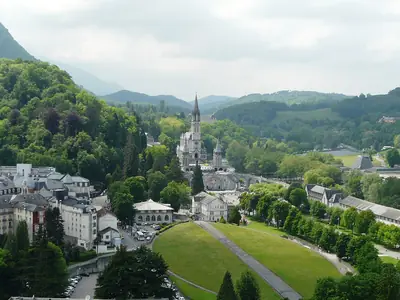
The Sanctuary of Our Lady of Lourdes is one of the world’s best-known Catholic pilgrimage sites. Its 52-hectare domain brings together the Grotto of Massabielle, three basilicas, chapels, fountains, baths, prayer spaces and areas for processions.
The sanctuary’s history is linked to events in 1858, when Bernadette Soubirous said that she repeatedly saw a lady at the Grotto of Massabielle. The Catholic Church recognized the apparitions in 1862. Today, the sanctuary remains the central place to understand Lourdes and its religious importance.
Massabielle Grotto
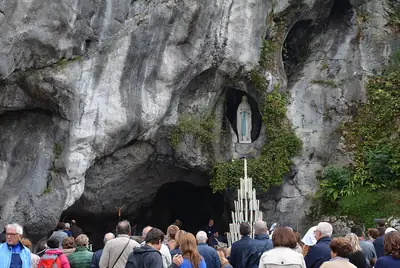
The Massabielle Grotto, also known as the Grotto of Lourdes, is the cave where Bernadette reported seeing the Virgin Mary. Between 11 February and 16 July 1858, she reported 18 apparitions and said that she discovered a spring at the Virgin Mary’s direction.
The water has been regarded as miraculous by believers ever since. Inside the grotto, a statue of the Virgin Mary stands at the place where Bernadette said the apparition appeared. Joseph-Hugues Fabisch carved the statue from white Carrara marble in 1864, following Bernadette’s description.
A chapel known as the Crypt was carved into the rock at the site and consecrated on 20 May 1866. It contains five chapels, including the Saint-Michel Chapel, where relics of Saint Bernadette are kept.
Basilica of the Immaculate Conception
The Basilica of the Immaculate Conception is the sanctuary’s Upper Church. It stands above the Basilica of the Rosary and overlooks the Grotto of Massabielle, making it one of the most prominent buildings in Lourdes.
Construction began in 1862, and the church was consecrated in July 1876. Its neo-Gothic design rises above the grotto, with a tower reaching 70 metres from the lower rock that supports it. Inside, three naves are separated by decorative marble columns, and the basilica contains 22 altars.
Rosary Basilica
The Rosary Basilica is also known as the Lower Basilica. Built between 1883 and 1889 and consecrated in 1901, it was designed to accommodate the growing number of pilgrims visiting Lourdes.
Its Romano-Byzantine, or Neo-Byzantine, style gives it a distinctive appearance. Above the main entrance, a relief shows the Virgin Mary and the infant Jesus presenting the Rosary to Saint Dominic. The basilica can hold up to 1,500 people and stands in front of, and below, the Upper Church.
Basilica of Saint Pius X
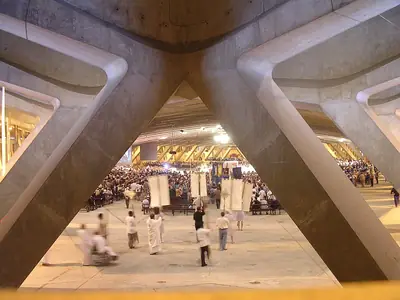
Beneath the sanctuary’s esplanade, the Basilica of Saint Pius X is also called the Underground Basilica. Completed and consecrated in 1958, it was built for the centenary of the apparitions and to receive the large crowds expected in Lourdes.
The vast building covers about 12,000 square metres and measures roughly 201 metres long by 81 metres wide. It can accommodate around 25,000 people, including 5,000 seated. Its construction also included steel sheet piling and pumping equipment to protect the interior from groundwater.
Other churches in Lourdes
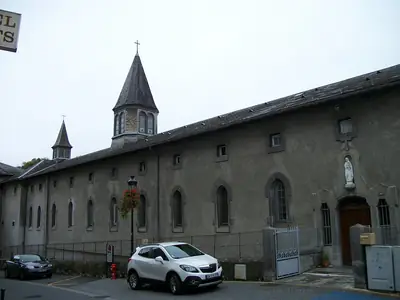
The sanctuary is not the only place of worship in the city. Sainte-Bernadette Church forms part of the sanctuary complex, while the Monastery of the Poor Clares of Lourdes belongs to the Order of Saint Clare and the Diocese of Tarbes and Lourdes.
The Carmel Monastery of Lourdes is home to a community of Carmelite nuns. The Dormition Ukrainian Orthodox Church adds an Eastern Christian presence, combining a Ukrainian Catholic identity with a Latinized form of the Byzantine rite.
The Church of the Sacred Heart stands in the upper part of the city, in the Ophite-Chantecler district, away from the sanctuary near the Gave de Pau. Construction began in 1875 at the initiative of Abbé Dominique Peyramale, the parish priest of Lourdes at the time of the apparitions. The project was completed in 1936, when the bell tower was built.
Lourdes also has local churches including Saint-Martin de Saux and Sainte-Bernadette d’Anclades.
Château fort de Lourdes
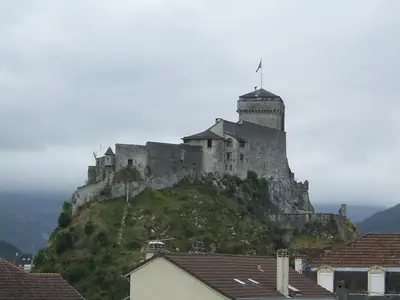
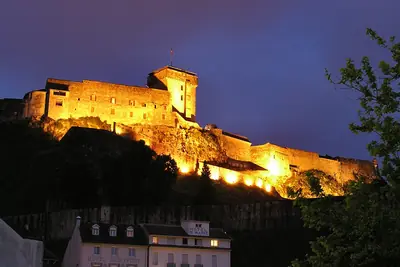
The Château fort de Lourdes is a strong medieval fortress rising above the city. Known in Gascon as Castèth de Lorda, it occupies a strategic position at the entrance to the seven valleys of the Lavedan.
The fortress was successively held by the counts of Foix-Béarn, the English during the Hundred Years’ War and later the Kingdom of France. Its tower, walls, drawbridge and Notre-Dame-du-Château chapel reveal both its defensive and religious roles.
The castle also provides a broad panorama of Lourdes, the Sanctuary of Our Lady of Lourdes and the Pyrenees. It houses the Musée pyrénéen de Lourdes, making it a place where the city’s medieval history and regional culture meet.
Musée pyrénéen de Lourdes
The Musée pyrénéen has been installed in the Château fort de Lourdes since 1921. The museum is devoted to the Pyrenees in all their aspects, while the fortress provides an important part of the setting.
Visiting the museum adds a regional perspective to a trip focused on Lourdes’ religious landmarks. The combination of museum and medieval castle connects the cultural history of the Pyrenees with the city’s historic landscape.
Moulin de Boly
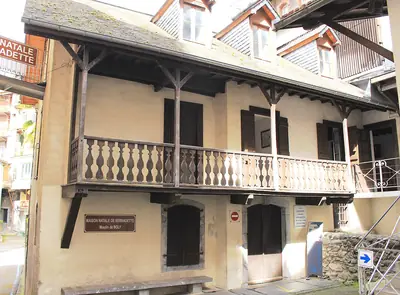
The Moulin de Boly is a watermill and the birthplace of Bernadette Soubirous. The site offers a more personal connection with her early life, before the events that made Lourdes an international pilgrimage destination.
The mill takes its name from one of its former owners. Bernadette’s maternal family, the Castérot family, operated it from 1786 to 1854.
Tour de Garnavie
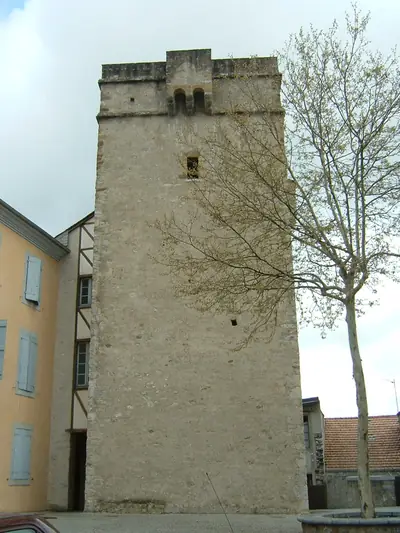
The Tour de Garnavie is a fortified structure and a surviving reminder of Lourdes’ defenses. It has been listed as a historic monument since 19 February 1946.
Together with the Château fort, the tower helps reveal the town’s military past, which predates Lourdes’ modern identity as a pilgrimage destination.
A Lourdes self-guided walking tour with Neywo
Neywo’s free audio guide makes it easy to explore Lourdes independently. The app tells the story of each place as you reach it, at your own pace, with no group and no schedule. Narration is available in 11 languages.
In Lourdes, Neywo offers two walking tours and one bus route:
- In Bernadette’s Footsteps: The Sanctuary of Lourdes: a 1.33 km walk lasting 65 minutes, with 8 narrated stops.
- Fortress, Mill and the Town Before the Pilgrims: a 1.39 km walk lasting 53 minutes, with 6 narrated stops.
- Bus L5: The Heart of Lourdes Loop: a 4.3 km bus route lasting 18 minutes, with 4 narrated stops.
The routes include the main basilicas and grotto, as well as the Château fort, Moulin de Boly, Musée pyrénéen, Tour de Garnavie and several churches. Download Neywo to explore Lourdes with its history in your ears, moving from one narrated place to the next whenever you are ready.
Lourdes is in Occitania, in the wider setting of France. For more city breaks in the region, discover Carcassonne, Montpellier or Collioure.
Places with an audio guide in Lourdes
8 places in Lourdes with a Neywo audio guide. Each one starts telling its story as you reach it.
Self-guided tours in Lourdes
3 tours in Lourdes, free in the Neywo app. Each stop tells its story as you reach it.
- Bus ride
Bus L5: The Heart of Lourdes Loop
Seasonal city-centre loop of the Lourdes bus network, starting and ending at the Saint-Joseph/Grotte stop. It passes the old town, Bernadette's birthplace mill and the castle district before returning to the sanctuary: a cheap way to see Lourdes beyond the pilgrim esplanade.
Monastère des Clarisses de Lourdes · Tour de Garnavie · Moulin de Boly · Basilica of St. Pius X
Open this tour: Bus L5: The Heart of Lourdes Loop - Walk
In Bernadette's Footsteps: The Sanctuary of Lourdes
Walk the heart of the pilgrimage from the vast underground basilica to the Grotto of Massabielle, where Bernadette Soubirous saw her visions in 1858. Pass the Rosary Basilica, the Gothic upper church and the modern church across the river, then the Carmelite monastery, and finish at a Ukrainian chapel that few visitors find.
Basilica of St. Pius X · Rosary Basilica · Basilique de l'Immaculée-Conception de Lourdes · Sanctuary of Our Lady of Lourdes · Massabielle Grotto · Église Sainte-Bernadette de Lourdes …
Open this tour: In Bernadette's Footsteps: The Sanctuary of Lourdes - Walk
Fortress, Mill and the Town Before the Pilgrims
Leave the crowds behind for old Lourdes: the mill where Bernadette was born, the medieval castle above the town with its Pyrenean museum, a historic tower and a hillside parish church. A quieter walk that shows the town that existed long before the apparitions.
Monastère des Clarisses de Lourdes · Moulin de Boly · Château fort de Lourdes · Musée pyrénéen de Lourdes · Tour de Garnavie · Church of Sacred Heart, Lourdes
Open this tour: Fortress, Mill and the Town Before the Pilgrims
Walk Lourdes with Neywo
Neywo turns Lourdes into a self-guided audio tour. Stories arrive as you reach the place they belong to, and the route reshapes when you wander off it.


More in Occitania
Elsewhere in France
- Aix-en-ProvenceProvence-Alpes-Côte d'Azur
- AntibesProvence-Alpes-Côte d'Azur
- ArlesProvence-Alpes-Côte d'Azur
- AvignonProvence-Alpes-Côte d'Azur
- Bouc-Bel-AirProvence-Alpes-Côte d'Azur
- CannesProvence-Alpes-Côte d'Azur
- CassisProvence-Alpes-Côte d'Azur
- CavaillonProvence-Alpes-Côte d'Azur
- ÈzeProvence-Alpes-Côte d'Azur
- FréjusProvence-Alpes-Côte d'Azur
- MarseilleProvence-Alpes-Côte d'Azur
- MentonProvence-Alpes-Côte d'Azur