What to See in Stuttgart, Germany: Free Audio Guide
Things to Do in Stuttgart: Museums, Palaces and Modern Architecture
Stuttgart is the capital of Baden-Württemberg and a city shaped by royal history, art, architecture and the automobile. From palace gardens and historic houses to the Mercedes-Benz and Porsche museums, there are plenty of things to do in Stuttgart. Neywo’s free audio guide for Stuttgart covers 273 narrated places, helping you explore the city as you walk.
What to See in Stuttgart
Schloss Solitude
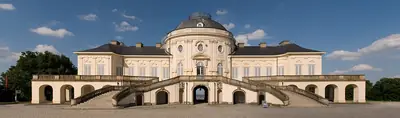
West of Stuttgart, Schloss Solitude is one of the city’s most distinctive Rococo landmarks. Charles Eugene, Duke of Württemberg, commissioned it in 1764 as a hunting retreat. Designed by Johann Friedrich Weyhing and Philippe de La Guêpière, the palace was completed in 1769 as a grand complex combining Rococo and emerging Neoclassical influences.
The original estate included avenues, gardens, a hedge maze, theater, orangery, riding hall, chinoiserie house and zoos. Its gardens and nearby forests were also maintained for court hunting. After falling into disuse, the palace underwent restoration between 1972 and 1983, bringing its interiors back to life.
Württemberg Mausoleum
On the hill known as the Württemberg stands the Württemberg Mausoleum, also called the Grabkapelle Rotenberg. King William I of Württemberg commissioned it after the death of his second wife, Catherine Pavlovna of Russia. The memorial, built between 1820 and 1824, became the final resting place of the couple and their daughter, Maria Friederike Charlotte.
Giovanni Salucci designed the circular building, which has three porticos and a free-standing dome. Its interior follows the tradition of a Russian Orthodox church, with a vestibule, nave and chancel. Corinthian columns and marble statues of the Four Evangelists add to the solemn character of the space.
Mercedes-Benz Museum
The Mercedes-Benz Museum traces the history of one of the world’s best-known automotive brands. Its collection includes more than 160 vehicles, from early motorcars to important Mercedes-Benz models and associated marques.
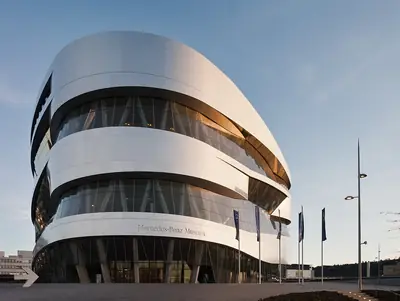
The building is an attraction in its own right. Designed by UN Studio, it is based on three overlapping circles whose centers have been removed. The resulting triangular atrium recalls the shape of a Wankel engine, while a double-helix layout accommodates 16,500 square metres of exhibition space.
The museum opened to the public on May 19, 2006, directly outside the main gate of the Mercedes-Benz factory in Stuttgart.
Porsche Museum
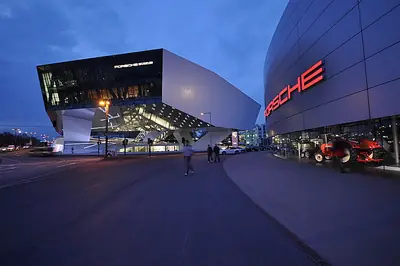
At Porscheplatz in Zuffenhausen, the Porsche Museum presents the development of the carmaker through road and racing vehicles arranged in chronological order. Highlights include the Porsche 356 No. 1 Roadster, different generations of the Porsche 911, and the Porsche 550 and 917.
The museum building, completed in 2009, appears to hover above the ground on three supporting columns. Outside, three tall pillars form a sculpture, each carrying an iconic Porsche 911 from a different decade. Porsche’s connection with Stuttgart began in 1931, when Ferdinand Porsche moved to the city and began designing engine components.
Staatsgalerie Stuttgart
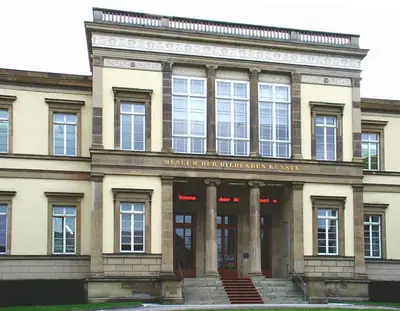
The Staatsgalerie Stuttgart is one of the most important art museums in Baden-Württemberg. Its collection includes paintings from the High Middle Ages onward, nineteenth-century sculptures and an extensive graphic collection.
The museum combines the original Alte Staatsgalerie, which opened in 1843, with the Neue Staatsgalerie. Designed by James Stirling and opened in 1984, the extension is regarded as a masterpiece of postmodern architecture in Germany. The museum complex was rebuilt after being practically destroyed during the Second World War and reopened in 1948.
StadtPalais, Museum for Stuttgart
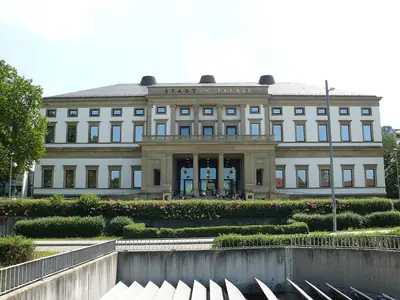
The StadtPalais, Museum for Stuttgart, tells the story of the city from the Wilhelm Palais on Konrad-Adenauer-Straße. The classicist city palace previously housed Stuttgart’s central public library, the city administration and the German Foreign Institute. Air raids in 1944 caused major damage, and the building was later reconstructed before being converted into a museum.
The museum opened on April 14, 2018. It provides a useful introduction to Stuttgart’s urban history while also showing how the city’s historic buildings have been adapted over time.
Weissenhof Estate and Weissenhof Museum
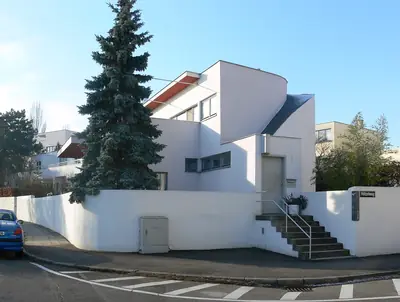
The Weissenhof Estate, or Weißenhofsiedlung, is one of Stuttgart’s clearest showcases of early modern architecture. Built for an exhibition in 1927, it brought together seventeen architects under the artistic direction of Mies van der Rohe. The result was twenty-one houses, including apartments, detached homes and terraced buildings.
The buildings explore practical ideas about modern housing, with flat roofs used as terraces, continuous bands of windows, streamlined façades and open interiors. Their colours were not limited to white: some architects used light pink, orange, blue and green.
The Weissenhof Museum occupies a semi-detached building designed by Le Corbusier and Pierre Jeanneret. Opened in 2006, it focuses on the history of the estate and modern architecture. Since 2016, the building has formed part of the UNESCO World Heritage Site dedicated to Le Corbusier’s work.
Kunstmuseum Stuttgart
In the centre of Stuttgart, the Kunstmuseum is recognizable by its cube of glass and stone. Opened in 2005, it presents modern and contemporary art together with selected works from Stuttgart’s municipal collection.
During the day, the glass façade gives the building a sleek appearance. At night, the illuminated limestone walls become more prominent. The collection includes artists such as Otto Dix, Willi Baumeister, Adolf Hölzel and Dieter Roth, with particularly important holdings of works by Otto Dix.
Klösterle in Bad Cannstatt
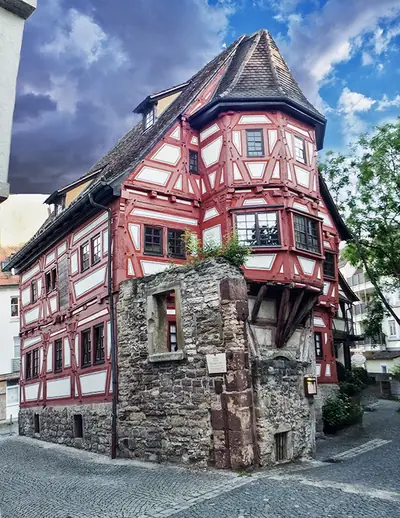
Klösterle is the oldest surviving residential building in Stuttgart, dating from around 1465. This half-timbered house may have been inhabited by Beguines, a religious community of women, during the Middle Ages.
Its most unusual feature is a Gothic chapel built into the first floor. Klösterle is also associated with the Stadtmuseum Bad Cannstatt, but the historic house itself remains the main reason to visit.
Burgholzhof Observation Tower
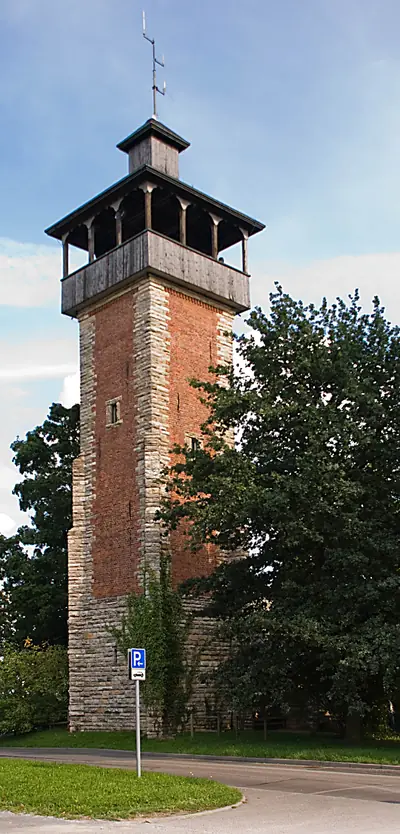
The Burgholzhof Observation Tower offers wide views over Stuttgart’s vineyards, Bad Cannstatt, Hallschlag and the Neckar Valley as far as Esslingen am Neckar. The protected historic landmark rises about 27 metres above Burgholzhof, with a covered main platform 18.7 metres above the ground.
The viewpoint is reached by a wooden staircase with 100 steps. The lower section is built from Cannstatt travertine, while the upper part is made of brick with travertine framing its corners. The foundation stone was laid on May 25, 1891, and the tower opened on September 19 of the same year.
Straßenbahnwelt Stuttgart
Straßenbahnwelt Stuttgart follows more than 140 years of urban transport history. The story begins with Stuttgart’s first horse-drawn tram from 1868 and continues through the development of electric trams and the modern light rail era.
Across approximately 2,500 square metres, the museum displays historic vehicles and objects from the operation and technology of the city’s tramways. One highlight is the Stuttgart classic GT4, which remained in service until modern light rail systems replaced it in 2007.
MHPArena and Neckarpark
MHPArena is a major sporting venue in Stuttgart’s Neckarpark district of Bad Cannstatt and the home stadium of VfB Stuttgart. Completed in 1933, it has been rebuilt and expanded several times and can accommodate 60,058 spectators.
The stadium hosted the fourth World Championships in Athletics in August 1993. Athletes from 187 countries competed in 44 events between August 13 and 22. The venue has also carried several names, including Neckarstadion, Gottlieb-Daimler-Stadion and Mercedes-Benz Arena; since July 1, 2023, it has been called MHPArena.
Explore Stuttgart with Neywo
Neywo offers six walking tours, one bus route and one bike route in Stuttgart:
- Six walking tours, ranging from 1.15 to 3.88 km and from 58 to 103 minutes, with 4 to 11 narrated stops each.
- One bus route, 7.7 km and 33 minutes, with 9 narrated stops.
- One bike route, 4.4 km and 22 minutes, with 6 narrated stops.
The walks cover Stuttgart’s old town, the cultural mile, Weissenhof and Killesberg, the Leonhard Quarter, Bad Cannstatt and Neckarpark. The bus route runs from Killesberg Park to the old town, while the bike route follows the Green U from Killesberg to Rosenstein Park.
Download Neywo and explore Stuttgart at your own pace. The app tells the story of each place as you reach it, with no group and no schedule. After Stuttgart, continue discovering Baden-Württemberg or explore more of Germany.
Places with an audio guide in Stuttgart
8 places in Stuttgart with a Neywo audio guide. Each one starts telling its story as you reach it.
Self-guided tours in Stuttgart
8 tours in Stuttgart, free in the Neywo app. Each stop tells its story as you reach it.
- Bike ride
The Green U: Killesberg to Rosenstein Park by Bike
Follow Stuttgart's Green U, the chain of parks built for the 1993 garden show. Ride from the Brenzkirche beside the Weissenhof Estate through Killesberg's art stations to the Gate of Hope, then on to the Wilhelma gardens and Rosenstein Castle.
Brenzkirche (Stuttgart) · Bei der Buche · Sanctuarium · Gate of Hope · Wilhelma-Theater · Museum Schloss Rosenstein
Open this tour: The Green U: Killesberg to Rosenstein Park by Bike - Bus ride
Bus 44: From Killesberg Park to the Old Town
A city bus (SSB line 44) that links the Killesberg park area with the centre. Ride it from the Weissenhof church past the Chinese garden and MiniaturWelten into the Schlossgarten, then by the Old Castle square and Karlsplatz to the Leonhard quarter.
Brenzkirche (Stuttgart) · Garten der Schönen Melodie · MiniaturWelten Stuttgart · Eberhardsgruppe by Paul Müller · Roter Baum · Merkursäule …
Open this tour: Bus 44: From Killesberg Park to the Old Town - Walk
Counts, Dukes and a Hovering Mercury: Stuttgart's Old Town
Stuttgart began as a horse-breeding farm and grew into the seat of the Counts and Dukes of Württemberg. Walk from the market square and its Art Nouveau market hall to the Gothic Collegiate Church, Schiller's square and the Renaissance Old Castle, then find the gilded Mercury floating above the Old Chancellery. The walk passes Hotel Silber, where the city remembers the darkest chapter of its history, and ends at the StadtPalais, the royal palace that is now the city museum.
Stuttgardia · Stuttgarter Marktplatz · Market Hall Stuttgart · Stuttgart Collegiate Church · Schillerplatz · Alte Kanzlei (Old Chancellery) …
Open this tour: Counts, Dukes and a Hovering Mercury: Stuttgart's Old Town - Walk
Palaces, Parade Grounds and the Cultural Mile
From a glass-and-limestone art cube to the Baroque New Palace, this walk crosses the great forecourt where kings once drilled their soldiers. Look for the heraldic stag and lion and the giant Hercules and Minerva at the palace gate, step into the Art Nouveau-era Kunstgebäude, pass the Neoclassical State Theatre and its Schiller monument, then follow the Kulturmeile to the State Gallery, famous for its postmodern wing by James Stirling and a Henry Moore reclining figure.
Kunstmuseum Stuttgart · Schloßplatz · Hirsch und Löwe · Herkules und Minerva · Kunstgebäude Stuttgart · Eberhardsgruppe by Paul Müller …
Open this tour: Palaces, Parade Grounds and the Cultural Mile - Walk
Modern Stuttgart: Weissenhof to Killesberg
In 1927 seventeen architects, led by Mies van der Rohe, built an estate to show how modern people could live. Visit it and the Le Corbusier house museum, see the New Objectivity Brenzkirche, then climb the cable-net tower in Killesberg Park and follow the art stations of the 1993 garden show, from a ring of stone thrones around a beech to Dan Graham's mirrored Gate of Hope and the natural history museum at the Lion Gate.
Brenzkirche (Stuttgart) · Weissenhof Estate · Weissenhof Museum · Bei der Buche · Killesberg Tower · Stangenwald …
Open this tour: Modern Stuttgart: Weissenhof to Killesberg - Walk
Hegel, Reuchlin and the Leonhard Quarter
Away from the royal squares, this walk visits the old craftsmen's streets south of the centre. Start at the Gothic Revival church rising from the Feuersee, then see an Art Nouveau theatre, the Hospitalhof on the site of a Dominican monastery, Schiller's building, the birthplace of the philosopher Hegel, Stuttgart's second-oldest church where the humanist Reuchlin is buried, a fountain shaped like a weaver's knot and a small Anglican church.
Johanneskirche · Altes Schauspielhaus Stuttgart · Hospitalhof Stuttgart · Schillerbau · Museum Hegel-Haus · Leonhardskirche …
Open this tour: Hegel, Reuchlin and the Leonhard Quarter - Walk
Bad Cannstatt: Spa Town, Zoo and the Birthplace of the Motor Car
Across the Neckar lies Bad Cannstatt, a spa town older than Stuttgart itself. Start at the royal Rosenstein palace and the historicist Wilhelma garden, stroll to the oldest surviving house in the city, visit the town church, then see the garden workshop where Gottlieb Daimler and Wilhelm Maybach built the first high-speed engine and the tram museum.
Museum Schloss Rosenstein · Wilhelma · Wilhelma-Theater · Klösterle · Town Church Bad Cannstadt · Gottlieb-Daimler-Gedenkstätte …
Open this tour: Bad Cannstatt: Spa Town, Zoo and the Birthplace of the Motor Car - Walk
Neckarpark: Silver Arrows, Football and Volksfest
The Neckarpark is Stuttgart's stage for big crowds. See the football stadium that has worn four names, the event hall that bears Carl Benz's name, the Wasen where the Volksfest pitches its tents each autumn and the spiralling Mercedes-Benz Museum.
Carl Benz Center · MHPArena · Cannstatter Wasen · Mercedes-Benz Museum
Open this tour: Neckarpark: Silver Arrows, Football and Volksfest
Walk Stuttgart with Neywo
Neywo turns Stuttgart into a self-guided audio tour. Stories arrive as you reach the place they belong to, and the route reshapes when you wander off it.

