Visiting Augsburg, Germany: Top Sights on Foot
Things to Do in Augsburg: Historic Churches, Fuggers and Water Towers
Augsburg is a historic Bavarian city whose landmarks bring together medieval religion, Renaissance architecture, banking, music and engineering. The best things to do in Augsburg are concentrated across the old town, where a cathedral, social housing complex, palaces, churches and former guild buildings reveal the city’s changing history. Neywo offers a free audio guide for Augsburg with 154 narrated places.
Augsburg is in Bavaria, in southern Germany, and its sights are easy to explore as a series of connected historic quarters. Here is what to see in Augsburg, from its most important religious buildings to its quieter museums and streets.
What to see in Augsburg
Augsburg Cathedral
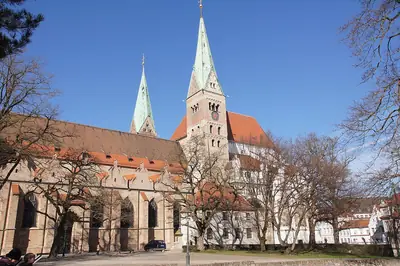
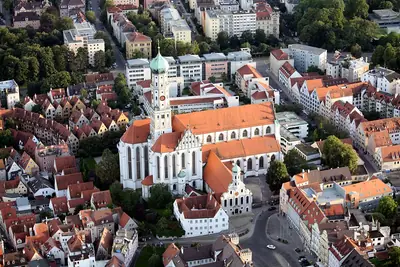
Augsburg Cathedral, also known as the Hohe Dom Mariä Heimsuchung, is one of Bavaria’s most significant church buildings. Its origins reach back to the eighth century, while the core of the present building was constructed from 995 onwards.
The cathedral combines a Romanesque nave with a Gothic high choir added in the fourteenth century. It is 113 metres long and 40 metres wide, with twin towers rising 62 metres. Inside, five stained-glass windows on the south wall depict the prophets Jonah, Daniel, Hosea, David and Moses. They are among the oldest figurative stained-glass windows in Europe.
The cathedral also played a role in imperial history. In 1690, it served as the coronation church for Joseph the First as Roman-German King and for his wife, Eleonore Magdalene, as Empress.
St. Anne’s Church and the Lutherstiege
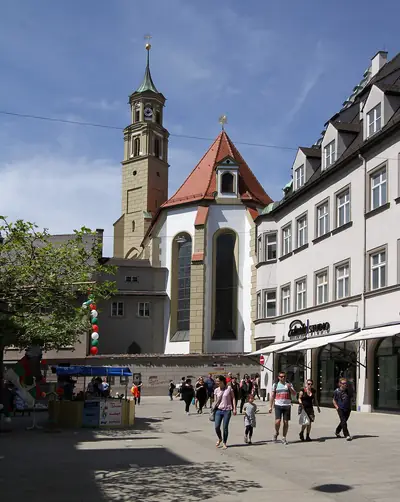
St. Anne’s Church began in 1321 as a Carmelite monastery. During the Reformation, it became one of Augsburg’s first Protestant churches in 1548. Its history remains visible in the building itself: the Fugger Chapel at the far end stayed Catholic, creating a striking religious contrast within the church.
The Gothic nave has pointed arches and vaulted ceilings, while the Fugger Chapel is one of the earliest Renaissance buildings north of the Alps. Built as a memorial chapel for the Fugger banking dynasty, it contains the church’s main organ.
Fuggerei
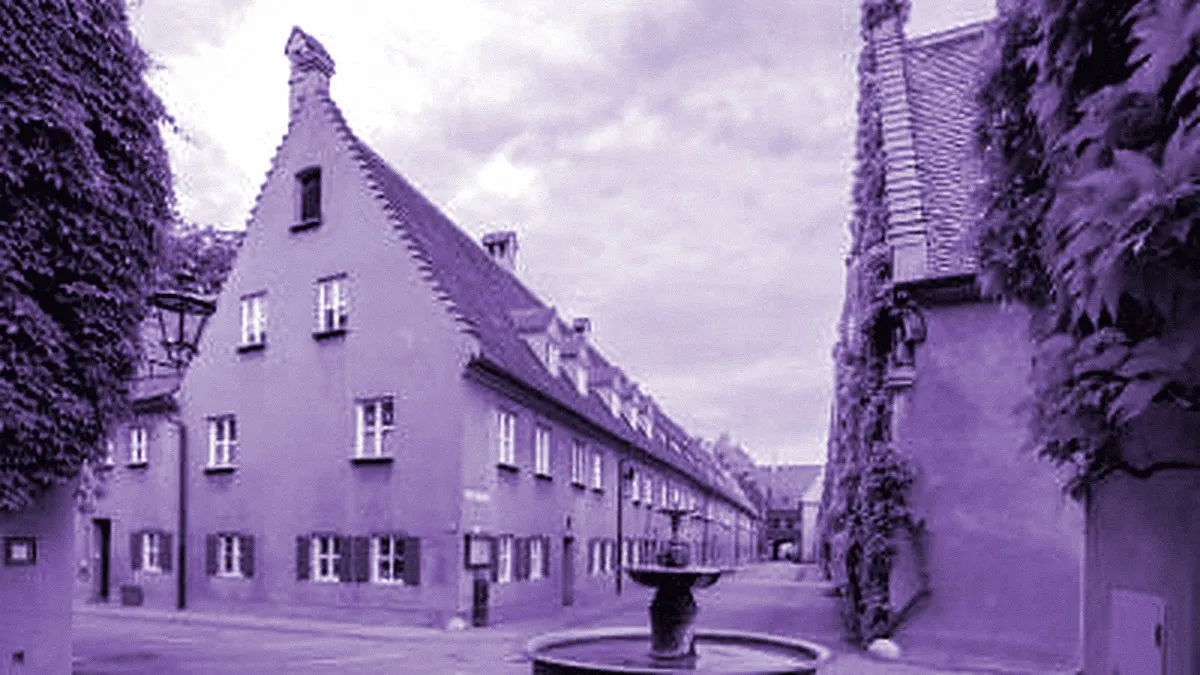
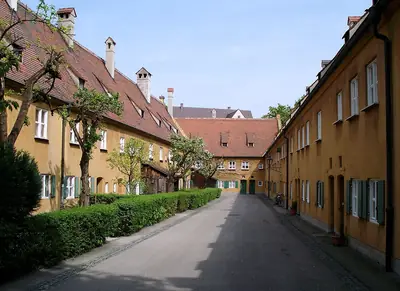
The Fuggerei is the world’s oldest social housing complex still in use. Jakob Fugger founded it in the early sixteenth century to house needy citizens of Augsburg. The settlement developed into a small enclosed community with quiet streets, squares and a church.
The complex contains 67 houses and 140 apartments. Its original social purpose remains central to its identity, making the Fuggerei one of the most distinctive places to visit in Augsburg. The gates, walls and compact layout give it the feeling of a small town within the city.
Schaezlerpalais
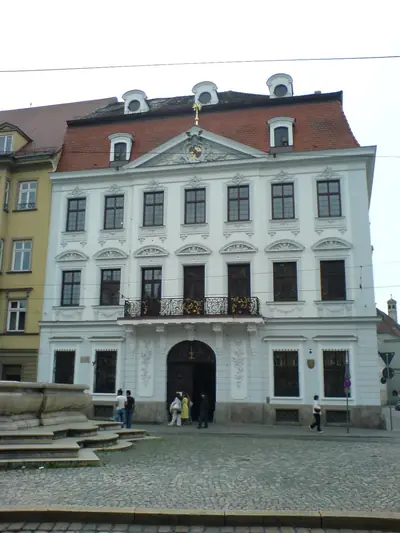
Beside the Hercules Fountain on Maximilianstraße, the Schaezlerpalais presents a more opulent side of Augsburg’s history. The palace was built in the 1760s for banker Benedikt Adam von Liebert, with Carl Albert von Lespilliez as architect.
Its façade is only 19 metres wide, but the complex extends 107 metres along Katharinengasse. Behind the relatively modest street front are rooms, courtyards and gardens. The gilded mirrored ballroom is the palace’s centrepiece and one of its most remarkable interiors.
The site has a much older history. A building stood here in 1346, and the property later passed through the hands of several prominent Augsburg families, including the Welsers, Rehlingens, Sulzers and Stettens.
Basilica of Saints Ulrich and Afra
The Basilica of Saints Ulrich and Afra is marked by its distinctive onion-domed tower, a form that influenced many Baroque church towers across Bavaria. Inside, it is one of the last great late-Gothic churches in Swabia.
The church’s most important artistic features are three enormous Renaissance altars, each regarded as a masterpiece of German sculpture from the period. The site has been sacred since Roman times: Saint Afra was martyred here in 304, and her tomb became the centre of the church.
A Benedictine abbey later grew around the shrine, dedicated to Saints Afra and Ulrich. The basilica has also welcomed notable visitors, including Mozart, who gave an organ concert here in 1777, and Pope Pius VI, who celebrated Mass in 1782.
St. Johann
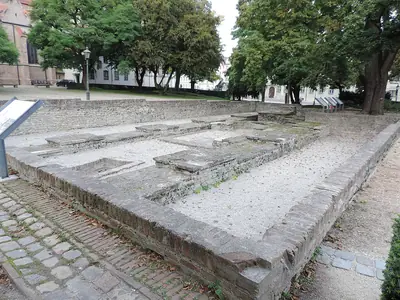
The open space in front of Augsburg Cathedral, the Domvorplatz, stands on the footprint of a lost church. St. Johann was the original parish and baptismal church for the cathedral community, dedicated to Saint John the Baptist.
The church was demolished in 1808 and 1809 after secularization, when the area was levelled to create the square. The site offers a reminder that Augsburg’s historic centre includes not only surviving buildings, but also traces of structures that disappeared.
Gignoux-Haus
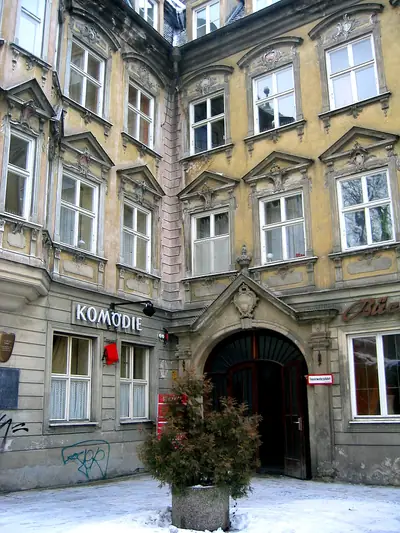
The Gignoux-Haus is a Rococo building in Augsburg’s historic Lechviertel. Built between 1764 and 1765 by Leonhard Christian Mayer, it has a light, decorative façade typical of the period.
The building later became a theatre and housed the Komödie, one of the stages of Theater Augsburg, until 2010. Although the theatre has since moved, the façade still reflects the cultural life that once filled the building.
Leopold-Mozart-Haus
The Leopold-Mozart-Haus occupies a three-storey seventeenth-century craftsman’s house with a distinctive curved gable. It is the birthplace of Leopold Mozart, Wolfgang Amadeus Mozart’s father, who was born here in 1719.
A museum has existed at the site since 1937. After a major renovation, it reopened in 2020 with a new permanent exhibition and its present name. The German Mozart Society is also based here, connecting the building with ongoing Mozart scholarship.
Wolfgang Amadeus Mozart visited his father’s hometown five times. During his visit in 1777, he met his cousin Maria Anna Thekla Mozart, an encounter remembered in the famous Basel letters.
Synagoge Ulmer Straße
The Synagoge Ulmer Straße, also called Synagoge Kriegshaber, is the oldest preserved synagogue in Bavarian Swabia. For almost three hundred years, it stood at the centre of the Jewish community in Kriegshaber.
The building was later desacralized and reopened in 2014 after careful renovation. Today, it forms part of the Jewish Museum Augsburg-Schwaben and provides an important perspective on the city’s Jewish history.
Weberhaus Augsburg
At Moritzplatz, the Weberhaus recalls Augsburg’s textile and commercial past. It was the headquarters of the weavers’ guild from 1389 until the guild was dissolved in 1548, making it a central place in the city’s medieval textile trade.
The original building was late Gothic and was renovated several times. Its former guild room contained an extensive late-Gothic picture cycle painted by Peter Kaltenhoff in 1457, with scenes from the Old Testament, the life of Alexander the Great, and figures from religious and political history.
The Red Gate and the Holy Spirit Chapel
The Rotes Tor, or Red Gate, is a surviving section of Augsburg’s medieval fortifications. Built in the late fourteenth century, it once protected the city and marked the southern approach. It was also known as Spitaltor, Hospital Gate and Haunstetter Tor.
Near the upper Brunnenmeisterhaus stands the small Heilig-Geist-Kapelle, or Holy Spirit Chapel. Together, the gate, chapel and nearby water structures show how Augsburg’s defensive and hydraulic infrastructure formed part of the historic city.
Other historic churches
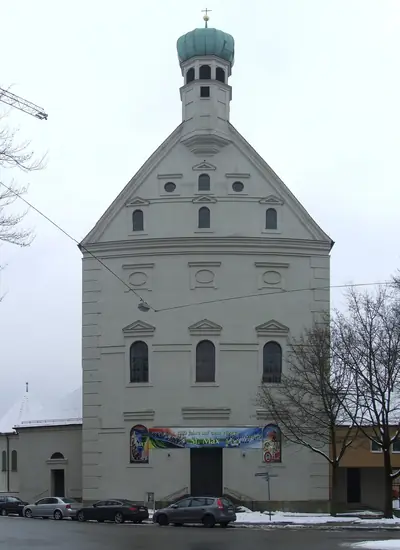
Augsburg’s religious heritage extends beyond its largest landmarks. St. Maximilian, known locally as St. Max, is a Roman Catholic parish church that was rebuilt soon after the Second World War. Before the war, it was the Franciscan monastery church of the Holy Sepulchre.
The Church of St. Margaret was once the convent church of a Dominican nunnery and is listed as a protected monument. The Heiligste Dreifaltigkeit in Kriegshaber is the district’s oldest church. Originally neo-Gothic, it was severely damaged and reconstructed, leaving a building whose appearance reflects both destruction and renewal.
Exploring Augsburg independently
Augsburg rewards slow exploration. The city’s churches, guild buildings, palaces and museums are not separate attractions so much as parts of a connected historical landscape. Banking and social housing appear alongside religious change; Mozart’s family story sits close to the cathedral; and the Red Gate introduces the water towers and defensive works of the southern old town.
For an Augsburg self-guided walking tour, Neywo’s routes link these places in focused walks. They are also a practical alternative to a conventional free walking tour in Augsburg: the narration follows the route, but you remain independent and can stop whenever you want.
Explore Augsburg with Neywo
Download Neywo and explore Augsburg with seven routes:
- Five walking tours, ranging from 1.09 to 2.51 km and from 82 to 110 minutes, with 8 to 11 narrated stops each.
- One bus route, 7.9 km and 34 minutes, with 9 narrated stops.
- One bike route, 2.4 km and 12 minutes, with 4 narrated stops.
The walks cover the town hall and Fugger sites, the Fuggerei and Jakobervorstadt, the cathedral quarter, Saints Ulrich and Afra, the northwest old town, and Augsburg’s textile quarter. The bus route follows the old town from the Lechhausen churches, while the bike route focuses on cotton, glass and fire in the textile district.
Neywo’s stories play as you reach each place, at your own pace, with no group and no schedule. The narration is available in 11 languages, and the Augsburg guide includes 154 narrated places.
Places with an audio guide in Augsburg
8 places in Augsburg with a Neywo audio guide. Each one starts telling its story as you reach it.
Self-guided tours in Augsburg
7 tours in Augsburg, free in the Neywo app. Each stop tells its story as you reach it.
- Bike ride
Cotton, Glass and Fire: Cycling the Textile Quarter
Ride the cycle paths through Augsburg's old textile quarter, where Europe's cloth was once spun. Pass the Sensemble Theater and the steel-and-glass Glaspalast, a former cotton mill turned art centre, then visit the fire-service exhibition and the Textile and Industry Museum in the old worsted spinning mill.
Sensemble Theater · Glaspalast Augsburg · Feuerwehrerlebniswelt · Augsburg textile and industry museum
Open this tour: Cotton, Glass and Fire: Cycling the Textile Quarter - Bus ride
Stadtbus 22: From the Lechhausen Churches Through the Old Town
Augsburg's city bus 22 cuts straight through the old town. Ride from the churches of Lechhausen past the Jakobertor and Vogeltor gates, the convent church of St Margaret and the twin churches of St Ulrich, then get off at the Hercules Fountain, the Weberhaus on Moritzplatz and the Jewish Museum in the Great Synagogue.
St. Franziskus · St. Petrus (Augsburg-Lechhausen) · Jakobertor · Vogeltor · St. Margaret · St. Ulrich …
Open this tour: Stadtbus 22: From the Lechhausen Churches Through the Old Town - Walk
Emperors, Bankers and a Town Hall Above the Clouds
Walk the grand axis of imperial Augsburg, from the Renaissance Town Hall and its 70-metre tower to Maximilianstraße, lined with the palaces of the Fugger bankers. Stand at the Hercules Fountain, where Charles V's politics were cast in bronze, and see the ballroom where Marie Antoinette danced.
Georgsbrunnen (Augsburg) · Elias-Holl-Platz · Rathaus · St. Peter am Perlach · Weberhaus Augsburg · St. Moritz …
Open this tour: Emperors, Bankers and a Town Hall Above the Clouds - Walk
The Fuggerei and the Jakobervorstadt
Visit the world's oldest social housing, still rented for 88 cents a year, then wander the old craftsmen's quarter outside the walls. Pass Neptune, the oldest fountain figure in the city, a medieval gate, a lonely watch tower and two very different churches.
Vogeltor · Das Museum der Bewohner · Fuggereimuseum · Fuggerei · Markuskirche der Fuggerei · Neptunbrunnen …
Open this tour: The Fuggerei and the Jakobervorstadt - Walk
Cathedral Quarter: Prince-Bishops, Mozart and the Peace Monument
The bishops' Augsburg: a thousand-year-old cathedral, the prince-bishop's palace and the golden salon hidden in Jesuit Lane. End at the house where Leopold Mozart, father of the prodigy, was born.
Friedensdenkmal · Fürstbischöfliche Residenz (Augsburg) · Kleiner Goldener Saal · Leopold-Mozart-Haus · Diözesanmuseum St. Afra · Augsburg Cathedral …
Open this tour: Cathedral Quarter: Prince-Bishops, Mozart and the Peace Monument - Walk
Two Churches at a Right Angle: Ulrich, Afra and the Water Towers
Begin at the onion-domed basilica of Ulrich and Afra, and the Catholic and Protestant churches that stand side by side at a right angle. Follow the old city's water system, a UNESCO site, from the Roman Museum to the Red Gate and the water towers beside it.
Römisches Museum Augsburg · St. Ulrich · St. Ulrich's and St. Afra's Abbey · Martini-Palais · St. Margaret · Heilig-Geist-Spital Augsburg …
Open this tour: Two Churches at a Right Angle: Ulrich, Afra and the Water Towers - Walk
Faith, Stage and Gate: The Northwest Old Town
Start at the synagogue and its museum, then pass the city's theatre and the two Holy Cross churches that stand side by side. Finish at the monastery of St George and the medieval gates of the old city wall.
St. Michael (Augsburg) · Jewish Museum Augsburg Swabia · Stadttheater Augsburg · Catholic Holy Cross Church, Augsburg · Evangelische Heilig-Kreuz-Kirche Augsburg · Kloster St. Georg (Augsburg) …
Open this tour: Faith, Stage and Gate: The Northwest Old Town
Walk Augsburg with Neywo
Neywo turns Augsburg into a self-guided audio tour. Stories arrive as you reach the place they belong to, and the route reshapes when you wander off it.


More in Bavaria
Elsewhere in Germany
- WürzburgBavaria
- FrankfurtHesse
- IdsteinHesse
- Rüdesheim am RheinHesse
- BinzMecklenburg-Western Pomerania
- RostockMecklenburg-Western Pomerania
- SchwerinMecklenburg-Western Pomerania
- AachenNorth Rhine-Westphalia
- AnholtNorth Rhine-Westphalia
- BonnNorth Rhine-Westphalia
- CologneNorth Rhine-Westphalia
- DuisburgNorth Rhine-Westphalia