Things to Do in Freiburg, Germany: Walking Guide
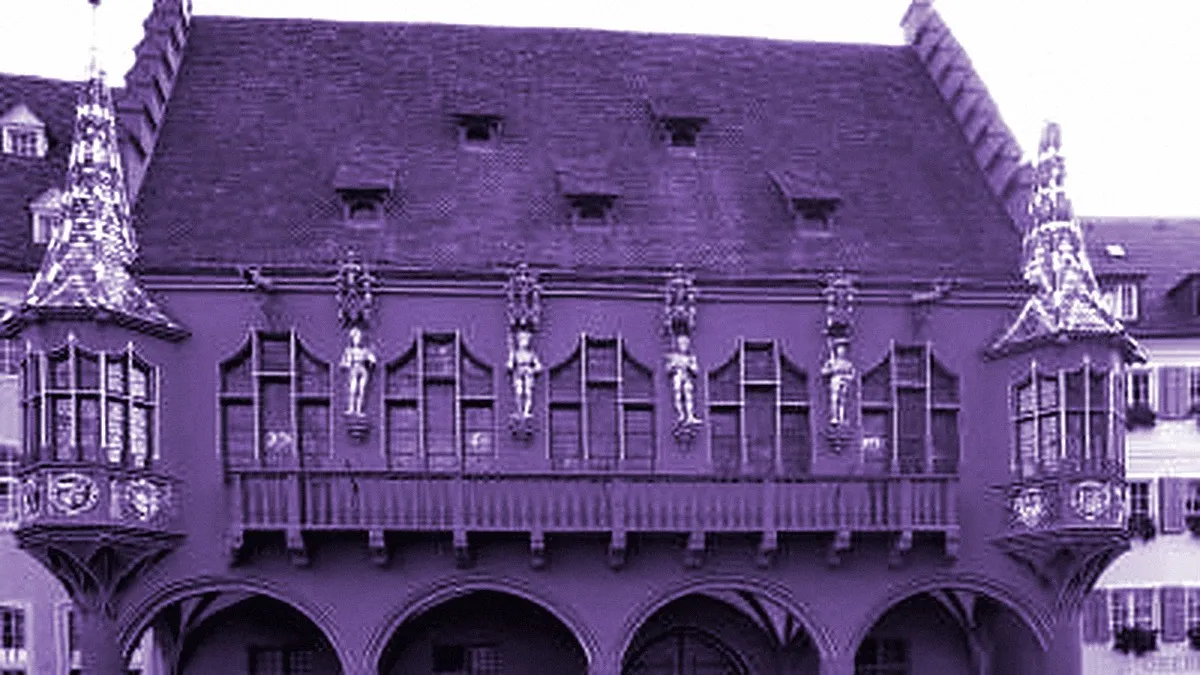
Things to Do in Freiburg: Historic Gates, Museums and the Minster
Freiburg is a city in southwest Germany known for its medieval old town, Gothic cathedral, museums and football tradition. At the centre of the city, historic gates and waterways meet university life and a rich collection of art and archaeology. Neywo offers a free audio guide for Freiburg with 217 narrated places, so you can discover the city while walking at your own pace.
As the capital of Baden-Württemberg, Freiburg is an excellent place to explore the region’s history and culture. Its most important sights range from the famous Freiburg Minster and surviving city gates to former monasteries, castles and football stadiums.
What to see in Freiburg
Freiburg Minster
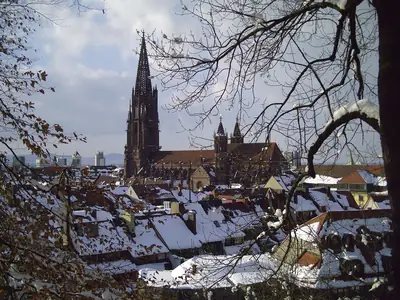
The Freiburg Minster, or Freiburger Münster, is the city’s defining landmark. Its tower rises 116 metres above the old town and is considered one of the great achievements of Gothic architecture.
Construction began around 1200 in the Romanesque style before continuing in the Gothic style from 1230. The building was officially completed in 1513, while the tower itself was finished in 1330. This makes it the only Gothic church tower in Germany completed during the Middle Ages.
The tower has an unusual form: an almost square base leads to a twelve-sided star gallery, followed by an octagonal upper section and spire. Sixteen bells hang inside, including the Hosanna bell, cast in 1258 and weighing 3,290 kilograms.
Inside, look for the high altar by Hans Baldung and an altar by Hans Holbein the Younger in a side chapel. The sculptures of the Ten Virgins at the inner portal, together with the nave windows, offer further details to examine. The church became the seat of the Archdiocese of Freiburg in 1827, although its traditional name, Münster, has remained.
Martinstor
Martinstor is one of Freiburg’s two surviving medieval city gates and the older of the pair. The first gate was established here in 1202, when it formed part of the city’s defensive fortifications. In the Middle Ages, it was also known as Norsinger Tor.
Its military role ended after changes to Freiburg’s defences in the seventeenth century. Later, the upper section was added in the early twentieth century. A plaque on the old-town side commemorates three women executed by burning here during the witch trials in 1599. The gate also served as a prison for debtors, reflecting the changing uses of this historic structure.
Schwabentor
The Schwabentor, also called the Obertor, is the second surviving medieval gate. Built around 1250, it is slightly newer than Martinstor and originally faced inward towards the city.
The tower was altered several times. A stone wall was added in 1547, a stair turret followed in 1572, and the structure was almost doubled in height around 1900 under the direction of Carl Schäfer. This transformation added the crow-stepped gable visible today. Fritz Geiges painted Saint George as a dragon hunter on the exterior in 1903, and a bell turret with an onion dome was added in 1913.
Under the inner arch, the Romanesque figure known as the Boy with Thorn received a Christian interpretation. Another detail is the painting of a merchant with a cart, created by Matthias Schwäri in 1572.
Augustiner Museum
The Augustiner Museum occupies a former Augustinian monastery and presents art from the Middle Ages through the Baroque period, as well as nineteenth-century paintings. It is regarded as one of the most important museums in the Upper Rhine region.
The building is part of the attraction. Its historic complex includes a Gothic cloister and a former monastery church. A renovation carried out in three stages transformed the site into a modern museum: the church reopened in 2010, the House of the Graphic Collection was completed in 2016, and the former convent building reopened in February 2026. The entire museum has been accessible again since February 28, 2026.
The collections include paintings, sculptures, decorative art, domestic objects from the Black Forest region, coins, timepieces and a remarkable fourteenth-century carpet. Works by artists including Lucas Cranach the Elder, Anselm Feuerbach, Hans Baldung Grien and Matthias Grünewald are part of the museum’s holdings.
Colombischlössle Archeological Museum
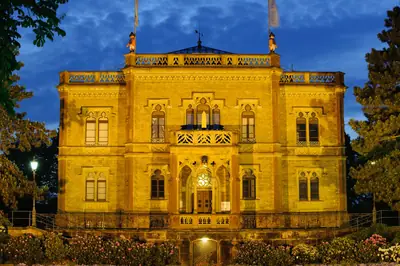
The Colombischlössle Archeological Museum traces human history in the High and Upper Rhine. It is housed in the neo-Gothic Villa Colombischlössle on Rotteckring.
The displays cover the period from the Paleolithic Age to the Early Middle Ages. Highlights include Stone Age female figurines, Bronze Age representations of the moon, Celtic treasures from princely graves and Roman finds from the Dangstetten military site, villas, villages and sanctuaries.
Among the notable objects are a jet figurine from the tenth century BC, Roman glass and rune inscriptions. The Nendingen rune staff, dating from the sixth century, is another particularly important piece. Activities such as making fire in the Stone Age manner and producing clay vessels give younger visitors and school groups ways to engage with the collection.
Uniseum
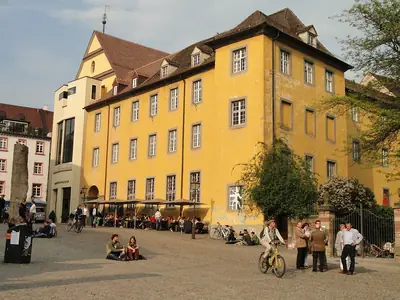
The Uniseum is the university museum of the Albert-Ludwigs-Universität in Freiburg. Its exhibitions tell the story of the university from its foundation in 1457 to the student movement of the 1960s.
The museum occupies the Alte Universität in the old town, a building that was once a Jesuit college. The university moved its teaching activities there in 1557. Across about one thousand square metres, thematic rooms explore the development of the university and fields including medicine, applied natural sciences and the humanities.
The vaulted cellars reveal earlier structures beneath the building. Other distinctive displays include a Renaissance-style Cabinet of Curiosities and a small collection of moulages.
Museum of Modern Art
Freiburg’s Museum of Modern Art, or Museum für Neue Kunst, is part of the city’s municipal museums. It brings together art from classical modernism to the present and also hosts regular special exhibitions.
The museum occupies the former Adelhausen girls’ civic school on Marienstraße 10a. The building was constructed in 1902 in a historicizing style and converted for museum use between 1984 and 1985.
Museum Natur und Mensch
At the edge of the old town on Augustinerplatz, the Museum Natur und Mensch combines collections about the natural world with material relating to different cultures. Its broad focus makes it another important museum stop in the southern part of the city centre.
Zinnfigurenklause
Inside the Schwabentor, the Zinnfigurenklause presents the history of southwestern Germany through tin figures. The small museum is privately run and maintained by volunteers, giving the medieval gate an unusual historical attraction of its own.
Freiburg’s castles and football grounds
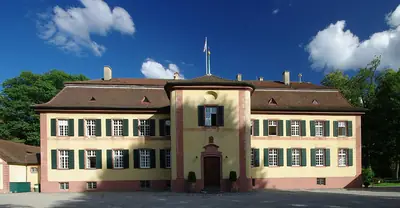
Freiburg’s sights extend beyond the old town. Munzingen Palace, or Schloss Munzingen, stands slightly elevated on the Schlossbuck in the Munzingen district.
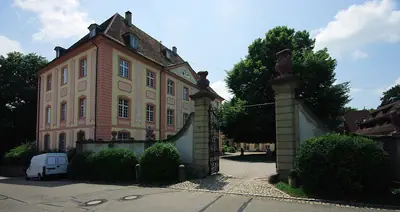
Further east, Ebnet Castle is an elegant Baroque mansion built between 1748 and 1750 by Johann Jakob Fechter of Basel. Johann Christian Wenzinger advised on the garden façade and created sculptures representing the four seasons for the castle park in 1748 and 1749.
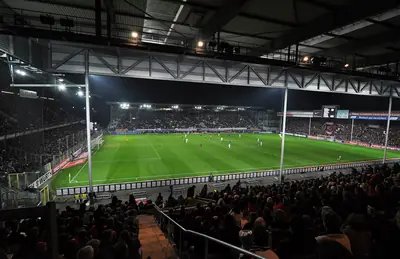
Football supporters can compare two important stadiums. The Dreisamstadion stands beside the Dreisam River in the Waldsee district. Built in 1953, it was the home ground of SC Freiburg’s first men’s team from September 1955 until September 2021 and can hold 24,000 spectators. Since the 2021–22 season, the club’s second men’s team and women’s team have played there.
The Europa-Park-Stadion in Freiburg’s Brühl district has been SC Freiburg’s home since it opened in October 2021. Beside the city’s airport, it accommodates 34,700 spectators and replaced the Dreisamstadion as the first men’s team’s home ground.
Explore Freiburg with a self-guided audio tour
For a Freiburg self-guided walking tour, Neywo offers four walks, one bus route and one bike route. The walks range from 1.31 to 1.98 km and take between 64 and 84 minutes, with 8 to 12 narrated stops each.
The bus route covers 2.2 km in 9 minutes and includes 6 stops. The bike route crosses Freiburg from west to east through the old town, covering 5.7 km in 29 minutes with 10 narrated stops. Across all these options, the app includes 217 narrated places and narration in 11 languages.
Download Neywo and explore Freiburg without a group or a schedule. The app tells the story of each place as you reach it, at your own pace, whether you choose to walk, take the bus or cycle through the city.
Places with an audio guide in Freiburg
8 places in Freiburg with a Neywo audio guide. Each one starts telling its story as you reach it.
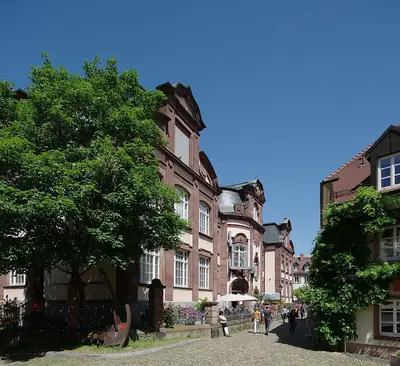
Self-guided tours in Freiburg
6 tours in Freiburg, free in the Neywo app. Each stop tells its story as you reach it.
- Bike ride
Across Freiburg by Bike: West to East Through the Old Town
Freiburg is Germany's cycling city. This ride follows its cycle lanes from the western districts through the university area and the old town, past the Victory Monument and the Swabian Gate, then along the Dreisam river to the football stadium, passing modern sculptures all the way.
Die Spur · Translation · Architettura Uomo · Albertus Magnus · Siegesdenkmal · Wartende …
Open this tour: Across Freiburg by Bike: West to East Through the Old Town - Bus ride
Bus 27: Ludwigskirche to the Sculptures of the Western Centre
Freiburg's city bus 27 starts near the neo-Gothic Ludwigskirche, passes the Victory Monument on Europaplatz and continues west past a string of modern sculptures. A cheap short ride across the northern edge of the old town.
Ludwigskirche · Christus als Erlöser · Siegesdenkmal · Unvergessene Heimat · Architettura Uomo · Atlas
Open this tour: Bus 27: Ludwigskirche to the Sculptures of the Western Centre - Walk
Gates, Gargoyles and a Red Merchants' Hall
Walk Freiburg's medieval core from one surviving city gate to the other. Pass the Whale House, the fountains and plague columns of Minster Square, the Minster with its 116-metre Gothic spire, the crimson Merchants' Hall and the Augustinian museum before ending at the painted Swabian Gate.
Martinstor · Kaiser-Joseph-Straße · Bertoldsbrunnen · St. Martin's Church (Freiburg) · The Whale House · Fischbrunnen (Freiburg) …
Open this tour: Gates, Gargoyles and a Red Merchants' Hall - Walk
Up the Schlossberg: Towers, Ruins and Views
Leave the old town for the castle hill. Visit the ruined Allerheiligen monastery, ride the little funicular, find the vanished castle's earthworks, a red sandstone Bismarck tower and the twisted timber lookout with views over the whole city.
Kloster Allerheiligen · Schlossbergbahn · Wartende · Windspiel · Dominikanerkloster St. Albert · Freiburg Castle …
Open this tour: Up the Schlossberg: Towers, Ruins and Views - Walk
Scholars, Nuns and a Lost Synagogue
Explore Freiburg's university quarter, founded in 1457. Step into the Old University museum, the Jesuit church, the Peterhof, a convent church called the Black Monastery, a Henry Moore sculpture, the memorial pool of the Old Synagogue, the city theatre and a neo-Gothic villa full of Celtic treasures.
Wallgraben-Theater · Uniseum · University Church, Freiburg · Peterhofkapelle · Schwarzes Kloster · Reclining Figure: External Form …
Open this tour: Scholars, Nuns and a Lost Synagogue - Walk
Museums and Monasteries of the Southern Old Town
Wander the quieter southern half of the old town, where medieval convents became museums. Visit the Teutonic Order commandry, the natural history museum, the White Monastery of Adelhausen, the museum of modern art and the graphic collection, with sculptures and a theatre in the old municipal baths along the way.
Teutonic Order commandry Freiburg im Breisgau · Museum Natur und Mensch (Freiburg im Breisgau) · Adelhausen monastery · Museum of Modern Art · Gegenseitig · Theater im Marienbad …
Open this tour: Museums and Monasteries of the Southern Old Town
Walk Freiburg with Neywo
Neywo turns Freiburg into a self-guided audio tour. Stories arrive as you reach the place they belong to, and the route reshapes when you wander off it.

