What to See in Bamberg, Germany: Free Audio Guide
Things to Do in Bamberg: What to See in the Historic City
The best things to do in Bamberg include exploring its UNESCO-listed old town, visiting its cathedral and hilltop monasteries, and following the Regnitz past bridges and fishermen’s houses. With medieval, Romanesque, Gothic, and Baroque landmarks close together, Bamberg rewards travellers who explore on foot. Neywo’s free audio guide for Bamberg tells the stories of 99 narrated places as you reach them.
Bamberg is in Bavaria, in southern Germany. Its historic centre brings together imperial history, religious architecture, riverside views, and the everyday character of a city shaped by its hills and waterways.
What to see in Bamberg
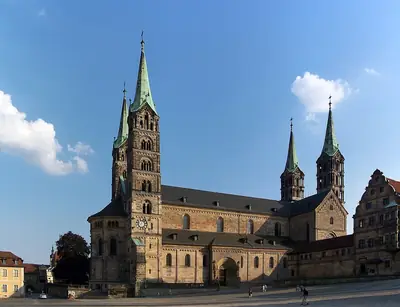
Bamberg Cathedral
Bamberg Cathedral is one of the defining landmarks of the old town and stands on Cathedral Hill. Its four towers rise 81 metres above the city, while the building itself extends for 94 metres. The present structure dates from the thirteenth century and combines late Romanesque architecture with early Gothic elements.
The cathedral was founded in 1002 by King Heinrich II, later Holy Roman Emperor, and was consecrated in 1012. Fire destroyed the first two buildings. Inside, the marble sarcophagus of Emperor Heinrich II and Empress Cunigunde recalls the cathedral’s imperial past. The Prince’s Portal, on the north side, is particularly notable for its expressive biblical carvings.
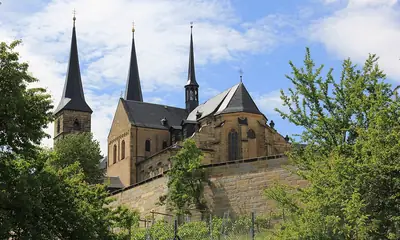
Michaelsberg Abbey
Michaelsberg Abbey crowns the hill of the same name and offers one of Bamberg’s finest panoramas, with red rooftops, cathedral towers, and the Regnitz below. Emperor Henry II and Empress Cunigunde founded the abbey in 1015 as a Benedictine centre.
The complex combines Romanesque foundations with later Baroque additions. Its church, Michaelskirche, is especially known for the “Garden of Heaven” ceiling: hundreds of plants and herbs cover the vault, each rendered in striking detail. The abbey also became an important religious and intellectual centre, particularly during the twelfth century.
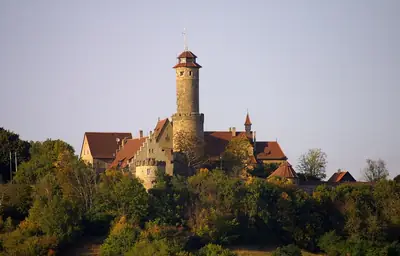
Altenburg
Altenburg stands on the tallest of Bamberg’s seven hills, about 400 metres above sea level. The castle’s origins reach back at least to 1109, although an earlier palisade fortress may have occupied the site.
For centuries, Altenburg served as a refuge castle where townspeople could shelter during danger. From 1305 to 1553, it was the residence of Bamberg’s prince-bishops. The castle was burned during the Second Margrave War and later used as a prison before being restored from 1801 by the Bamberg physician Adalbert Friedrich Marcus.
Today, the grounds include a restaurant in a medieval setting, while the Knights Hall hosts weddings and celebrations.
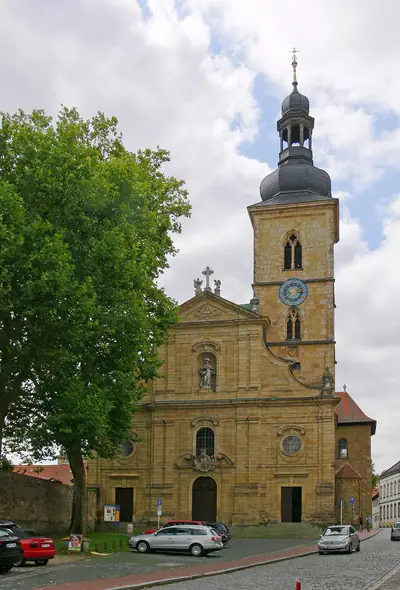
St.Jakob in Bamberg
A short climb from the cathedral leads to St. Jakob on Jakobsberg hill, one of Bamberg’s oldest churches. Founded in the early twelfth century and consecrated in 1109, it was built for pilgrims travelling towards Santiago de Compostela and dedicated to Saint James the Greater, the patron saint of travellers.
Its Romanesque origins remain visible in the sturdy walls and round-arched windows, while pointed vaults and later sculptural details reflect the arrival of Gothic style. Inside, medieval stone reliefs stand alongside Baroque altars, creating a quieter and more intimate atmosphere than the nearby cathedral.
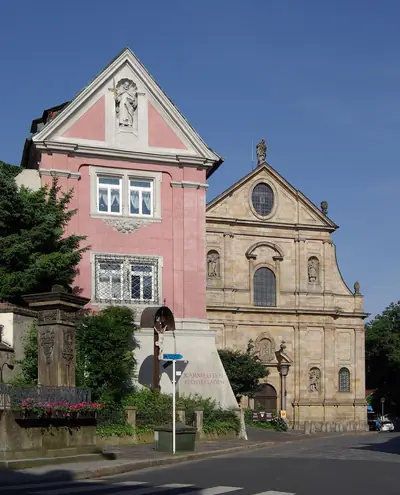
Karmelitenkloster Bamberg
The Carmelite Monastery of Saint Maria and Saint Theodor occupies Kaulberg hill and reflects several centuries of changing religious history. It began in 1157 as a Cistercian abbey for noblewomen, was dissolved in 1554, and was taken over by the Carmelites in 1589. Secularization removed the order in 1802, but the Carmelites returned after repurchasing the monastery in 1902.
The church preserves a Romanesque core, including the lion portal on the west side. Its Baroque interior was transformed by Leonhard Dientzenhofer, who moved the high altar from east to west. The east façade became the new principal entrance and received an elaborate sculptural design.
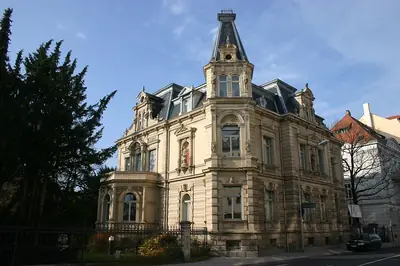
Villa Dessauer
Villa Dessauer is a Neo-Renaissance mansion built in 1884 for Carl Dessauer, a successful hop merchant. Its symmetrical façade, classical details, and elegant window frames reflect the prosperity associated with Bamberg’s hop trade.
The villa also carries the history of persecution. During the Nazi regime, the Dessauer family lost the property, which was confiscated. After the war, Carl Dessauer’s son regained ownership but sold the house to the City of Bamberg rather than returning to live there. Since 1987, the building has served as a municipal art gallery with changing exhibitions by local and international contemporary artists.
Gabelmann
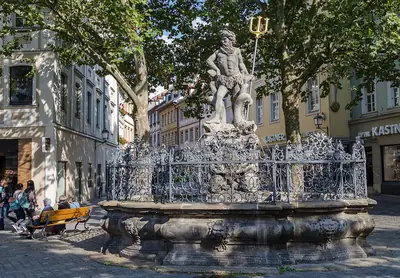
In the pedestrian zone, the Gabelmann fountain is a familiar meeting place. The Baroque fountain features Neptune, the Roman god of the sea, holding a raised trident. That three-pronged weapon gave the statue its popular nickname, “Gabelmann”, or “Fork Man”, which also became the name of the fountain.
The Lower Bridge and Little Venice
At the entrance to the Lower Bridge stands a figure of Saint Cunigunde, wife of Emperor Henry II and one of Bamberg’s patrons. Cunigunde was remembered not only as an empress but also for governing the German monarchy after Henry became seriously ill and died.
The bridge also provides a view towards Little Venice, the riverside row of colourful half-timbered houses once occupied by Bamberg’s fishermen. The houses along the Regnitz form one of the city’s most recognisable views and show a different side of Bamberg’s historic character.
Other places to notice
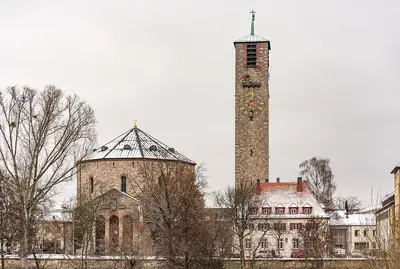
Bamberg’s heritage extends beyond its best-known landmarks. The Erlöserkirche, also called the Zentralbau, is the city’s central Protestant church on the bank of the Main-Danube Canal. The Marter, or Luthermarter, and the St. Sebastian or Löhrmarter are protected wayside devotional monuments. Other designated cultural heritage sites include Heiliger Otto, St. Michael, the Basilika also known as St. Josef, and the Brunnenhäuschen, or Ottobrunnen.
Explore Bamberg with a self-guided audio tour
A Bamberg self-guided walking tour is a practical way to connect the city’s hills, churches, bridges, and historic streets. Neywo offers four walking tours and one bus route, with stories that play as you reach each place, at your own pace, with no group and no schedule. Narration is available in 11 languages.
The walking tours are:
- Seven Hills, One Emperor: Cathedral Hill and the Prince-Bishops — 1.78 km, 96 minutes, 9 narrated stops.
- Little Venice and the Town Hall in the River — 1.37 km, 78 minutes, 9 narrated stops.
- Hoffmann, Hops and Memory: Bamberg’s Romantic and Jewish Story — 1.79 km, 75 minutes, 8 narrated stops.
- Gardeners’ town: market gardens, chapels and the Sebastian hill — 2.21 km, 76 minutes, 7 narrated stops.
There is also one bus route:
- Bus 908: Villa Dessauer, the Hoffmann house and the Upper Parish church — 3.7 km, 16 minutes, 5 narrated stops.
Together, these routes cover imperial Bamberg, Little Venice, the town hall, Villa Dessauer, the city’s gardeners’ quarter, and several of its churches and museums. They offer a free walking tour of Bamberg with the flexibility to pause, continue, or choose another route whenever you like.
Download the Neywo audio guide for Bamberg
Download Neywo to explore Bamberg with 99 narrated places, four walking tours, and one bus route. The app tells the story of each place as you reach it, at your own pace, with no group and no schedule. Choose a route through the old town, follow the Regnitz towards Little Venice, or discover Bamberg’s hills and religious landmarks with a free audio guide in 11 languages.
Places with an audio guide in Bamberg
8 places in Bamberg with a Neywo audio guide. Each one starts telling its story as you reach it.
Self-guided tours in Bamberg
5 tours in Bamberg, free in the Neywo app. Each stop tells its story as you reach it.
- Bus ride
Bus 908: Villa Dessauer, the Hoffmann house and the Upper Parish church
Stadtwerke Bamberg's line 908 runs from the central bus station past the hop merchant's Villa Dessauer, the E.T.A. Hoffmann house, the site of the Franciscan monastery on Schranne and the Church of Our Lady on the Kaulberg, and out to the church of St. Urban.
Villa Dessauer · E.T.A. Hoffmann-Haus · Schranne 2, 3 · Obere Pfarre · St. Urban
Open this tour: Bus 908: Villa Dessauer, the Hoffmann house and the Upper Parish church - Walk
Seven Hills, One Emperor: Cathedral Hill and the Prince-Bishops
Climb from the Carmelite cloister to the cathedral where Emperor Heinrich II and the only pope buried north of the Alps lie, see the imperial robes in the Diocesan Museum, then go through the bishops' Old Court and rose-garden palace to a pilgrim church and the hilltop abbey with the finest view over the red roofs, ending in its brewery museum.
Karmelitenkloster Bamberg · Obere Pfarre · Diözesanmuseum Bamberg · Bamberg Cathedral · Historical Museum Bamberg · New Residence, Bamberg …
Open this tour: Seven Hills, One Emperor: Cathedral Hill and the Prince-Bishops - Walk
Little Venice and the Town Hall in the River
Follow the Regnitz through the old island town: a 1405 smoke-beer tavern, the fishermen's houses of Klein Venedig, a town hall built on an artificial island out of spite at the bishop, and the baroque squares of the merchants' quarter.
Original Schlenkerla Smokebeer · Klein Venedig · Hafen · Old town hall · Residenzschloss Geyerswörth · Gabelmann …
Open this tour: Little Venice and the Town Hall in the River - Walk
Hoffmann, Hops and Memory: Bamberg's Romantic and Jewish Story
Walk the streets where E.T.A. Hoffmann wrote and conducted for five years, past the hop merchant's villa and the garden of the Harmonie society, to the site of the synagogue that stood for barely three decades.
Schiffsanlegeplatz · E.T.A. Hoffmann-Haus · E.T.A.-Hoffmann-Theater · Harmoniegarten · Luitpolddenkmal · Villa Dessauer …
Open this tour: Hoffmann, Hops and Memory: Bamberg's Romantic and Jewish Story - Walk
Gardeners' town: market gardens, chapels and the Sebastian hill
Leave the island town for the Gärtnerstadt, where Bamberg's gardeners and hop growers lived. Visit the gardeners' museum, a Dominican convent, St Otto's church and the small chapels on the way up to the Sebastian chapel.
Zentralbau · Sankt Gangolf (Bamberg, Germany) · Gärtner- und Häckermuseum · Dominikanerinnenkloster zum Heiligen Grab · Sankt Otto · Gönningerkapelle …
Open this tour: Gardeners' town: market gardens, chapels and the Sebastian hill
Walk Bamberg with Neywo
Neywo turns Bamberg into a self-guided audio tour. Stories arrive as you reach the place they belong to, and the route reshapes when you wander off it.


More in Bavaria
Elsewhere in Germany
- FrankfurtHesse
- IdsteinHesse
- Rüdesheim am RheinHesse
- BinzMecklenburg-Western Pomerania
- RostockMecklenburg-Western Pomerania
- SchwerinMecklenburg-Western Pomerania
- AachenNorth Rhine-Westphalia
- AnholtNorth Rhine-Westphalia
- BonnNorth Rhine-Westphalia
- CologneNorth Rhine-Westphalia
- DuisburgNorth Rhine-Westphalia
- DüsseldorfNorth Rhine-Westphalia