Visiting Heidelberg, Germany: Top Sights on Foot
Things to Do in Heidelberg: A Self-Guided Walk Through the City
Heidelberg is a historic university city in Baden-Württemberg, known for its hilltop castle ruins, red sandstone churches, Baroque buildings and wooded hills above the Neckar. The city is worth visiting for the way these landmarks fit together: a castle overlooking the Old Town, historic streets filled with churches and Renaissance façades, and elevated viewpoints with wide views across the valley. Neywo has a free audio guide for Heidelberg with 146 narrated places.
What to See in Heidelberg
Heidelberg Castle
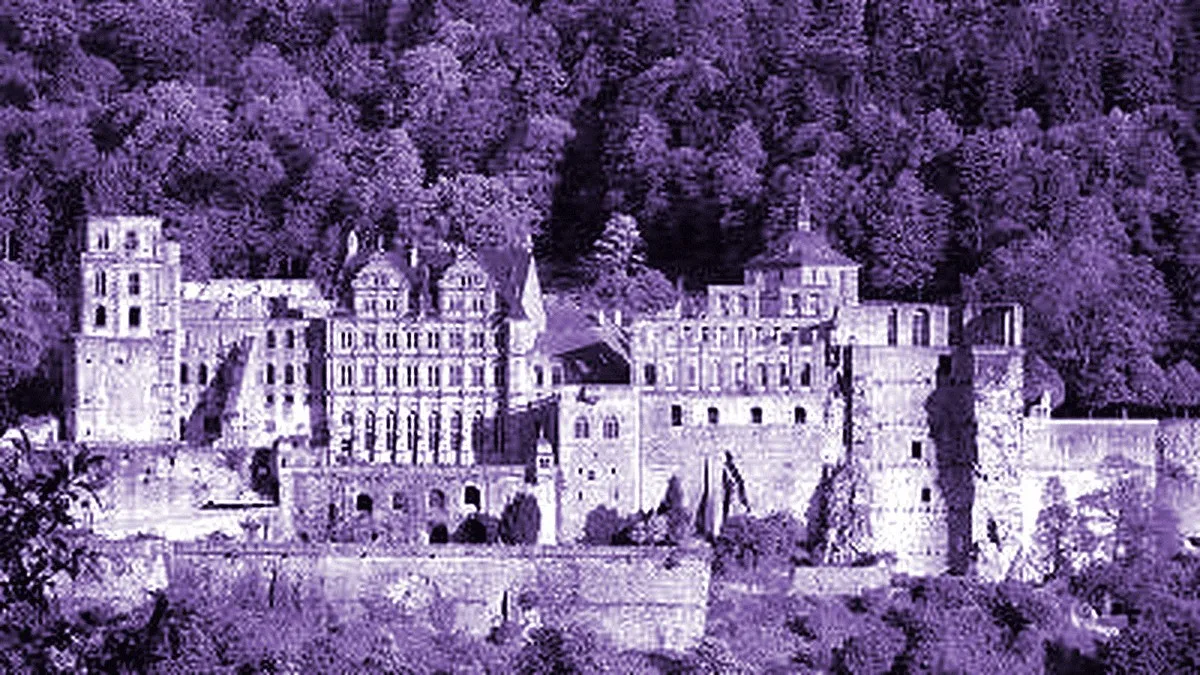
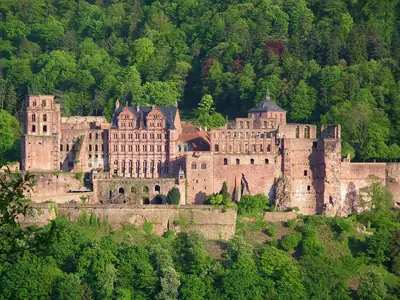
Heidelberg Castle is the city’s defining landmark, rising above the Old Town on the northern slope of the Königstuhl. The red sandstone complex began as a fortress and gradually developed into a palace that served for almost three centuries as the residence of the counts palatine and electors of the Palatinate.
The buildings show the castle’s long development, from fortified Gothic sections to an important Renaissance residence. Much of the complex took shape between the thirteenth and seventeenth centuries, and the castle is regarded as one of the most important Renaissance structures north of the Alps.
Wars in the seventeenth century caused extensive damage, including attacks by French forces in 1689 and 1693. The Powder Tower and other parts of the fortifications were blown up in 1693, while a lightning strike caused another major fire in 1764. Restoration was eventually abandoned, leaving the dramatic ruins that define Heidelberg’s skyline today.
The castle grounds include the Elisabeth Gate, a triumphal-arch entrance in the Stückgarten, as well as the German Pharmacy Museum. The gardens and castle buildings are covered in Neywo’s walk Heidelberg Castle: Ruins, Gardens and a Giant Barrel, which includes 10 narrated stops over 1.8 kilometres.
Church of the Holy Spirit and Market Square
The Church of the Holy Spirit rises at the centre of Heidelberg’s Market Square. Built between 1398 and 1515 as a Gothic hall church, it is Heidelberg’s largest and most important church. Its red Neckar Valley sandstone, Baroque roof and Baroque tower cap make it one of the Old Town’s most recognisable buildings.
The church was planned as the burial place of the Electors of the Palatinate and as a representative church for Heidelberg. The Palatine War of Succession badly damaged the princely tombs, although the surviving tomb of Elector Ruprecht III and Elisabeth of Hohenzollern remains an important historical feature.
The church also reflects Heidelberg’s religious divisions. From 1706 until 1936, a wall separated the nave from the choir, allowing Protestants and Catholics to worship in different parts of the building. The wall was removed in 1936, and the entire church became Protestant.
Haus zum Ritter
Opposite the Church of the Holy Spirit on Heidelberg’s Hauptstraße, Haus zum Ritter is the oldest surviving residential building in the Old Town. Built in 1592, it is distinguished by an elaborate Renaissance façade commissioned by Charles Belier, a French textile merchant and Huguenot.
The house survived the destruction of the Palatinate in 1688 and 1689, as well as the fire and destruction of 1693. After much of Heidelberg had been lost, it served as the town hall from 1693 to 1703. In 1705, it became the Inn to the Knight of Saint George.
Look above the entrance for the lamb motif. It refers to the Belier family’s guild as cloth merchants and plays on belier, the French word for ram. The building’s Latin inscriptions include a saying meaning, “Unless the Lord builds the house, the builders work in vain.”
Jesuitenkirche
The Jesuitenkirche is one of Heidelberg’s largest churches and the architectural centre of the former Jesuit quarter. Built in the Baroque style between 1712 and 1759, it is officially known as the Parish Church of the Holy Spirit and Saint Ignatius and now serves Heidelberg’s Catholic Holy Spirit parish.
Its unusual orientation distinguishes it from many churches: instead of facing east, it faces south. The Neo-Baroque tower was added between 1868 and 1872. On the north façade, Christ stands above the centre, while Saint Ignatius of Loyola and Saint Francis Xavier appear above the side portals. The façade also represents the virtues of Love, Hope and Faith.
Providence Church and St. Anna
Heidelberg’s historic centre contains several churches that reveal the city’s denominational and architectural history. Providence Church was built between 1659 and 1661 for Heidelberg’s Lutheran community, on the grounds of a former electoral manor garden. Damaged in the 1693 city fire, it was rebuilt after 1700, and a tower was added in 1717. A later interior renovation gave it a luminous neo-Renaissance appearance.
St. Anna is a Catholic Baroque church built between 1714 and 1717 as part of a planned hospital complex. Its red sandstone façade has a curved upper section, while the interior includes a blue choir room and a main altar with a crucifix believed to be the work of Paul Egell.
These churches are among the stops on Palaces, Museums and Memory: Heidelberg’s Baroque Quarter, a 2.46-kilometre walk with 10 narrated places.
Großherzogliches Palais
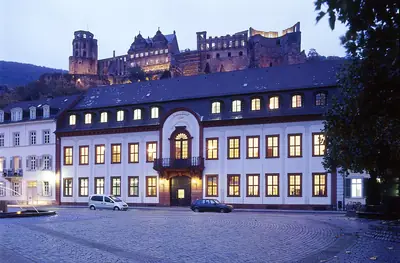
At Karlsplatz, the Großherzogliches Palais adds a scholarly chapter to Heidelberg’s Baroque quarter. Built in 1717, the palace now houses the Heidelberg Academy of Sciences, continuing its role as a place connected with learning and scholarship.
Heiligenberg Tower and Stephanskloster
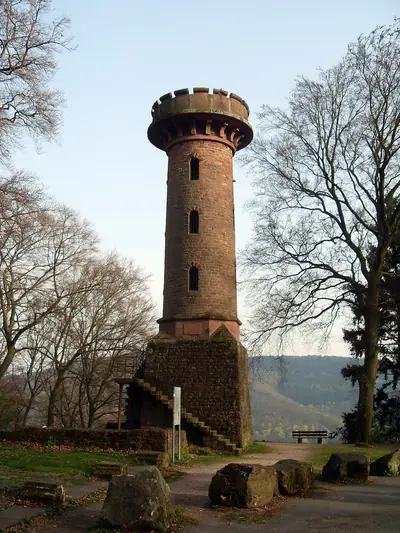
Across the Neckar from the Old Town, the Heiligenberg offers viewpoints and historic remains in a wooded setting. The Heiligenberg Tower stands at the edge of the former Stephanskloster and looks across the Neckar Valley towards Heidelberg’s Old Town.
The tower was built in 1885 from stones taken from the former monastery. It rises 16.5 metres above the Michelsberg, a 375.5-metre-high summit on the southern side of the Heiligenberg. Beside it, the foundation ruins of Stephanskloster recall a monastery founded in the eleventh century as the second branch of Lorsch Abbey.
Further along the hill, the Bismarck Tower was completed in 1903. This protected observation tower belongs to a group of monuments built throughout Germany in honour of Otto von Bismarck. Its design includes an eagle with the serpent of discord and a cast-iron fire bowl at the summit. From the tower, views extend over Heidelberg’s Old Town and the surrounding landscape.
Monastery of St. Michael
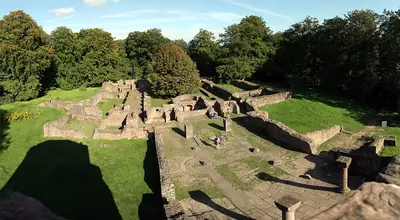
The ruins of St. Michael’s Monastery, or Michaelskloster, occupy a forest clearing on the northern summit of the Heiligenberg. The monastery began as a branch of Lorsch Abbey. In 1023, Abbot Reginbald replaced the earlier foundation with a larger Benedictine monastery and a three-aisled basilica.
The surviving remains include the basilica’s foundations, eastern and western crypts, cloister and monks’ living quarters. Two western towers remain at different heights, and restored sections make the layout easier to understand across the sloping summit. The open ruins can be explored freely, and the accessible tower remains provide views over the monastery plan, woodland, the Rhine plain and the Neckar.
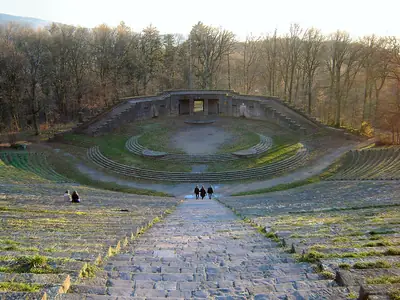
The hill’s darker twentieth-century history is visible at Thingstätte Heidelberg, an open-air theatre built during the National Socialist period for gatherings, performances and propaganda events connected with the Thingspiel movement. Its foundation stone was laid on 30 May 1934, and Joseph Goebbels opened it on 22 June 1935 under the name Feierstätte Heiligenberg. The stone amphitheatre provided seating for around 8,000 people, or standing room for as many as 15,000.
The Heiligenberg landmarks feature in Neywo’s Heiligenberg: Monastery Ruins, Lookouts and a Mysterious Shaft, a 2.3-kilometre walk with seven narrated stops.
Wieblingen’s Churches
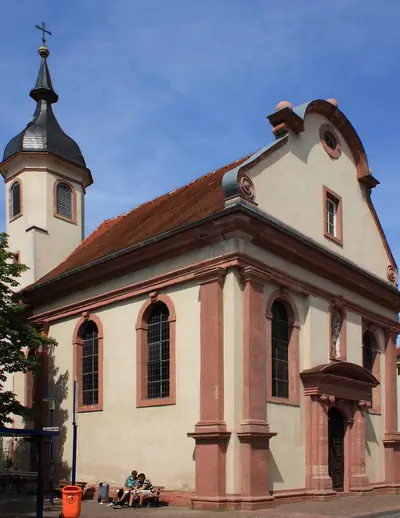
Outside the Old Town, Heidelberg’s Wieblingen district contains several different chapters of local religious architecture. The old St. Bartholomew’s Church is a small Baroque village church built between 1744 and 1746 for the Catholic community. Its curved gable, scroll-shaped volutes, stone balls and Baroque-roofed tower give the street-facing façade a distinctive character.
The church was altered in 1970 and 1971 when one window bay was removed and the façade was moved back to meet traffic requirements. The original footprint remains marked in the pavement.
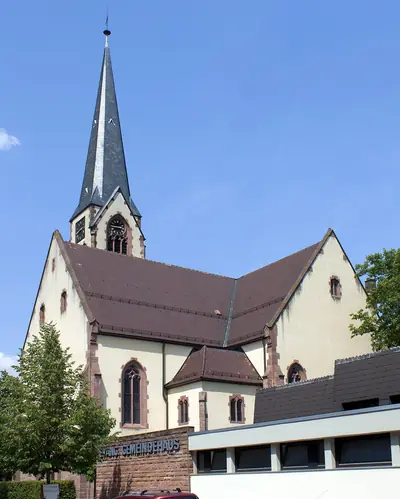
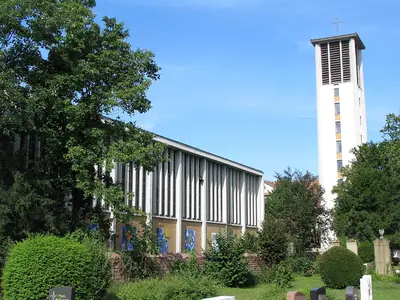
The protected Kreuzkirche, built between 1904 and 1906, represents the district’s Neo-Gothic Protestant architecture. Wieblingen’s newer Roman Catholic parish church, St. Bartholomew’s, was built in 1955 and 1956 after the older church had become too small. It was remodelled between 2018 and 2020.
Explore Heidelberg with Neywo
Neywo offers a free Heidelberg audio guide with 146 narrated places. Its tours include five walking routes, one bus route and one bike route:
- Heidelberg Castle: Ruins, Gardens and a Giant Barrel — 1.8 km, 93 minutes, 10 stops
- Old Bridge to Old University: Heidelberg’s Old Town — 2.29 km, 96 minutes, 11 stops
- Palaces, Museums and Memory: Heidelberg’s Baroque Quarter — 2.46 km, 91 minutes, 10 stops
- Heiligenberg: Monastery Ruins, Lookouts and a Mysterious Shaft — 2.3 km, 84 minutes, seven stops
- Hauptstrasse West: Art, Anatomy and Packaging — 1.63 km, 56 minutes, seven stops
- Bus 20: Through the Old Town — 3.8 km, 16 minutes, seven stops
- Neckar Valley Ride to Schlierbach — 4.9 km, 25 minutes, five stops
The app tells the story of each place as you reach it, at your own pace, with no group and no schedule. Narration is available in 11 languages. Download Neywo and explore Heidelberg’s castle, churches, Baroque quarter and hilltop ruins as you walk.
Heidelberg is part of Baden-Württemberg in Germany.
Places with an audio guide in Heidelberg
8 places in Heidelberg with a Neywo audio guide. Each one starts telling its story as you reach it.
Self-guided tours in Heidelberg
7 tours in Heidelberg, free in the Neywo app. Each stop tells its story as you reach it.
- Bike ride
Neckar Valley Ride to Schlierbach
Leave the Old Town by the Karlstor and follow the Neckar cycle path upstream to the village of Schlierbach. Pass a neo-Gothic church, a 15th-century chapel and a sculpture park set in a hospital's gardens. About 5 km, flat, with river views.
Ethnographic Museum Heidelberg · Karlstor (Heidelberg) · St. Laurentius · Gutleuthofkapelle · Sculpture Park Heidelberg
Open this tour: Neckar Valley Ride to Schlierbach - Bus ride
Bus 20: Through the Old Town
A regular rnv city bus that crosses the Altstadt from the Karlstor at its eastern gate to the Peterskirche, then runs on west past the Erlöserkirche to the Print Media Academy and its giant steel horse. Ride it past the museum quarter, the Grand Ducal palace, the Sinti and Roma documentation centre and the university church, without climbing the Hauptstrasse.
Karlstor (Heidelberg) · Ethnographic Museum Heidelberg · Großherzogliches Palais · Documentation and Cultural Centre of German Sinti and Roma · Peterskirche · Erlöserkirche …
Open this tour: Bus 20: Through the Old Town - Walk
Heidelberg Castle: Ruins, Gardens and a Giant Barrel
Start high at the Molkenkur ruins and the funicular, then walk down through the Elisabeth Gate to the red-sandstone castle: the Thick Tower, the English Building, the German Pharmacy Museum, the terraced Hortus Palatinus and the Great Grotto. Finish at the Scheffel monument on the castle terrace, with the whole Old Town below.
Obere Burg · Heidelberger Bergbahn · Elisabeth Gate · Thick tower · Heidelberg Castle · English building …
Open this tour: Heidelberg Castle: Ruins, Gardens and a Giant Barrel - Walk
Old Bridge to Old University: Heidelberg's Old Town
From the baroque Karlstor, walk along the Neckar to the Old Bridge and its lucky monkey, then up the Hauptstrasse past the 1592 Haus zum Ritter and the Jesuit church to Germany's oldest university, where students were once locked up for pranks. A classic Heidelberg afternoon.
Karlstor (Heidelberg) · Kornmarkt · Marktplatz · Church of the Holy Spirit, Heidelberg · Haus zum Ritter, Heidelberg · Heidelberg Bridge Monkey …
Open this tour: Old Bridge to Old University: Heidelberg's Old Town - Walk
Palaces, Museums and Memory: Heidelberg's Baroque Quarter
Leave the tourist crowds on the Hauptstrasse for the Baroque quarter: a Grand Ducal palace, the Sinti and Roma documentation centre, the site of the synagogue destroyed in 1938, the university's antiquities museum and the riverside armory. Then on to the Palatinate museum, the Providence Church and the Redeemer Church.
Ethnographic Museum Heidelberg · Großherzogliches Palais · Documentation and Cultural Centre of German Sinti and Roma · Synagoge Heidelberg (1878-1938) · Museum of Antiquities of the University of Heidelberg · Marstall (Heidelberg) …
Open this tour: Palaces, Museums and Memory: Heidelberg's Baroque Quarter - Walk
Heiligenberg: Monastery Ruins, Lookouts and a Mysterious Shaft
Cross the Neckar and climb into the forest of the Heiligenberg. Pause at the Bismarck Tower and Merian's viewpoint, then explore the ruins of two medieval monasteries, the 55 m deep Heidenloch and a vast open-air theatre from the Nazi era, built on top of Celtic and Roman remains.
Joseph von Eichendorff · Bismarck Tower · Meriankanzel · Stephanskloster · Heidenloch · Thingstätte Heidelberg …
Open this tour: Heiligenberg: Monastery Ruins, Lookouts and a Mysterious Shaft - Walk
Hauptstrasse West: Art, Anatomy and Packaging
The university quarter west of the Old Town, away from the castle crowds: the Prinzhorn Collection of art by psychiatric patients, the Body Worlds anatomy exhibition, the main university building and the museum of packaging, ending at two Hauptstrasse house fronts. Cheap, quirky and very Heidelberg.
Sammlung Prinzhorn · Körperwelten · Bismarckplatz · Heidelberg University · Deutsches Verpackungs-Museum · Friedrichsbau …
Open this tour: Hauptstrasse West: Art, Anatomy and Packaging
Walk Heidelberg with Neywo
Neywo turns Heidelberg into a self-guided audio tour. Stories arrive as you reach the place they belong to, and the route reshapes when you wander off it.

