Volterra, Italy: Self-Guided Walking Tour
Things to Do in Volterra: Etruscan History, Medieval Streets and Alabaster
Volterra is a historic hill town in Tuscany where Etruscan, Roman, medieval and Renaissance heritage come together in a compact centre. Its archaeological sites, museums, churches, palaces and long alabaster tradition make it one of the most distinctive places to visit in Tuscany. Neywo offers a free audio guide for Volterra with 55 narrated places.
What to See in Volterra
The best things to do in Volterra are spread through and around the historic centre. Walking between them reveals the town’s changing history, from ancient Etruscan collections and Roman ruins to medieval civic buildings, religious art and Renaissance residences.
Roman Theatre of Volterra
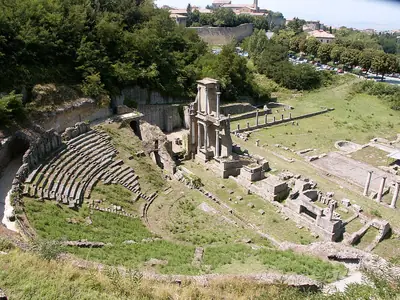
The Roman Theatre of Volterra is one of the best-preserved Roman theatres in Italy. It stands in the Vallebuona valley, just outside the old Etruscan walls and near Porta Fiorentina. Archaeologists uncovered the structure in the 1950s under the direction of local historian Enrico Fiumi. A plaque at the entrance recalls the contribution of workers from Volterra’s psychiatric hospital to the excavations.
Guarnacci Museum
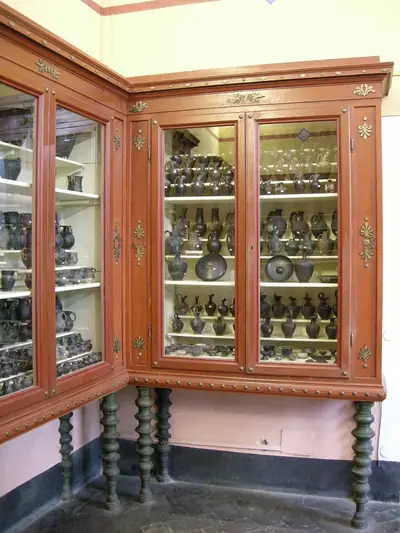
The Guarnacci Museum is one of Europe’s oldest public museums and one of the essential places to see in Volterra. Its collection follows the history of the town and its surrounding territory from the Villanovan age through the Roman period.
The museum’s most remarkable collection is made up of around 600 Etruscan cinerary urns. Created in local workshops between the fourth and first centuries BC, they were carved from alabaster, tufa and terracotta. The museum was created after the local aristocrat, abbot and archaeologist Mario Guarnacci donated his archaeological collection and library to Volterra in 1761.
Fortezza Medicea
The Fortezza Medicea occupies the highest point of Volterra’s hill. It consists of two sections joined by defensive walls: the older Rocca Vecchia, also known as the Cassero, and the newer Rocca Nuova, or Il Mastio.
The southern section dates from 1342, while the newer fortress was built between 1472 and 1474 after Florence conquered Volterra. The discovery of valuable alum in the area had increased Florence’s interest in the town, culminating in the siege and sack of Volterra by approximately 7,000 Florentine troops in 1472.
Palazzo dei Priori
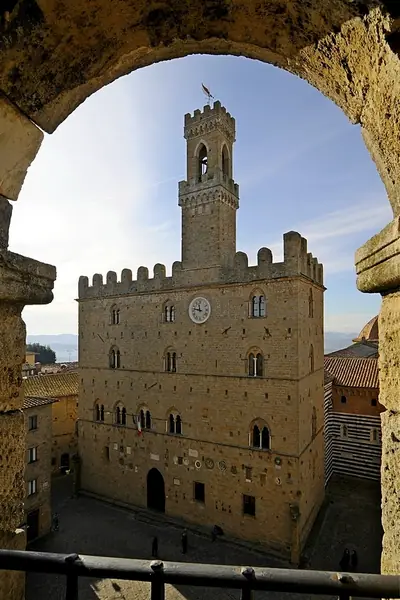
Piazza dei Priori, also known as Piazza Maggiore, is the centre of medieval Volterra. Its most prominent building is the Palazzo dei Priori, a Gothic civic building from the thirteenth century and the oldest town hall in Tuscany.
The palace was originally built for the town’s appointed magistrates and still houses offices of the local commune, including the communal council. Its imposing stone façade has dominated the square for more than seven centuries.
Palazzo Pretorio
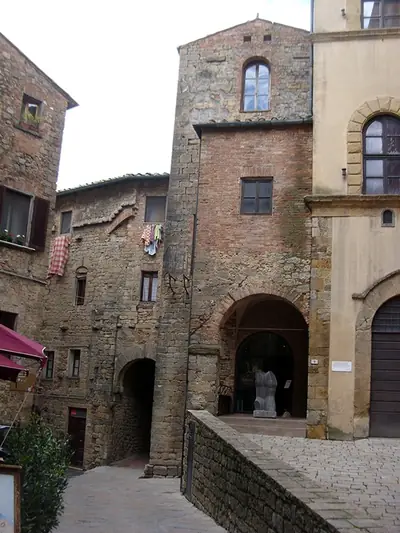
Also standing in Piazza dei Priori, Palazzo Pretorio is a complex of several buildings joined together into its present form in the nineteenth century. During the communal era, it was the seat of the podestà and the captains of the people. Its walls are therefore closely connected with Volterra’s medieval civic and political life.
Cathedral Basilica of the Assumption of Mary
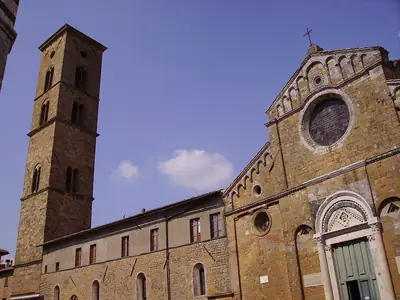
Volterra’s cathedral, also called the Duomo of Volterra, is the city’s main Catholic place of worship and the seat of the bishop of Volterra. The building is Romanesque and dates from the twelfth century. Dedicated to the Assumption of the Virgin Mary, it was elevated to the dignity of a minor basilica by Pope Pius XII in 1957.
The cathedral stands alongside the Baptistery of San Giovanni, making this part of the historic centre an important stop for understanding Volterra’s religious heritage.
Palazzo Minucci-Solaini and the Ecomuseo dell’Alabastro
Palazzo Minucci-Solaini stands at the beginning of Via dei Sarti. Since 1982, it has housed Volterra’s main art gallery as well as the Ecomuseo dell’Alabastro.
The alabaster museum presents both ancient works and pieces made by contemporary artisans. A reconstructed workshop displays the traditional tools used to shape the pale stone, showing how alabaster craftsmanship remains part of Volterra’s identity.
Palazzo Incontri Viti and Teatro Persio Flacco
Palazzo Incontri Viti, generally known as Palazzo Viti, is an elegant historic residence in the medieval centre. Today it is a house museum that offers a glimpse into Volterra’s refined past.
The ground floor and garden behind the palace contain the Teatro Persio Flacco, which opened in 1828. The palace and theatre together connect domestic history with the town’s cultural life.
Museo della Tortura
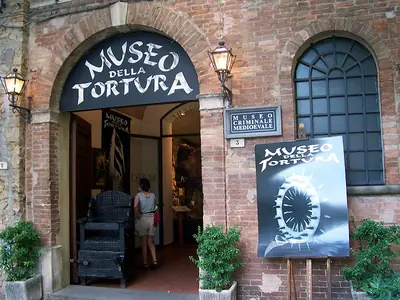
The Museo della Tortura explores the history of punishment and interrogation. It offers a more sombre perspective on the past and is a place to visit slowly, giving time to consider the objects and subject matter on display.
Diocesan Museum of Sacred Art
The Museo Diocesano di Arte Sacra is housed in the Church of Sant’Agostino, a thirteenth-century church and former monastery on Piazza XX Settembre. The church was restructured from 2017 to provide a permanent home for Volterra’s collection of sacred art.
The site is linked to the Augustinian order, which arrived in Volterra with what was believed to be a spine from the crown of thorns. The order remained connected with the church and monastery for centuries.
Palazzo Maffei
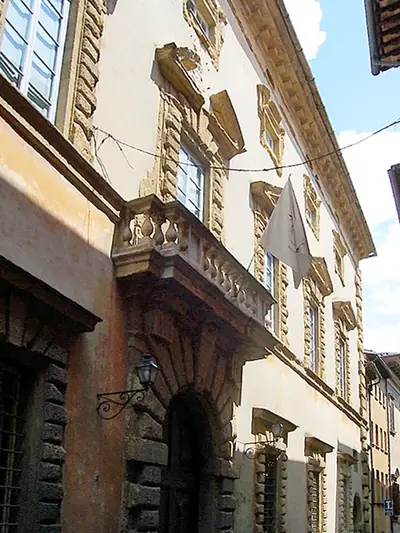
Palazzo Maffei is a Renaissance aristocratic palace on Via Giacomo Matteotti. It was commissioned by Bishop Mario Maffei, who lived from 1463 to 1537, and completed in 1527.
The building once had a façade fresco depicting a Roman triumph by Daniele Ricciarelli, although the work has not survived. In the late eighteenth century, Mario Guarnacci bought the palace and displayed his Etruscan collection on the ground floor before it was moved to the Palazzo dei Priori after his death.
Abbey of Saints Justin and Clement
The Abbey of Saints Justin and Clement, also known as the Camaldolese Abbey of Saint Justin, was founded in the eleventh century. It was home to Camaldolese monks for much of its history.
Earthquake damage forced the monks to leave in the nineteenth century, and the abbey was later dissolved during the Risorgimento.
Convento dei Cappuccini and Santa Chiara
South of the centre, the Cappuccini is the site of a former Capuchin convent dedicated to Saint Matthew the Apostle. In the historic town, the Church of Santa Chiara offers another quieter religious stop among Volterra’s streets.
A Volterra Self-Guided Walking Tour with Neywo
A free walking tour in Volterra can show you the main sights, but a self-guided route gives you more freedom to stop, look around and continue when you are ready. Neywo’s Volterra audio guide includes three walking tours, with 34 narrated stops across the routes:
- Etruscan Stage to Medieval Piazza: 1.15 km, 76 minutes and 12 stops.
- Gates, Fortress and Etruscan Treasures: 2.09 km, 80 minutes and 10 stops.
- The Western Walls: Etruscan Arch and Quiet Churches: 2.35 km, 94 minutes and 12 stops.
The tours include places such as the Roman Theatre, Porta Fiorentina, Palazzo Maffei, Palazzo Incontri Viti, the cathedral, Fortezza Medicea, the Guarnacci Museum, Porta all’Arco, Santa Chiara and the Church of Saints Justin and Clement.
Neywo tells the story of each place as you reach it. You explore at your own pace, with no group and no schedule, and the narration is available in 11 languages.
Download Neywo and Explore Volterra
Download Neywo to explore Volterra with a free audio guide covering 55 narrated places. Choose one of the three walking tours, follow the route through the historic centre and hear each story when you arrive at the corresponding site.
Volterra is part of Italy, and its Tuscan setting makes it easy to place alongside other destinations in the region, including Siena, San Gimignano and Pisa.
Places with an audio guide in Volterra
8 places in Volterra with a Neywo audio guide. Each one starts telling its story as you reach it.
Self-guided tours in Volterra
3 tours in Volterra, free in the Neywo app. Each stop tells its story as you reach it.
- Walk
Etruscan Stage to Medieval Piazza
Start at a Roman theatre dug out of a valley and climb through Volterra's old gate into the Renaissance palaces of Via dei Sarti. The walk ends where the town has made its decisions for eight centuries: Piazza dei Priori, the oldest town hall in Tuscany, and the green-and-white marble Duomo precinct.
Roman Theatre of Volterra · Porta Fiorentina (Volterra) · San Michele Arcangelo · Palazzo Maffei, Volterra · Palazzo Incontri Viti · Palazzo Minucci-Solaini …
Open this tour: Etruscan Stage to Medieval Piazza - Walk
Gates, Fortress and Etruscan Treasures
Walk the eastern edge of the hill town, where the Medici fortress and the old gates guard the skyline. Between them sit the Guarnacci Museum with its hundreds of Etruscan urns, a Baroque seminary church and the Augustinian church that now holds the diocesan museum and a small museum for the town's darker side.
San Girolamo al Velloso · Sant'Andrea Apostolo · Porta a Selci · San Pietro in Selci · Fortezza Medicea · Porta Marcoli …
Open this tour: Gates, Fortress and Etruscan Treasures - Walk
The Western Walls: Etruscan Arch and Quiet Churches
A quieter loop along Volterra's western walls. It starts outside the 2,300-year-old Etruscan arch and wanders through oratories, a ruined Romanesque facade and the Franciscan quarter, with views over the valley from the gates.
Sant'Alessandro · Porta all'Arco · San Cristoforo · Madonna del Gabellino · San Lino · San Francesco …
Open this tour: The Western Walls: Etruscan Arch and Quiet Churches
Walk Volterra with Neywo
Neywo turns Volterra into a self-guided audio tour. Stories arrive as you reach the place they belong to, and the route reshapes when you wander off it.

