Visiting Memmingen, Germany: Top Sights on Foot
Things to do in Memmingen: a self-guided tour of the historic city
Memmingen is a Bavarian city with a remarkably rich historic centre, shaped by medieval churches, former monasteries, museums and surviving city gates. The city is especially rewarding to explore on foot, with landmarks that reveal its religious, artistic and civic history. Neywo has a free audio guide for Memmingen with 35 narrated places, available in 11 languages.
What to see in Memmingen
The best things to do in Memmingen are concentrated in and around the historic centre. These are some of the places that give the city its distinctive character.
St. Martin
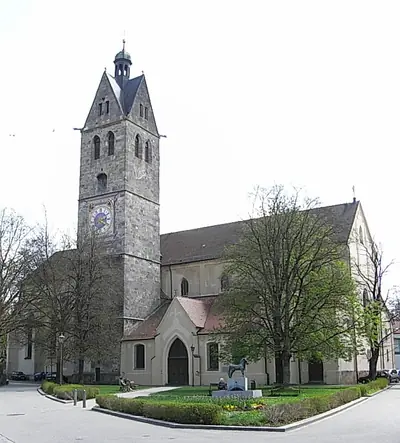
St. Martin is one of Memmingen’s defining landmarks. Its tower rises about 65 metres, making it the tallest building in the city, while the church itself is one of the oldest in Upper Swabia.
The present three-nave basilica was built between around 1325 and 1500. Once completed, it was the largest Gothic town church between Lake Constance and the Lech River. Memmingen’s citizens financed the project, underlining the church’s importance to the medieval town.
St. Martin also played a role in the sixteenth-century Memmingen Reformation, associated with the preacher Christoph Schappeler. Inside, the more-than-500-year-old choir stalls are considered among the finest examples of late Gothic carving in southern Germany and the city’s greatest artistic treasure.
Augustinerinnenkloster and the Landestheater Schwaben
The former Augustinian convent has documentary evidence dating from either 1252 or 1256. Dedicated to Saint Elisabeth, it recalls the long history of the Augustinian hermit nuns in Memmingen and their place in the city’s religious life.
The site is also connected with the Landestheater Schwaben. Based at the Stadttheater Memmingen, this theatre ensemble works across Upper Swabia, combining a home venue with performances for audiences throughout the region.
Our Women Church
Known locally as Pfarrkirche Unser Frauen or the Frauenkirche, Our Women Church stands in Memmingen’s former weavers’ and tanners’ quarter. The evangelical parish church was first mentioned in 1258, although an earlier church may have occupied the site before the year 500.
Its most striking feature is a series of exceptionally well-preserved fifteenth-century frescoes belonging to the early Memmingen School. The church’s history also reflects the city’s religious changes: after the Reformation, Catholic and Protestant communities used it together from about 1530 until 1806. Until secularization in 1802, the Catholic Kreuzherren and Franciscan nuns also used the building.
Antoniter Museum and the former Antonite monastery
The Antoniter Museum is housed in the Antoniterhaus and explores the history and work of the Antonite Order. Founded in 1996, it forms part of a wider heritage complex that includes the former Antonite monastery, or Antonierkloster.
The four-winged monastery complex is described as the best-preserved of its kind in the world. The Antoniterhaus also contains the Strigel Museum, devoted to the painting and sculpture of the Strigel family of artists from Memmingen.
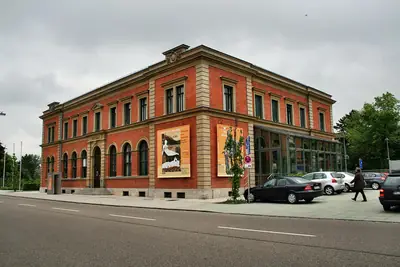
MEWO Kunsthalle
For a change of focus, visit the MEWO Kunsthalle, Memmingen’s exhibition house. It presents contemporary art alongside works from the nineteenth and twentieth centuries, with exhibitions that can include photography, graphic works, drawings and sculpture.
The Kunsthalle occupies the Alte Post, or Old Post, a building constructed in 1901. The institution was founded in 2002 and opened in this location in November 2005.
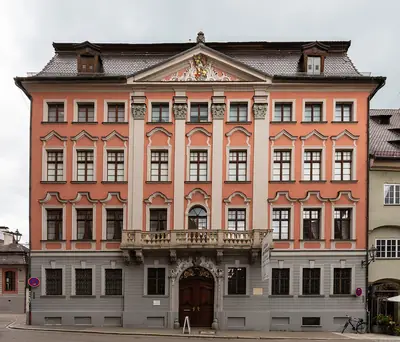
Stadtmuseum Memmingen
Stadtmuseum Memmingen explores art and cultural history in the Bavarian city. It is one of the places to include when discovering how Memmingen’s artistic and civic identity has developed.
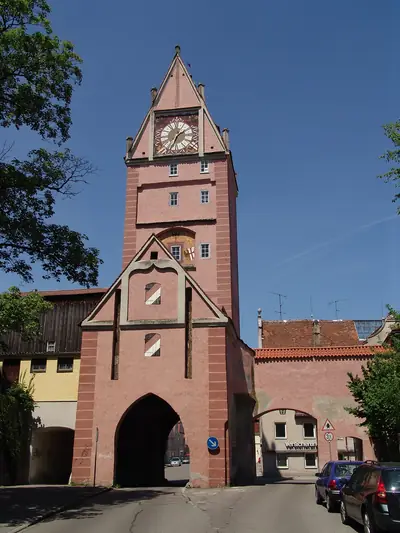
Memmingen’s historic gates
Memmingen’s surviving gates offer a direct connection with the city’s former fortifications. Kempter Tor is one of the historic entrances to the Upper Swabian town, while Westertor stands on the western side of the old town between the Kerkerturm and Lindauer Tor.
Together with the old streets and other defensive remains, these gateways help make the historic centre especially suitable for a self-guided walking tour.
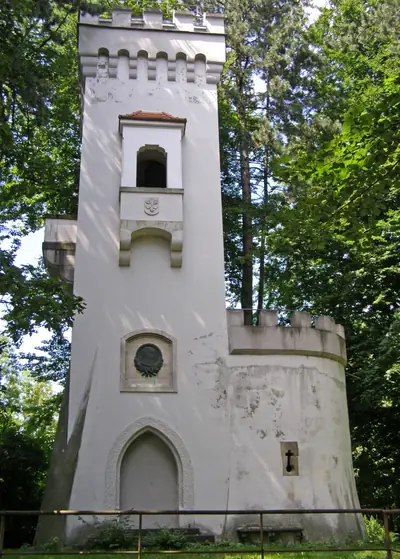
The Bismarck Tower
On Memmingen’s Hühnerberg, the Bismarck Tower is a protected monument built as an observation tower. It rises 18 metres above the hill and is topped with battlements.
Peter Lang, Memmingen’s municipal building master, designed the tower, which was built in 1904. It was commissioned by the local beautification association and included an attached section and an observation platform. The tower was renovated in 2000, when its white paint was renewed.
Grünenfurt and Eisenburg
Memmingen’s districts extend the city’s historic story beyond the old centre. Schloss Grünenfurt is a country estate surrounded by an English landscape garden. The property is privately owned and cannot be visited, but its exterior history reaches back to a Renaissance predecessor. The present complex was rebuilt in the Late Baroque style between 1737 and 1738.
Schloss Eisenburg stands in the district of Eisenburg. Until secularization, it was the main seat of the lordship of Eisenburg; later, it passed into the hands of patrician families from Memmingen.
St. Josef
St. Josef is a Catholic parish church built between 1927 and 1929. It is the principal church of the Memmingen deanery and is dedicated to Saint Joseph. Its patronal feast is celebrated on 19 March.
Alter Friedhof
Alter Friedhof recalls the former Schottenkloster St. Nikolaus, where Irish monks once lived according to the Benedictine rule. The monastery was later administered by Ottobeuren Abbey and belonged to the Diocese of Augsburg.
Franziskanerinnenkloster
Also known as Maria Garten, the former Franciscan convent dates back to the fifteenth century. Two sisters from the hermitage at Leutkirch founded it in 1444. As the community grew, they bought a house opposite the Frauenkirche, which was developed between 1467 and 1470 into a convent with a chapel, cloister, cells and inner courtyard.
The nuns later refused to adopt the new confession during the Reformation and fled the city. After their convent was dissolved, the building became a hospital, then a poorhouse and charitable institution from 1869. Today, it is the Bürgerstift retirement home.
Kreuzherrenkloster
The Kreuzherrenkloster is a former convent that belonged to the Hospitallers of the Holy Spirit and formed part of the Diocese of Augsburg. Its religious history adds another layer to Memmingen’s concentration of former convents and monasteries.
Explore Memmingen with a free audio guide
Neywo turns a visit into a Memmingen self-guided walking tour: the app tells the story of each place as you reach it, at your own pace, with no group and no schedule.
The Memmingen audio guide includes:
- Three walking tours
- Peasants, Reformers and a Leaning Tower: 1.53 km, 84 minutes and 11 narrated stops
- Gates, Weavers and the House of Seven Roofs: 1.63 km, 66 minutes and 8 narrated stops
- East of the Walls: Irish Monks, a Mosque and a Tent-Shaped Church: 1.8 km, 46 minutes and 4 narrated stops
- One bus route
- Line 3: Out to Eisenburg and Back to the Old Town: 12.7 km, 54 minutes and 5 narrated stops
Download Neywo and explore Memmingen independently, hearing the history of its churches, museums, monasteries and city gates exactly when you arrive. It is a free audio guide with 35 narrated places and narration in 11 languages. Memmingen is part of Bavaria, in Germany, and Neywo can also accompany you in nearby Kempten.
Places with an audio guide in Memmingen
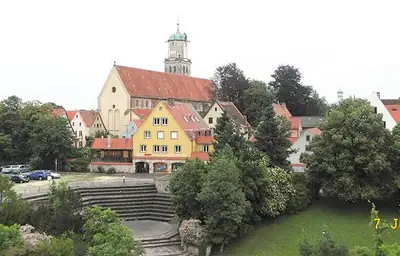
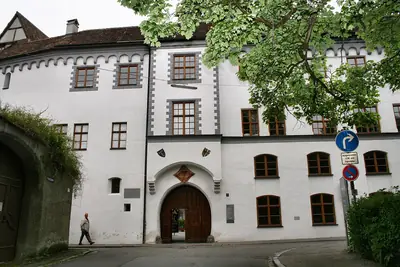
8 places in Memmingen with a Neywo audio guide. Each one starts telling its story as you reach it.
Self-guided tours in Memmingen
4 tours in Memmingen, free in the Neywo app. Each stop tells its story as you reach it.
- Bus ride
Line 3: Out to Eisenburg and Back to the Old Town
Stadtverkehr Memmingen's line 3 takes you from the MEWO Kunsthalle out to Eisenburg, a hillside village on the dry valley that is only served by this line, where a small Nepomuk chapel stands in the middle of the Oberdorf. It then returns through St. Josef to the old town's Antoniter Museum and the Kramerzunftstube, where the peasants' Twelve Articles were drafted.
MEWO Kunsthalle · Kapelle Sankt Johannes von Nepomuk · St. Josef · Antoniter-Museum · Kramerzunftstube
Open this tour: Line 3: Out to Eisenburg and Back to the Old Town - Walk
Peasants, Reformers and a Leaning Tower
In 1525 the peasants of Upper Swabia wrote their Twelve Articles in Memmingen, one of Europe's first statements of human rights. Walk the old town streets where that story unfolded, past the great Gothic church of St. Martin, medieval monasteries, the vanished synagogue and the crooked Witches' Tower.
Westertor · Synagoge (Memmingen) · Antoniter-Museum · Kramerzunftstube · Children's Education Church · St. Martin (Memmingen) …
Open this tour: Peasants, Reformers and a Leaning Tower - Walk
Gates, Weavers and the House of Seven Roofs
The southern old town was home to Memmingen's weavers and tanners, and it still feels like a working medieval quarter. Pass through the Kempter Tor, visit a church whose frescoes are older than the Reformation, stop at the quirky Siebendächerhaus and end by the river in the Old Post, now an art gallery.
Kempter Tor · Franziskanerinnenkloster Memmingen · Our women · Siebendächerhaus · Stadttheater Memmingen · Kreuzherrenkloster …
Open this tour: Gates, Weavers and the House of Seven Roofs - Walk
East of the Walls: Irish Monks, a Mosque and a Tent-Shaped Church
Step outside the old town's eastern edge. Visit the Fatih Mosque, the Old Cemetery that remembers Irish monks, the modern parish church of Mariä Himmelfahrt and the Christuskirche, a Lutheran church built in the shape of a tent.
Fatih Moschee · Alter Friedhof · Mariä Himmelfahrt · Christuskirche
Open this tour: East of the Walls: Irish Monks, a Mosque and a Tent-Shaped Church
Walk Memmingen with Neywo
Neywo turns Memmingen into a self-guided audio tour. Stories arrive as you reach the place they belong to, and the route reshapes when you wander off it.


More in Bavaria
Elsewhere in Germany
- FrankfurtHesse
- IdsteinHesse
- Rüdesheim am RheinHesse
- BinzMecklenburg-Western Pomerania
- RostockMecklenburg-Western Pomerania
- SchwerinMecklenburg-Western Pomerania
- AachenNorth Rhine-Westphalia
- AnholtNorth Rhine-Westphalia
- BonnNorth Rhine-Westphalia
- CologneNorth Rhine-Westphalia
- DuisburgNorth Rhine-Westphalia
- DüsseldorfNorth Rhine-Westphalia