Things to Do in Passau, Germany: Walking Guide
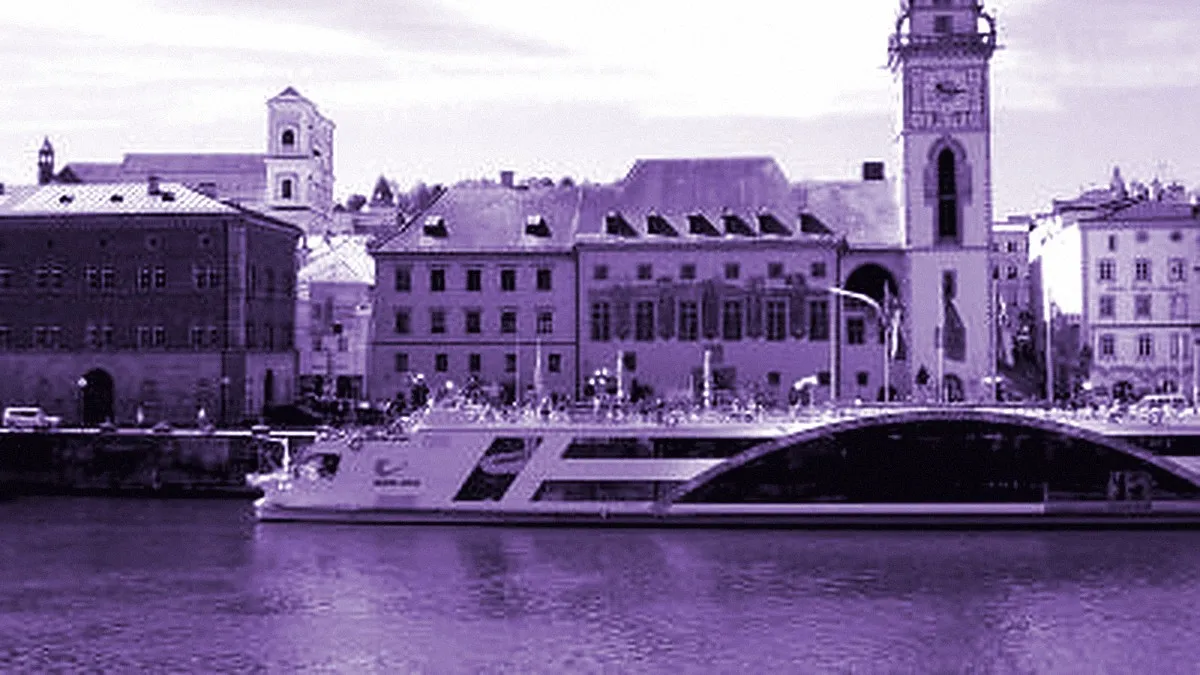
Things to Do in Passau: What to See in the City of Three Rivers
Looking for things to do in Passau? Start in the historic centre, where Baroque churches, old city gates, fortresses and riverside landmarks reveal the character of this Bavarian city. Passau stands between the Danube, the Inn and the Ilz, and its compact historic districts make it well suited to exploring on foot. Neywo has a free audio guide for Passau with 55 narrated places, available in 11 languages.
What to See in Passau
St. Stephen’s Cathedral
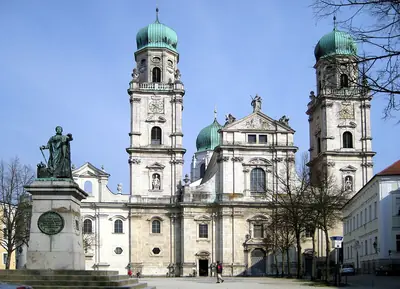
St. Stephen’s Cathedral, or Dom St. Stephan, rises at the highest point of Passau’s old town, between the Inn and the Danube. It is the seat of the Catholic Bishop of Passau and the principal church of the diocese.
The present Baroque cathedral was built after a major fire destroyed its predecessor in 1662. Construction began in 1668 and continued until 1693. Carlo Lurago created the architectural plan, Giovanni Battista Carlone worked on the interior decoration, and Carpoforo Tencalla painted the vivid frescoes.
Inside, the cathedral has one of the largest Baroque church interiors north of the Alps. Its five-part organ system is another defining feature. Late Gothic elements from the earlier church remain in the eastern section, adding further layers to the building’s history.
St. Michael’s Church
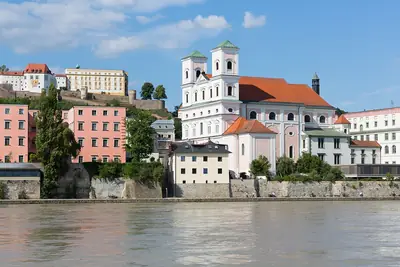
St. Michael’s Church, also known as the Studienkirche or Jesuit Church, stands beside the Leopoldinum School. The Jesuits arrived in Passau in 1611 and established a college and church here. After the earlier church was destroyed in the 1662 fire, the present building was constructed between 1665 and 1678.
Its exterior reflects Italian-style design, while the interior is richly decorated with elaborate altars, angel statues and a painting of the fallen angel. The adjoining buildings now house the University of Passau’s Faculty of Catholic Theology and the Passau State Library, which has an extensive collection of books and manuscripts.
St. Paul
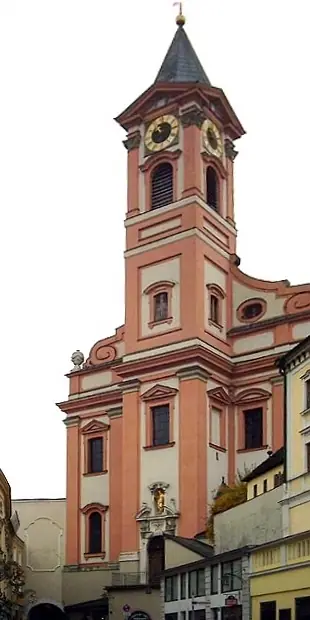
Beyond the Paulusbogen, the northern gate to Passau’s old town, St. Paul’s cream-and-pink façade stands above a staircase. It is regarded as the city’s oldest church. The first church on this site was dedicated to Saint Paul around 1050.
After fires in 1512 and 1662, the building was rebuilt in 1678 to designs by Carlo Antonio Carlone. Its tower was greatly enlarged in the nineteenth century, but the tall structure became unsafe and was demolished in 1950. A shorter tower, about one third of the original height, replaced it.
St. Matthäus
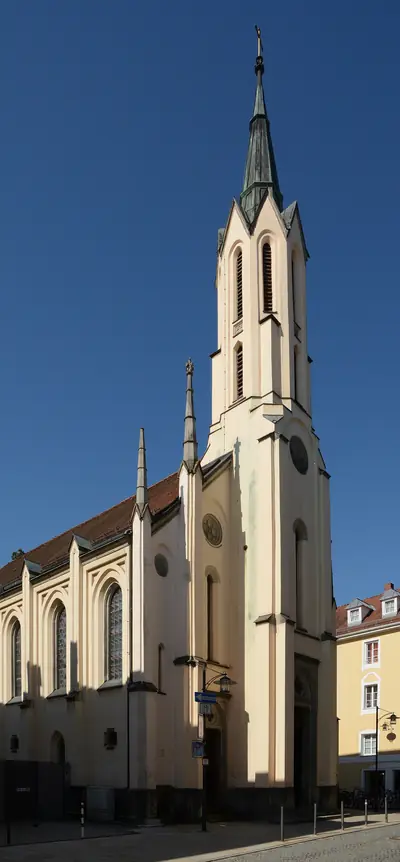
St. Matthäus has a special place in Passau’s religious history as the city’s first Protestant church. Designed by Friedrich Bürklein, it was inaugurated in 1859.
Spitalkirche at Rindermarkt
The Spitalkirche, also known as St. Johann, is linked to the former hospital beside it. Passau’s cathedral chapter founded the hospital in 1198, and the city took it over in 1278. It has continued as a home for older people to this day.
Although the church was also begun in 1198, much of the present building dates from the fourteenth and fifteenth centuries. Its unusual two-aisled layout, cross vaulting and north chapel are notable features. A restoration between 1860 and 1864 gave the interior its largely Neo-Gothic furnishings, while a fifteenth-century relief of Christ between Mary and John remains among the older surviving works.
Wittelsbacherbrunnen
The Wittelsbacherbrunnen stands on Residenzplatz in a richly decorated Neo-Baroque form. It commemorates one hundred years of Passau’s affiliation with the Kingdom of Bavaria and was built between 1904 and 1906. Prince Regent Luitpold commissioned the fountain, which was designed by Jakob Bradl.
Its three-part composition includes a basin with inscriptions and the coats of arms of Passau and Bavaria. Above it, dolphins, shells and angels decorate a column representing the Danube, the Ilz and the Inn. A figure of Mary crowns the fountain.
Oberhausmuseum and Veste Oberhaus
Across the Danube, Veste Oberhaus rises above the old town on Georgsberg, between the Danube and the Ilz. Founded in 1219, it served for most of its history as the stronghold and residence of the prince bishops of Passau. Its buildings were expanded repeatedly until 1800.
The fortress formed part of a larger defensive system with Veste Niederhaus below. St. George’s Chapel contains a fresco cycle depicting the legend of Saint George. The complex also has a darker history: during the sixteenth century, many Anabaptists were imprisoned there because of their faith. Later, it served as a prison and became known as Bavaria’s Bastille.
Today, the Oberhausmuseum presents the history of Passau inside the fortress.
Severinstor
Severinstor, also called the Peichtertor, marks the western entrance to Passau’s Innstadt. The former city gate dates from 1412 and once formed part of the Innstadt fortifications. Its barbican survives, along with part of the fortification wall and its towers.
Nearby stands the Peichterturm, a round tower built in 1403 to strengthen the city wall. The gate and tower recall the former Boiotro fort, which once stood in this area.
Schaiblingsturm
On the Innkai, the Schaibling Tower stands on a rock beside the river. Its round shape, white walls and pointed red roof make it one of Passau’s most distinctive historic sights.
Built in 1250 as part of the medieval city wall, the tower protected the city and later served as a salt store and a landing place for ships and rafts during the salt trade. A cable ferry connected it with the Innstadt until 1957. The tower survived the city fires of 1662 and 1680 without damage.
Fünferlsteg
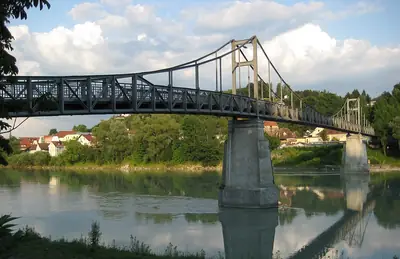
The Fünferlsteg, also known as the Innsteg or Hindenburgbrücke, is a pedestrian bridge across the Inn between Passau’s Old Town and the Innstadt. Its familiar name comes from the five-pfennig toll once charged to cross it.
The bridge opened on 2 October 1916 after a citizens’ campaign and a privately financed construction project. A small toll booth at its northern end is still preserved. The bridge itself was blown up on 3 May 1945, near the end of the Second World War.
Schloss Freudenhain
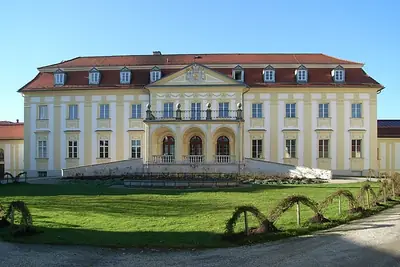
On the northern bank of the Danube, Schloss Freudenhain stands in its namesake park. The residence began as a summer retreat for Passau’s prince-bishop, Cardinal Joseph Franz Anton Count von Auersperg. Johann Georg von Hagenauer designed the palace, which was built between 1785 and 1792.
For more than a hundred years, Schloss Freudenhain has been used as a school. The palace and park form part of a protected historic monument complex.
Exploring Passau with a Free Audio Guide
A Passau self-guided walking tour lets you explore the city without joining a group or following a fixed timetable. Neywo tells the story of each place as you reach it, at your own pace, with no group and no schedule.
The app includes four walking tours and one bus route:
- Baroque Passau: Cathedral, Palaces and the Fool’s Head — 1.35 km, 106 minutes and 12 narrated stops.
- Along the Danube Quay to the Meeting of Three Rivers — 1.35 km, 68 minutes and 9 narrated stops.
- Fortress Hill above the Danube — 0.86 km, 40 minutes and 5 narrated stops.
- Innstadt: Romans, Gates and Pilgrims — 2.24 km, 77 minutes and 8 narrated stops.
- City Bus 3: Ilz River to the Innstadt — 4.4 km, 19 minutes and 5 narrated stops.
Together with the individual stories, these routes cover Passau’s cathedral, rivers, fortifications, churches, bridges and historic districts. Download Neywo and explore Passau with an audio guide that starts speaking when you arrive at each place—at your own pace, without a group or schedule. You can also continue discovering Bavaria and the rest of Germany.
Places with an audio guide in Passau
8 places in Passau with a Neywo audio guide. Each one starts telling its story as you reach it.
Self-guided tours in Passau
5 tours in Passau, free in the Neywo app. Each stop tells its story as you reach it.
- Bus ride
City Bus 3: Ilz River to the Innstadt
Passau's city bus 3 runs along the Danube side of the old town. Ride from the mouth of the Ilz past the Salvator church, the abbey of St Nikola and the theatre to St Gertraud on the Inn.
Ilz · Sankt Salvator church · Abbey of St. Nikola in Passau · Stadttheater Passau · St. Gertraud
Open this tour: City Bus 3: Ilz River to the Innstadt - Walk
Baroque Passau: Cathedral, Palaces and the Fool's Head
Italian master builders rebuilt Passau after the great fire of 1662, and this walk follows their work from the pedestrian zone to Domplatz, past the cathedral with one of the largest organs in the world, the old and new prince-bishops' residences and the stone Fool of Passau that grins at passers-by.
Votivkirche · St. Matthäus · Rindermarkt · Spitalkirche · St. Paul in Passau · Lamberg-Palais …
Open this tour: Baroque Passau: Cathedral, Palaces and the Fool's Head - Walk
Along the Danube Quay to the Meeting of Three Rivers
Stroll from the town hall tower and the glass museum along the Danube quay, past the Jesuit church, the abbey of Niedernburg and the round Schaibling tower, to the pointed tip where the Danube, the Inn and the Ilz meet in three different colours.
Glass Museum, Passau · Town hall of Passau · St. Michael's Church · Kloster Niedernburg · Schaiblingsturm · Museum of Modern Art …
Open this tour: Along the Danube Quay to the Meeting of Three Rivers - Walk
Fortress Hill above the Danube
Cross the Danube and climb to the Veste Oberhaus, the prince-bishops' fortress that has watched over the city since 1219. Come down past the Salvator church to the lower castle and the mouth of the dark Ilz river.
Veste Oberhaus · Sankt Salvator church · Veste Niederhaus · Ilz · St. Bartholomäus, Passau
Open this tour: Fortress Hill above the Danube - Walk
Innstadt: Romans, Gates and Pilgrims
Cross the Inn into the Innstadt, the old craftsmen's quarter, where the Roman fort of Boiotro stands beside the Severin gate. Wander back across the Fünferlsteg footbridge, and finish at the former abbey of St Nikola, with a view up to the Mariahilf pilgrimage hill where you begin.
Pilgrimage Church of Mariahilf · St. Gertraud · Museum Castrum Boiotro · Severinstor · St. Severin, Passau · Fünferlsteg …
Open this tour: Innstadt: Romans, Gates and Pilgrims
Walk Passau with Neywo
Neywo turns Passau into a self-guided audio tour. Stories arrive as you reach the place they belong to, and the route reshapes when you wander off it.


More in Bavaria
Elsewhere in Germany
- FrankfurtHesse
- IdsteinHesse
- Rüdesheim am RheinHesse
- BinzMecklenburg-Western Pomerania
- RostockMecklenburg-Western Pomerania
- SchwerinMecklenburg-Western Pomerania
- AachenNorth Rhine-Westphalia
- AnholtNorth Rhine-Westphalia
- BonnNorth Rhine-Westphalia
- CologneNorth Rhine-Westphalia
- DuisburgNorth Rhine-Westphalia
- DüsseldorfNorth Rhine-Westphalia