Things to Do in Munich, Germany: Walking Guide
Things to Do in Munich: What to See in Bavaria’s Capital
Looking for things to do in Munich? Bavaria’s capital brings together royal residences, Gothic churches, Renaissance and Baroque architecture, major art museums, historic squares, and the open spaces of the English Garden. A free Munich audio guide from Neywo covers 580 narrated places, helping you explore the city independently.
What to See in Munich
Munich’s historic centre is a natural starting point, but the city’s most important sights extend from the Kunstareal and Nymphenburg to Lehel, the Isar banks, and Prinzregentenstraße.
Marienplatz, Frauenkirche and Petersplatz
Frauenkirche, officially the Dom zu Unserer Lieben Frau, is one of Munich’s defining landmarks. Its two almost equally tall towers rise above a late-Gothic, three-aisled brick church begun in 1468 and consecrated in 1494. Since 1821, it has been the cathedral church of the Archbishop of Munich and Freising.
Nearby Petersplatz is associated with St. Peter’s Church, Munich’s oldest recorded parish church. Its 91-metre tower, known as Alter Peter, is one of the city’s emblems. Inside, the three-aisled basilica has a richly decorated interior and a Baroque high altar created with reference to Bernini’s Cathedra Petri.
Karlstor and Brunnenbuberl
At the western end of Neuhauser Straße, Karlstor marks the historic entrance to Munich’s old town. Built around 1300 as Neuhauser Tor, it is the westernmost of the city’s three surviving Gothic town gates. Its two flanking towers are original, while the central section was redesigned in Neo-Gothic style in 1861 and 1862.
The gate was damaged during the Second World War and later rebuilt in a somewhat simplified form. A few steps away, Brunnenbuberl adds a smaller landmark to this busy entrance to the pedestrian zone and Karlsplatz, locally known as Stachus.
St. Michael’s Church
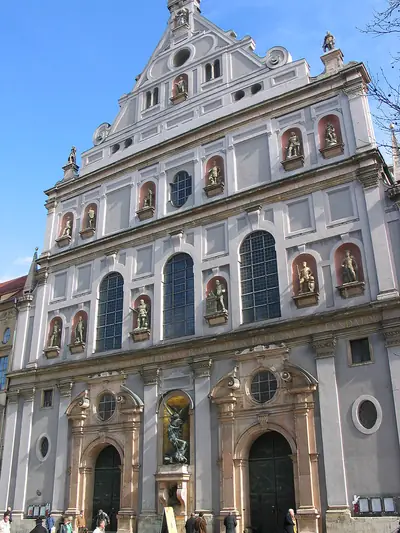
St. Michael’s Church was built between 1583 and 1597 for William V, Duke of Bavaria, together with an adjoining Jesuit college. Its design stands at the transition between the late Renaissance and the emerging Baroque, drawing inspiration from Il Gesù in Rome.
The church became an important centre of the Counter-Reformation in Bavaria and a dynastic centre for the Wittelsbach family. Its crypt serves as the burial place of the Bavarian dukes, adding a strong connection with the ruling dynasty to its architectural importance.
Asam Church
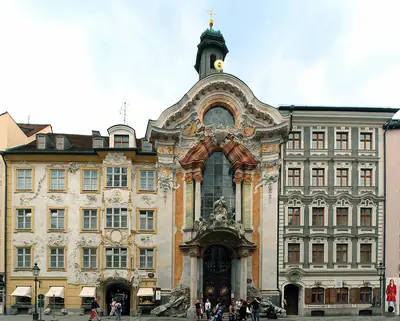
On Sendlinger Straße, the Asam Church, also known as St. Johann Nepomuk, is one of the outstanding works of southern German Late Baroque. The two Asam brothers created this small church as their own private church.
Its richly decorated design approaches the Rococo, although the characteristic rocaille ornament had not yet appeared. The compact scale makes the church especially striking in contrast with Munich’s larger religious buildings.
Munich Residence and the Theatine Church
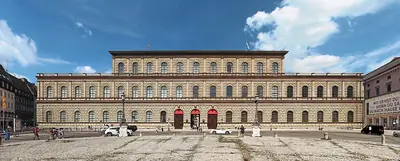
The Munich Residence was the palace of Bavaria’s dukes, electors, and kings from the Wittelsbach family. Developed over four centuries from a small fortified castle, it now forms Germany’s largest city palace, with more than 40,000 square metres of floor space, ten courtyards, and more than 150 exhibition rooms.
Its architecture brings together Renaissance, Baroque, Rococo, and Neoclassical styles. The complex includes the Königsbau, the Alte Residenz, and the Festsaalbau, as well as the Cuvilliés Theatre, the Allerheiligen-Hofkirche, the Court Garden, and the Marstall.
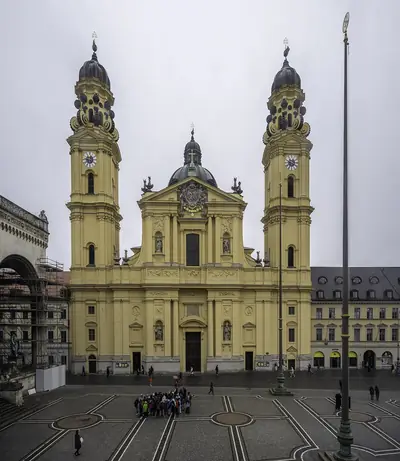
Across from the Residence at Odeonsplatz, the warm yellow façade of the Theatine Church stands out. Built between 1663 and 1690, it was founded by Elector Ferdinand Maria and Henriette Adelaide of Savoy to celebrate the birth of their heir. Its Italian High Baroque design was created by Agostino Barelli, with later work by Enrico Zuccalli, who added the towers and completed the dome.
The Kunstareal: Glyptothek and Alte Pinakothek
Königsplatz is home to the Glyptothek, Munich’s museum of ancient sculpture and one of the defining landmarks of the Kunstareal. Commissioned by King Ludwig I and designed by Leo von Klenze, it was built between 1816 and 1830 and opened as Munich’s oldest public museum.
The collection includes Greek, Roman, and Etruscan sculpture, including original works, Roman copies of lost Greek sculptures, and modern reconstructions. Notable pieces include the Barberini Faun, the Drunken Old Woman, the Boy with the Goose, Eirene with the Ploutos Boy, the Aeginetan figures, and two kouroi.
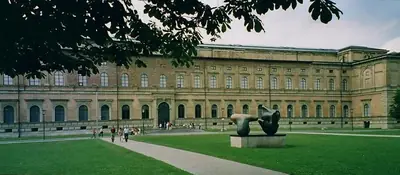
The Alte Pinakothek focuses on Old Master paintings from the fourteenth to the eighteenth century. Leo von Klenze designed its building between 1826 and 1836. After wartime damage, Hans Döllgast restored it between 1952 and 1957, leaving the museum with both its nineteenth-century origins and the visible history of reconstruction.
Nymphenburg Palace and Amalienburg
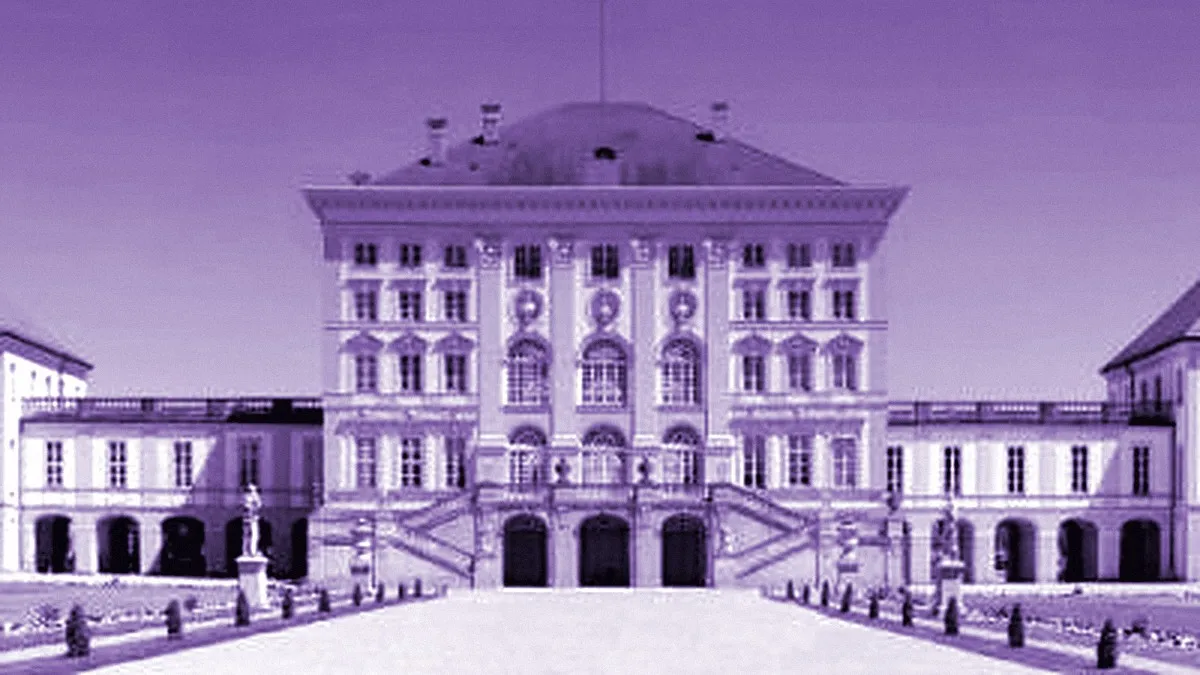
Nymphenburg Palace began in 1664 as a country residence commissioned by Elector Ferdinand Maria to celebrate the birth of his heir, Maximilian Emanuel. Expanded over two centuries, it became the summer residence of Bavaria’s electors and kings from the House of Wittelsbach between 1715 and 1918.
The palace and park form an extensive ensemble of Baroque architecture, canals, water features, and historic buildings. The palace has a frontage of 632 metres, while the estate includes a park covering 180 hectares. The complex also contains four smaller buildings known as burgs.
Within the palace park, Amalienburg is an elegant Rococo hunting lodge designed by François de Cuvilliés and built between 1734 and 1739. Commissioned for Elector Karl Albrecht and Maria Amalia of Austria, it is particularly known for its Mirror Hall and finely crafted interior decoration.
The English Garden and Monopteros
The Monopteros is one of the distinctive places to pause in Munich’s English Garden. The park was among the first large continental European parks to be open to everyone. A major road divides it into a southern section, the original English Garden, and a northern section known as the Hirschau.
Münchner Stadtmuseum and Abbey Church of St. Anna
At St.-Jakobs-Platz, the Münchner Stadtmuseum explores Munich’s cultural and contemporary history. Founded on July 29, 1888, by city archivist Ernst von Destouches, it preserves material traces of the city’s development and the way Munich understands itself.
The museum occupies a complex that includes the former municipal arsenal and stables, both late-Gothic buildings. The historic setting forms part of the story told by its permanent and temporary exhibitions.
In Lehel, the Abbey Church of St. Anna is an important Rococo landmark. It was the first Rococo church in Old Bavaria and influenced religious architecture across the region. Destroyed during the Second World War, it was reconstructed by 1979 and now serves as the abbey church of Munich’s Franciscan monastery.
Villa Stuck
Villa Stuck on Prinzregentenstraße is both an art museum and the former home and studio of Franz von Stuck. The artist designed and built it for himself between 1897 and 1898.
The white exterior, with its Doric columns, contrasts with the richly unified interior. Stuck designed the rooms, furnishings, textiles, sculpture, and decoration as a complete artistic composition influenced by antiquity, Byzantium, the East, and the Italian Renaissance. The villa preserves private rooms, formal spaces, and the artist’s studio, while also hosting exhibitions of art from around 1900 and contemporary art.
Explore Munich with a Self-Guided Audio Tour
Neywo’s free audio guide for Munich includes 7 walking tours, 1 bus route, and 1 bike route, with narration available in 11 languages. The app tells the story of each place as you reach it, at your own pace, with no group and no schedule.
The walks include:
- Old Munich: City Gate, Cathedral and the Town Halls — 1.55 km, 107 minutes, 8 narrated stops.
- The Kunstareal: Antiquities, Old Masters and Modern Art — 2 km, 114 minutes, 8 stops.
- Royal Munich: Old Court, Residence and Court Garden — 1.34 km, 111 minutes, 7 stops.
- Medieval Munich: Sendlinger Tor, the Asam Church and the Jesuits — 1.21 km, 74 minutes, 5 stops.
- Nymphenburg: The Summer Palace and Its Garden Pavilions — 3.19 km, 117 minutes, 7 stops.
- Prinzregentenstraße: Museums to the Peace Angel — 2.22 km, 80 minutes, 7 stops.
- Isar Banks: Deutsches Museum to the Maximilianeum — 2.8 km, 86 minutes, 6 stops.
There is also a 6.5-kilometre, 28-minute bus route with 10 stops, and a 2.9-kilometre, 14-minute bike route through the English Garden with 5 stops. Download Neywo and explore Munich’s historic centre, museums, palaces, and parks through a self-guided audio tour.
Munich is an excellent base for discovering more of Bavaria, while the nearby cities of Nuremberg, Regensburg, and Passau offer further stops in the region.
Places with an audio guide in Munich
8 places in Munich with a Neywo audio guide. Each one starts telling its story as you reach it.
Self-guided tours in Munich
9 tours in Munich, free in the Neywo app. Each stop tells its story as you reach it.
- Bike ride
Englischer Garten by Bike: Haus der Kunst, Monopteros and the Chinese Tower
Ride into one of the world's largest city parks along its paved paths, from the Haus der Kunst past the Rumford monument to the Monopteros temple on its hill and the Chinese Tower beer garden.
Haus der Kunst · Rumford-Denkmal · Monopteros · Chinese Tower · Englischer Garten
Open this tour: Englischer Garten by Bike: Haus der Kunst, Monopteros and the Chinese Tower - Bus ride
Museenlinie 100: Munich's Museum Bus from Ostbahnhof to the Hauptbahnhof
Ride MVG's special museum line 100 across the city. It runs past Villa Stuck, the Angel of Peace, the Schack Collection and the Haus der Kunst, then through Odeonsplatz and Karolinenplatz to the Pinakothek museums and Königsplatz, ending at the main station.
Orleansplatz · Richard Wagner · Villa Stuck · Friedensengel · Schack Collection · Haus der Kunst …
Open this tour: Museenlinie 100: Munich's Museum Bus from Ostbahnhof to the Hauptbahnhof - Walk
Old Munich: City Gate, Cathedral and the Town Halls
Start at the Gothic Karlstor and walk the pedestrian zone past the Bürgersaal to the twin-towered Frauenkirche. Continue to Marienplatz with its two town halls, then St Peter's, the Viktualienmarkt and the Holy Spirit Church, the old heart of the city.
Karlstor (München) · Bürgersaalkirche · Frauenkirche · New Town Hall · Old Town Hall, Munich · St. Peter's Church, Munich …
Open this tour: Old Munich: City Gate, Cathedral and the Town Halls - Walk
The Kunstareal: Antiquities, Old Masters and Modern Art
Visit the greatest cluster of museums in Bavaria. Start at the Greek-style gateway of Königsplatz, with its sculpture museum and the Lenbachhaus, then walk east to the Alte Pinakothek's old masters, the Pinakothek der Moderne and the Brandhorst Museum.
Königsplatz · Propylaea · Glyptothek · Lenbachhaus · NS-Dokumentationszentrum · Alte Pinakothek …
Open this tour: The Kunstareal: Antiquities, Old Masters and Modern Art - Walk
Royal Munich: Old Court, Residence and Court Garden
Walk the route of the Wittelsbach kings. Begin at the Old Court, cross Max-Joseph-Platz to the National Theatre and Germany's largest city palace, then step to Odeonsplatz for the yellow Theatine Church and the Feldherrnhalle. End in the Baroque Court Garden.
Alter Hof · Max-Joseph-Denkmal · National Theatre Munich · Munich Residence · Theatine Church · Feldherrnhalle …
Open this tour: Royal Munich: Old Court, Residence and Court Garden - Walk
Medieval Munich: Sendlinger Tor, the Asam Church and the Jesuits
Enter through the Gothic Sendlinger Tor and walk along Sendlinger Straße to the Rococo jewel built by the Asam brothers. Visit the City Museum in the old arsenal, then the Augustinian church and St Michael's, the largest Renaissance church north of the Alps.
Sendlinger Tor · Asam Church · Münchner Stadtmuseum · Augustinerkirche · St. Michael's Church, Munich
Open this tour: Medieval Munich: Sendlinger Tor, the Asam Church and the Jesuits - Walk
Nymphenburg: The Summer Palace and Its Garden Pavilions
Stroll through the park of Nymphenburg Palace, the Wittelsbach summer residence. See the palace itself and then the pleasure houses in the park: the rococo Amalienburg, the Badenburg with its royal bathing hall, the Pagodenburg and the hermit's cell of the Magdalenenklause.
Museum of Man and Nature · Nymphenburg Palace · Marstallmuseum · Amalienburg · Badenburg · Gartenpavillon Pagodenburg in München …
Open this tour: Nymphenburg: The Summer Palace and Its Garden Pavilions - Walk
Prinzregentenstraße: Museums to the Peace Angel
Follow Munich's most elegant museum boulevard east from the Haus der Kunst. Stop at the Bavarian National Museum, the archaeological collection and the Schack Collection, then climb to the Peace Angel and finish at Villa Stuck and the Prinzregententheater.
Haus der Kunst · Bayerisches Nationalmuseum · Archäologische Staatssammlung · Schack Collection · Friedensengel · Villa Stuck …
Open this tour: Prinzregentenstraße: Museums to the Peace Angel - Walk
Isar Banks: Deutsches Museum to the Maximilianeum
Cross to the river island of the Deutsches Museum and walk the Isar's bank to the Art Nouveau Müllersches Volksbad. Continue past the Alpine Museum and the Five Continents Museum, then reach the Maximilianeum, seat of Bavaria's parliament.
Deutsches Museum · Müllersches Volksbad · Alpine Museum · Five Continents Museum · Parish Church of St. Anna · Maximilianeum
Open this tour: Isar Banks: Deutsches Museum to the Maximilianeum
Walk Munich with Neywo
Neywo turns Munich into a self-guided audio tour. Stories arrive as you reach the place they belong to, and the route reshapes when you wander off it.


More in Bavaria
Elsewhere in Germany
- FrankfurtHesse
- IdsteinHesse
- Rüdesheim am RheinHesse
- BinzMecklenburg-Western Pomerania
- RostockMecklenburg-Western Pomerania
- SchwerinMecklenburg-Western Pomerania
- AachenNorth Rhine-Westphalia
- AnholtNorth Rhine-Westphalia
- BonnNorth Rhine-Westphalia
- CologneNorth Rhine-Westphalia
- DuisburgNorth Rhine-Westphalia
- DüsseldorfNorth Rhine-Westphalia