Things to Do in Nuremberg, Germany: Walking Guide
Things to Do in Nuremberg: What to See in the Old Town and Beyond
The best things to do in Nuremberg include exploring its medieval Old Town, climbing Castle Hill, discovering historic churches and visiting places connected with the city’s difficult twentieth-century history. Nuremberg’s landmarks bring together Gothic architecture, imperial power, literary traditions and a culture of remembrance. Neywo’s free audio guide for Nuremberg covers 257 narrated places, helping you discover the city as you walk.
What to See in Nuremberg
Nuremberg Castle
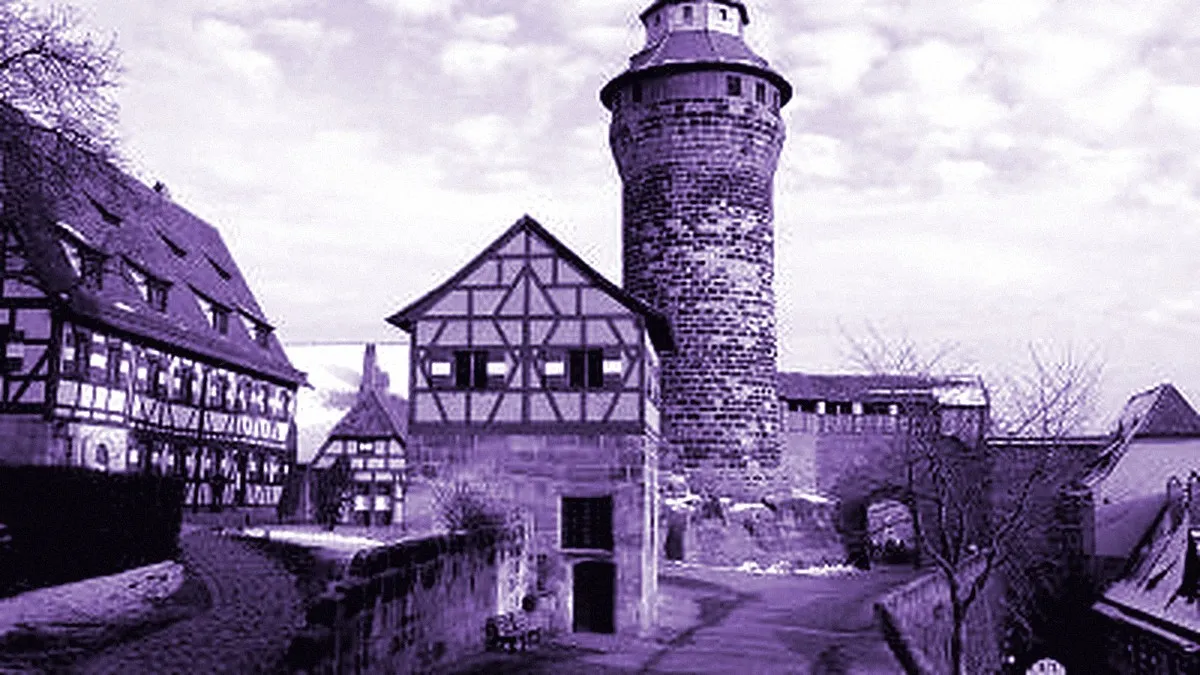
Nuremberg Castle, also known as the Imperial Castle or Kaiserburg, rises above the historic centre. The complex combines the Kaiserburg and the Burggrafenburg and, together with the city walls, once formed one of Europe’s most formidable medieval fortifications.
The earliest structural remains date from around the year 1000. Across its history, the castle served as a defensive structure, imperial residence, royal castle and seat of the Hohenzollern burgraves. Air raids during the Second World War caused severe damage, but the complex was rebuilt in historical forms. The Kaiserburg-Museum adds further context to the castle’s long history.
St. Sebaldus
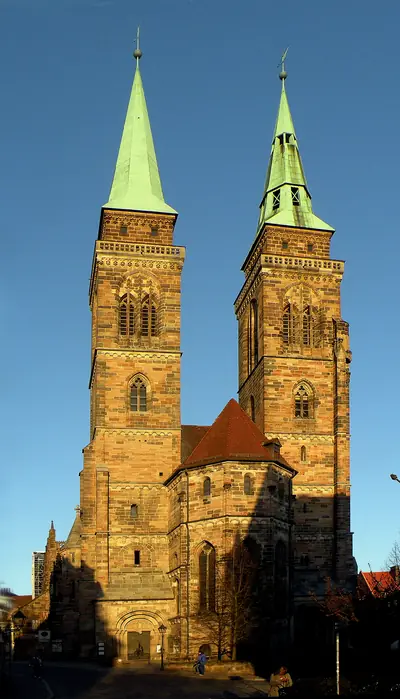
Standing in front of the Old City Hall at Albrecht-Dürer-Platz, St. Sebaldus is one of Nuremberg’s major churches and the city’s oldest parish church. It is named after Sebaldus, an eighth-century hermit and missionary regarded as Nuremberg’s patron saint.
The building combines late Romanesque forms in its western choir and nave with Gothic elements in the eastern choir, side chapels and entrance portals. A major eastern choir was added in the fourteenth century as devotion to Saint Sebald grew. Inside, look for works including a Saint Christopher from 1442, a Saint Catherine from around 1320 and several Madonna figures.
Do not confuse this church with St. Sebald in Altenfurt, a district of Nuremberg. That Roman Catholic church is a protected monument and is also associated with the city’s patron saint.
Frauenkirche and Hauptmarkt
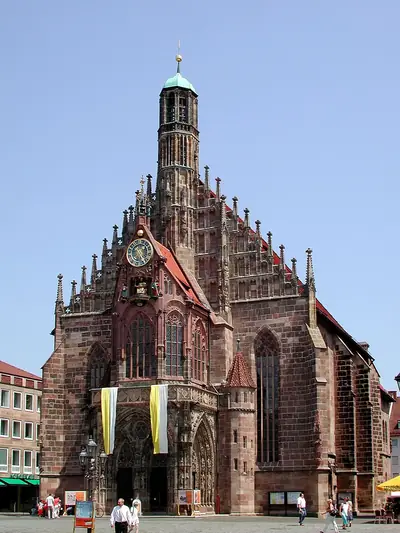
The Frauenkirche, or Church of Our Lady, stands on the eastern side of Hauptmarkt. Built between 1352 and 1362 on the initiative of Emperor Charles IV, it is a brick Gothic hall church with three aisles and a two-bay choir.
Its richly decorated western façade faces the market. Above the porch, the famous Männleinlaufen mechanism was created by Adam Kraft in 1509 and remains in operation. The Chapel of Saint Michael sits above the porch; from there, the emperor once displayed imperial relics and insignia of power.
Hauptmarkt is one of the central squares of the Old Town, and the Schöner Brunnen is another of its defining landmarks. Together, the square and church make a natural starting point for a Nuremberg self-guided walking tour through the historic centre.
St. Lawrence
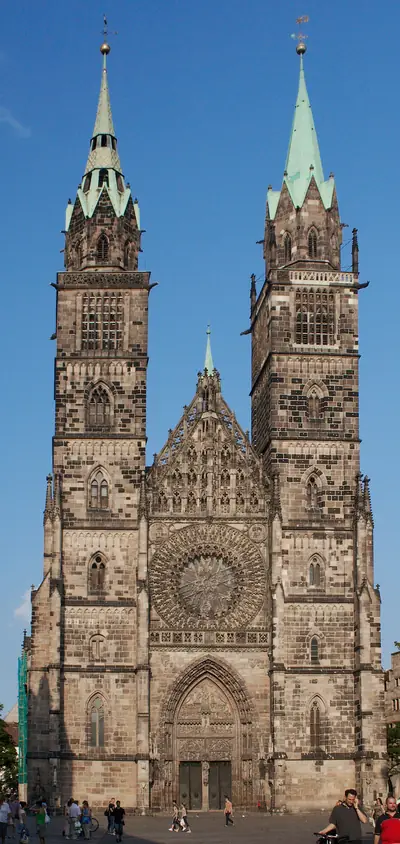
On the southern side of the Pegnitz, St. Lawrence Church, or St. Lorenz, is one of Nuremberg’s great medieval landmarks. Construction began around 1250 as a three-naved basilica, and its Late Gothic hall choir was completed in 1477.
In the medieval city, St. Lorenz served the parish south of the Pegnitz, forming an urban counterpart to St. Sebaldus in the north. The church suffered severe damage to its roof and vaults during the Second World War, but was later restored. Many important Late Gothic works survived because they had been moved to safety, including the famous Sacrament House created by Adam Kraft.
St. Egidien
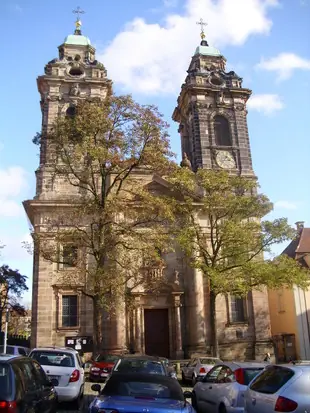
At Egidienplatz in the Sebalder Old Town, St. Egidien is Nuremberg’s only Baroque church. The Evangelical Lutheran building occupies what is considered the city’s oldest church site and reflects its earlier identity as the Benedictine Abbey of Saint Giles.
Its Baroque architecture is a rare presence among the predominantly medieval buildings of Nuremberg’s historic centre.
St. Martha and St. Jakob
St. Martha is a medieval Gothic church on Königstraße, set slightly back between two houses. This gap in the streetscape makes it easy to overlook. The church was severely damaged by a fire on the night of June 5, 2014, and reopened after reconstruction in 2018.
In the southwestern Jakoberviertel, St. Jakob is another medieval church in the Lorenzer Old Town. Dedicated to Saint James the Greater, it remains an important stop on the Franconian Way of St. James. Its Gothic character reflects its origins, while its history also includes severe Second World War damage and later restoration.
The Holzschuherkapelle
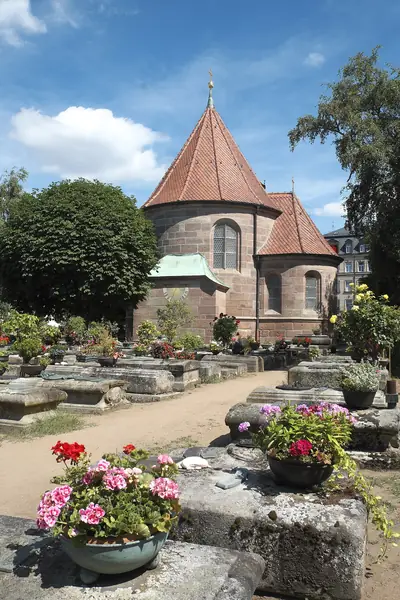
The small chapel at Johannisstraße 59, also known as the Holzschuherkapelle, is a cultural heritage monument recognized in Bavaria. Its modest scale makes it a useful reminder that Nuremberg’s historic character extends beyond its largest churches and monuments.
Schloss Neunhof
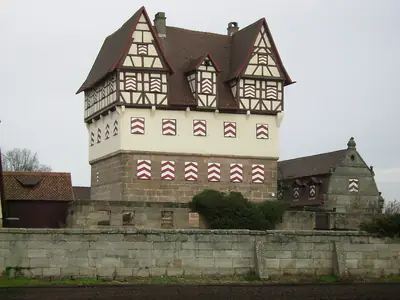
At the southern edge of the village of Neunhof, now part of Nuremberg, Schloss Neunhof is a Renaissance-era castle built around 1500. It represents an ideal type of pond house, a residence traditionally associated with water around the building.
The castle’s interior furnishings have survived unusually completely, while its Baroque park was reconstructed in 1964 and again in 1978 and 1979. Schloss Neunhof is currently closed for renovation work.
Pellerschloss
Pellerschloss in Fischbach is a sixteenth-century manor house associated with Nuremberg’s patrician families. It is one of the area’s surviving former water castles and is notable for preserving much of its original substance.
Schloss Großgründlach and Serz’sches Herrenhaus
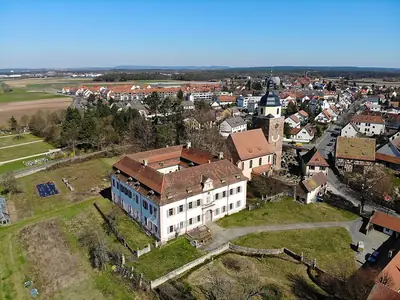
Schloss Großgründlach, also known as Hallerschloss, is a historic manor in Nuremberg. The Serz’sches Herrenhaus adds another historic building to the city’s architectural landscape.
Irrhain
In the Kraftshofer Forest near Kraftshof, the Irrhain is a small nature reserve where landscape and literary history meet. The woodland is connected with the Pegnesischer Blumenorden, a language and literary society founded in 1644.
The name Irrhain recalls the site’s original maze-like design. The woodland has served as a meeting place for the society since its beginnings, preserving an unusual link between Nuremberg’s cultural history and its surrounding landscape.
Pfarrkirche Heilige Familie
In Reichelsdorf, the Pfarrkirche Heilige Familie, or Parish Church of the Holy Family, is a Roman Catholic church and protected monument. It is one of the local landmarks that shows how Nuremberg’s heritage continues beyond the central Old Town.
Explore Nuremberg with a Free Audio Guide
Download Neywo to explore Nuremberg independently with 7 walking tours and 1 bus route. The walking tours range from 0.87 to 2.17 km and last from 47 to 103 minutes, with between 4 and 11 narrated stops. The bus route covers 6.4 km, lasts 27 minutes and includes 9 narrated stops.
The walks include Hauptmarkt and its clockwork figures, Castle Hill and Dürer’s House, the churches and bridges across the Pegnitz, the Rally Grounds, the Nuremberg Trials and the southern Old Town. The bus route connects the Rally Grounds with the Old Town.
Neywo tells the story of each place as you reach it, at your own pace, with no group and no schedule. Narration is available in 11 languages—a practical way to turn a free walking tour of Nuremberg into a self-guided experience.
Nuremberg is in Bavaria, in Germany. If you are continuing through the region, you can also explore Munich, Regensburg or Rothenburg.
Places with an audio guide in Nuremberg
8 places in Nuremberg with a Neywo audio guide. Each one starts telling its story as you reach it.
Self-guided tours in Nuremberg
8 tours in Nuremberg, free in the Neywo app. Each stop tells its story as you reach it.
- Bus ride
Bus 36: Rally Grounds to the Old Town
VAG's regular city bus 36 links the Documentation Center at the Nazi Party Rally Grounds with Nuremberg's old town. Ride past the Laufer Tor and St Sebaldus to Maxplatz and the Tower of the Senses. One ticket, no tour group.
Documentation Center Nazi Party Rally Grounds · St. Bartholomäus · Laufer Tor · Allerheiligenkapelle (Nuremberg-Sankt Sebald) · St. Sebaldus · Hauptmarkt …
Open this tour: Bus 36: Rally Grounds to the Old Town - Walk
Hauptmarkt: Clockwork Figures, a Golden Fountain and Dürer's Square
The heart of Nuremberg's old town. Wait for the mechanical figures on the Frauenkirche, spin the brass ring on the Beautiful Fountain, then follow the city's patron saint to the church of St Sebaldus and the monument to Albrecht Dürer.
Synagogue monument Nuremberg · Frauenkirche · Hauptmarkt · Schöner Brunnen · Augustinerkloster Nürnberg · Nuremberg Toy Museum …
Open this tour: Hauptmarkt: Clockwork Figures, a Golden Fountain and Dürer's Square - Walk
Castle Hill: Dürer's House and the Emperor's Fortress
Climb from the underground art bunker that hid the empire's treasures to Albrecht Dürer's home, the house of Pilate and the double castle that once hosted emperors and burgraves. A short, steep and rewarding walk.
Neutor (Nürnberg) · Albrecht Dürer's House · Pilatushaus · Historischer Kunstbunker · Nuremberg Castle · Burgkapelle Burg 16 in Nürnberg …
Open this tour: Castle Hill: Dürer's House and the Emperor's Fortress - Walk
Across the Pegnitz: Hangman's Island to St Lawrence
Follow the river through the old town: Germany's largest half-timbered building, the island once home to the executioner, a flat-arched bridge with a stone ox, then the great Gothic church of St Lawrence and the last residential tower in the city.
Weinstadel · Henkerhaus Nürnberg · Unschlittplatz · Trödelmarkt · Fleischbrücke (Nürnberg) · Katharinenkirche, Nuremberg …
Open this tour: Across the Pegnitz: Hangman's Island to St Lawrence - Walk
The Rally Grounds: Confronting Nuremberg's Nazi Past
A sober walk through the unfinished Congress Hall, its documentation centre, the Zeppelin tribune and the stadium beside it. The sites show how the Nazis staged power and how Nuremberg now examines that history.
Documentation Center Nazi Party Rally Grounds · Kongresshalle · Zeppelinhaupttribüne · Max-Morlock-Stadion
Open this tour: The Rally Grounds: Confronting Nuremberg's Nazi Past - Walk
Behind the Wall: Teutonic Knights, Human Rights and the Southern Gate
Explore the southern old town: the churches of the Jakobsviertel and the Teutonic Order's commandery, then the Germanisches Nationalmuseum with its Way of Human Rights. Pass the old customs hall and two Gothic churches on Königstraße and leave the walls through the Frauentor at the craftsmen's courtyard.
St. Jakob · St. Elizabeth · Deutschordenskommende Nürnberg · Way of Human Rights · Germanisches Nationalmuseum · Mauthalle …
Open this tour: Behind the Wall: Teutonic Knights, Human Rights and the Southern Gate - Walk
Dürer's Way of the Cross to the Rose Cemetery
Follow the stations of Adam Kraft's Way of the Cross out of the castle quarter and through the baroque Hesperides gardens to the Johannisfriedhof, the Rose Cemetery, and the little Holzschuher chapel.
Kreuzweg Burgschmietstraße 18 in Nürnberg · Kreuzweg Campestraße 1 in Nürnberg · Kreuzweg Burgschmietstraße 40a; Burgschmietstraße; Burgschmietstraße 42 in Nürnberg · Hesperidengärten · Kapelle Johannisstraße 59 in Nürnberg · Johannisfriedhof (Nürnberg)
Open this tour: Dürer's Way of the Cross to the Rose Cemetery - Walk
Courtroom 600: Where the Nuremberg Trials Were Held
Walk from the Quelle tower, once Europe's largest mail-order house, to the Palace of Justice on Fürther Strasse. Learn how the war crimes trials and the later doctors' trial were staged here, and visit the memorial museum in the court building.
Quelleturm · Palace of Justice · Memorium Nürnberger Prozesse · Nuremberg Medical Trial
Open this tour: Courtroom 600: Where the Nuremberg Trials Were Held
Walk Nuremberg with Neywo
Neywo turns Nuremberg into a self-guided audio tour. Stories arrive as you reach the place they belong to, and the route reshapes when you wander off it.


More in Bavaria
Elsewhere in Germany
- FrankfurtHesse
- IdsteinHesse
- Rüdesheim am RheinHesse
- BinzMecklenburg-Western Pomerania
- RostockMecklenburg-Western Pomerania
- SchwerinMecklenburg-Western Pomerania
- AachenNorth Rhine-Westphalia
- AnholtNorth Rhine-Westphalia
- BonnNorth Rhine-Westphalia
- CologneNorth Rhine-Westphalia
- DuisburgNorth Rhine-Westphalia
- DüsseldorfNorth Rhine-Westphalia