What to See in Regensburg, Germany: Free Audio Guide
Things to do in Regensburg: what to see in Bavaria’s historic city
The best things to do in Regensburg include exploring its Roman remains, Gothic cathedral, medieval Stone Bridge, historic churches, patrician towers, and former abbey buildings. The city’s Old Town brings together layers of Roman, medieval, Baroque, and modern history in a setting that is particularly rewarding to discover on foot. Neywo offers a free audio guide for Regensburg with 141 narrated places.
What to see in Regensburg
Stone Bridge and Brückturm
The Stone Bridge, or Steinerne Brücke, is one of Regensburg’s defining landmarks. Built between 1135 and 1146, it remained the city’s only bridge across the Danube until the 1930s. Today, the bridge is reserved for pedestrians and provides views of the river and the Old Town, including the cathedral spires.
The bridge’s sturdy arches have survived floods, wars, and centuries of use. Regensburg’s best-known bridge legend says that its master builder made a pact with the Devil, promising the first three souls to cross it. He supposedly sent a rooster, a hen, and a dog instead.
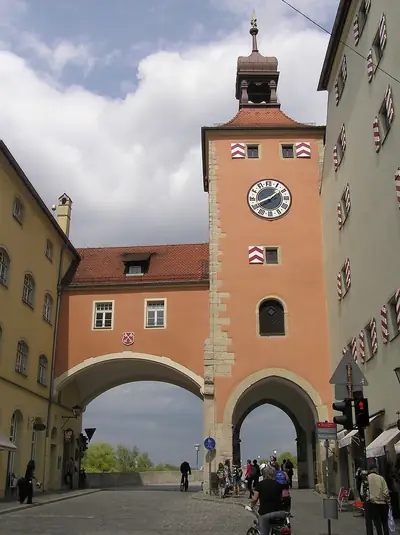
At the Old Town end of the bridge, the Brückturm stands as a reminder of the medieval crossing. Nearby, the Goliathhaus is another memorable sight. This former house fortress dates from around 1220 to 1230 and was built on the foundations of the northern Roman wall of Castra Regina. Its crenellated façade carries a large painting of David fighting Goliath. The current version was painted by Franz Rinner in 1900.
Regensburg Cathedral
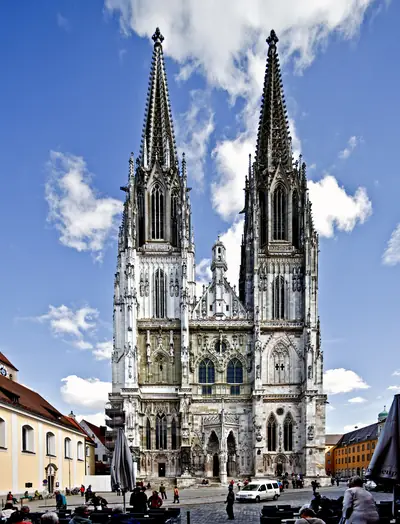
Regensburg Cathedral, or Dom St. Peter, is the city’s most important church and the cathedral of the Diocese of Regensburg. Its twin towers dominate the Old Town and make the building easy to recognize among the winding streets.
The present Gothic cathedral replaced an earlier Romanesque church destroyed by fire in 1273. Construction began in 1275. The building was roofed and in use by around 1450, while the towers and spires were completed between 1859 and 1869.
Inside, the stained-glass windows from the thirteenth and fourteenth centuries bring color to the vast Gothic interior. The cathedral is regarded as an important example of Gothic architecture in Bavaria and one of Germany’s significant Gothic cathedrals.
The Basilica of the Nativity of Our Lady
The Basilica of the Nativity of Our Lady is also known as the Alte Kapelle, or Old Chapel. Regarded as Regensburg’s oldest church, it is also one of Bavaria’s important Rococo churches.
Tradition places an early chapel here after the fall of the Western Roman Empire, on the site of a Roman temple dedicated to Juno. The present building has an Ottonian core, while its elevated choir was added in the mid-fifteenth century in the Late Gothic style.
A major redesign in the second half of the eighteenth century transformed the interior. Gilded stucco and luminous frescoes associated with the Asam brothers and the Wessobrunn school give the chapel its dazzling Rococo character. The statue of Our Lady, Patroness of Bavaria, is another important feature.
St. Emmeram’s Basilica and Palace
St. Emmeram’s Basilica began around 780 as the main church of St. Emmeram’s Abbey. The Benedictine abbey itself was founded around 739 at the grave of Saint Emmeram, a Frankish missionary bishop honored as a martyr. It later became an imperial abbey, directly under the emperor.
After several fires and rebuildings, the church was remodeled between 1731 and 1733 by Cosmas Damian and Egid Quirin Asam. Their work created the richly decorated Baroque interior, with frescoes and gilded altars. Following the secularization of the abbey, the church became a parish church. Pope Paul the Sixth raised it to the rank of minor basilica on March 5, 1964.
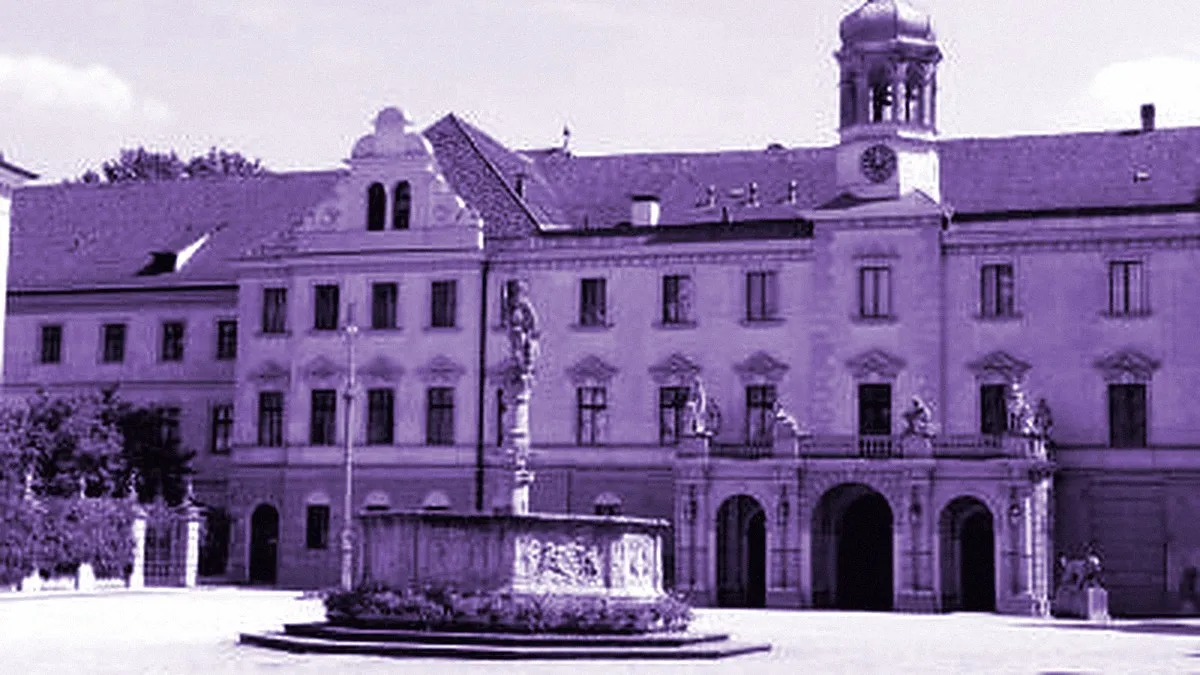
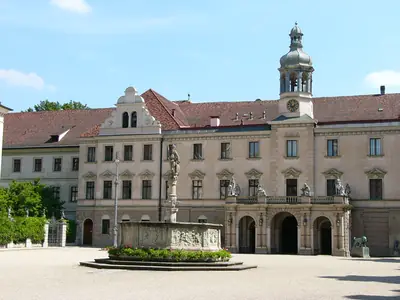
The adjoining St. Emmeram’s Palace, also known as Schloss Thurn und Taxis, occupies the former abbey complex. The Thurn und Taxis princely family took possession of it in 1812, after the abbey was dissolved. Much of the palace as it appears today comes from a major late-nineteenth-century building campaign, which added new wings and converted monastic structures into a residence.
Scots Monastery
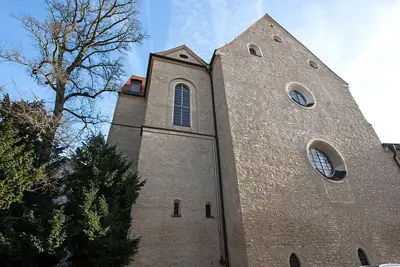
The Scots Monastery, or Schottenkirche St. Jakob, is officially the Irish Benedictine Abbey Church of St. James and St. Gertrude. The monastery was founded in the eleventh century by Irish missionaries, and Irish and later Scottish monks were associated with it for much of its history.
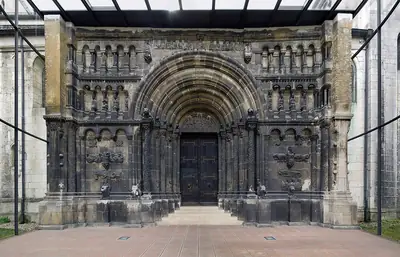
The church is a notable example of high Romanesque architecture in southern Germany. Its most famous feature is the north portal, created in the middle of the twelfth century. Known as the Scottish Portal, it is covered with enigmatic sculptures of fantastic creatures, biblical scenes, and mysterious symbols.
Dreieinigkeitskirche
The Dreieinigkeitskirche, or Church of the Holy Trinity, is an early Baroque Protestant church in Regensburg’s Old Town. Built between 1627 and 1631 to designs by Hanns Carl, it was one of the first new Lutheran churches built in Bavaria and the largest church constructed in Regensburg during its period as a Free Imperial City.
The interior is a column-free hall church, giving the main space a clear and open appearance. The church also has a climbable tower offering one of Regensburg’s memorable viewpoints.
Its southern churchyard reflects the city’s wartime history. During the Thirty Years’ War, a senior Swedish officer was buried here at the request of Bernhard of Saxe-Weimar, the Swedish commander involved in the fighting around Regensburg. Austrian Protestant exiles were also reburied here after their earlier graves outside the city walls had been plundered.
Niedermünster and document Niedermünster
Niedermünster was a former canonesses’ foundation and, at the height of its influence, one of the wealthiest and most powerful institutions in Bavaria. As the Imperial Abbey of Niedermünster, it was represented in the Bavarian Imperial Circle.
The Romanesque Niedermünster Church dates from the twelfth century and remains the parish church of Regensburg Cathedral. Beneath it, archaeological evidence reveals several layers of settlement and construction.
The document Niedermünster presents a photorealistic, three-dimensional reconstruction of this history. It offers a detailed way to explore the buildings and settlements beneath the Romanesque church.
Goldener Turm and Goldenes Kreuz
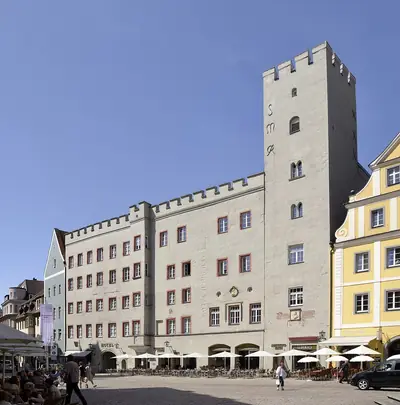
Regensburg’s medieval family towers reveal the wealth and status of its patrician families. The Goldener Turm, or Golden Tower, rises about 50 metres and was once the highest residential tower north of the Alps. Construction began around the middle of the thirteenth century, and four additional floors were added around 1300.
Renaissance arcades were added to the courtyard in the sixteenth century. The tower’s current name comes from an inn that operated here in the seventeenth century. After reconstruction in 1985, the building became student accommodation.
At Haidplatz, the Goldenes Kreuz is another former patrician castle, or family tower. Its position at Haidplatz 7 places it among the historic buildings that give the square its distinctive character.
Kepler Memorial House
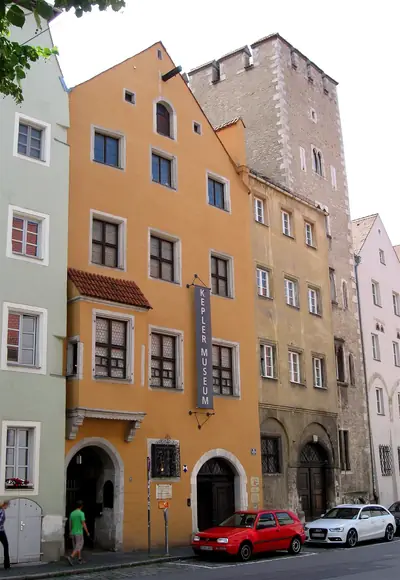
The Kepler Memorial House is connected with the final weeks of the astronomer Johannes Kepler’s life. Kepler took lodgings here in the autumn of 1630 and died in the house on November 15, 1630.
The building offers a more personal historical perspective than Regensburg’s monumental churches and bridges: it marks the place where the astronomer spent the final chapter of his life.
St. Oswald and Saint Mary Church
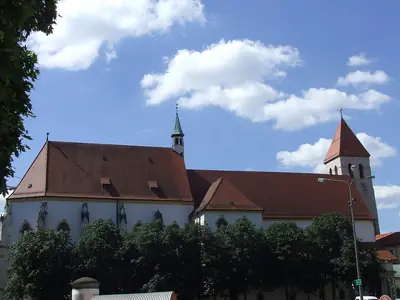
St. Oswald is a quiet Protestant church on the western edge of the Old Town, beside the south bank of the Danube. A Carmelite monastery was founded on the site around 1290, but the monks moved to Straubing by 1367. The church now belongs to the parish of the nearby Trinity Church.
Regensburg also has two churches known as Saint Mary Church. The church in the Irl district is a Roman Catholic subsidiary church and a listed historic monument. Built in 1759, it is a hall church in the light, playful Rococo style. Another Catholic side church of St. Maria is located in the Wutzlhofen district at Wutzlhofen 14.
Explore Regensburg with a self-guided audio tour
A Regensburg self-guided walking tour is a practical way to connect the city’s landmarks without joining a group. Neywo’s free audio guide tells the story of each place as you reach it, at your own pace, with no group and no schedule. Narration is available in 11 languages.
The Regensburg guide includes five walking tours, one bus route, and one bike route:
- Stone Bridge to Cathedral: Roman Gate, Gothic Spires — 1.19 km, 116 minutes, 11 narrated stops.
- Patricians, Towers and an Imperial Parliament — 1.18 km, 115 minutes, 12 narrated stops.
- Emperors, Monks and the Princes of Thurn und Taxis — 1.76 km, 113 minutes, 11 narrated stops.
- Convents, Danube Boats and Bavaria’s Story — 1.5 km, 81 minutes, 9 narrated stops.
- Across the Danube: Stadtamhof, Gardens and a Vanished Castle — 2.03 km, 65 minutes, 6 narrated stops.
- Line 11 Through the Old Town: Scots Monastery to the Stone Bridge — a 2.4 km bus route lasting 10 minutes, with 7 narrated stops.
- Around the Old Town: Gates, Danube and Stadtamhof by Bike — a 6.7 km bike route lasting 34 minutes, with 5 narrated stops.
Download Neywo and explore Regensburg with the city’s history unfolding at the places where it happened. The app covers 141 narrated places and lets you choose a walk, bus route, or bike route according to your own pace.
Regensburg is part of Bavaria, in Germany. If you are continuing through the region, you can also explore Nuremberg, Passau, or Munich.
Places with an audio guide in Regensburg
8 places in Regensburg with a Neywo audio guide. Each one starts telling its story as you reach it.
Self-guided tours in Regensburg
7 tours in Regensburg, free in the Neywo app. Each stop tells its story as you reach it.
- Bike ride
Around the Old Town: Gates, Danube and Stadtamhof by Bike
Ride the cycle paths that ring Regensburg's UNESCO old town. Start at the Kunstforum gallery, pass the medieval Jakobstor and the Teutonic church of St Ägidien, then follow the Danube cycle route to Stadtamhof and the abbey of St Mang, finishing at the north end of the Stone Bridge. The bridge itself is for walkers: leave your bike and cross on foot.
Kunstforum Ostdeutsche Galerie · Jakobstor · St. Ägidien · St. Mang · Stone Bridge
Open this tour: Around the Old Town: Gates, Danube and Stadtamhof by Bike - Bus ride
Line 11 Through the Old Town: Scots Monastery to the Stone Bridge
Regensburg's city bus 11 crosses the old town from west to east, past the Kunstforum gallery and the Irish Scots Monastery, along the Danube to St Oswald and Kepler's house, then to the Stone Bridge, the Danube shipping museum and the Carmelite church. Seven sights for the price of an ordinary city ticket.
Kunstforum Ostdeutsche Galerie · Scots Monastery · St. Oswald · Kepler Memorial House · Stone Bridge · Regensburg Museum of Danube Shipping …
Open this tour: Line 11 Through the Old Town: Scots Monastery to the Stone Bridge - Walk
Stone Bridge to Cathedral: Roman Gate, Gothic Spires
Cross the 12th-century Stone Bridge, the medieval masterpiece and its legend of a pact with the Devil, climb its surviving tower, then enter the old Roman fortress town. Pass the Goliath house, the Porta Praetoria that has stood since AD 179, the twin spires of the cathedral and a small chapel that honours the true length of Mary, and finish at the ancient Alte Kapelle and the Rococo church of St Kassian.
Stone Bridge · Brückenturm-Museum · Goliathhaus · Stiftskirche St. Johann · Porta Praetoria in Regensburg · Regensburg Cathedral …
Open this tour: Stone Bridge to Cathedral: Roman Gate, Gothic Spires - Walk
Patricians, Towers and an Imperial Parliament
Medieval Regensburg was a free imperial city where merchant dynasties built towers to show off their wealth and emperors held the Perpetual Diet. Walk from the house where Kepler died to the Imperial Hall, then past the Baumburger and Golden towers, the Baroque palace of a banker who went bankrupt, the square where the Jewish quarter once stood and the palaces and fountain of Haidplatz.
Kepler Memorial House · Runtingerhaus · Altes Rathaus, Regensburg · Baumburger Turm · Goldener Turm · Palais Löschenkohl …
Open this tour: Patricians, Towers and an Imperial Parliament - Walk
Emperors, Monks and the Princes of Thurn und Taxis
Explore the abbey quarter of St Emmeram, where a thousand-year-old basilica stands beside the palace and treasury of the Thurn und Taxis princes. Continue through the medieval Emmeram Gate and the Gothic and Baroque churches of the southern old town, visit the early Gothic Dominican church and the Scots Monastery, founded by Irish monks, whose Romanesque portal is one of the most puzzling in Germany, then leave by the medieval Jakobstor.
Emmeramer Tor · Fürstliche Schatzkammer Thurn und Taxis · St. Emmeram's Palace · St. Emmeram's Basilica · St. Rupert · Bruderhauskirche St. Ignaz Regensburg …
Open this tour: Emperors, Monks and the Princes of Thurn und Taxis - Walk
Convents, Danube Boats and Bavaria's Story
Leave the busy centre for the quiet eastern old town. Start on the river boats that once crowded the Danube harbour, visit the ancient convent of Niedermünster and the Carmelite church, learn Regensburg's story in the history museum, follow Bavaria's past in the museum by the Danube and finish at the king's summer villa and the Gothic Ostentor, the gate to Vienna.
Regensburg Museum of Danube Shipping · Niedermünster · Karmelitenkirche St. Joseph · Klarissenkloster St. Maria Magdalena, Regensburg · Regensburg Museum of History · Museum der Bayerischen Geschichte …
Open this tour: Convents, Danube Boats and Bavaria's Story - Walk
Across the Danube: Stadtamhof, Gardens and a Vanished Castle
Cross the Iron Footbridge to the quiet north bank of the Danube. Visit St Oswald, the hospital church of St Katharina with its beer tradition from 1238, the former abbey of St Mang in the old suburb of Stadtamhof, then climb the Dreifaltigkeitsberg, a hill crowned by a plague-thanksgiving church, to the site of the vanished Landeskron castle.
St. Oswald · Eiserner Steg · Spitalkirche St. Katharina · St. Mang · Dreifaltigkeitsberg · Burg Landeskron
Open this tour: Across the Danube: Stadtamhof, Gardens and a Vanished Castle
Walk Regensburg with Neywo
Neywo turns Regensburg into a self-guided audio tour. Stories arrive as you reach the place they belong to, and the route reshapes when you wander off it.


More in Bavaria
Elsewhere in Germany
- FrankfurtHesse
- IdsteinHesse
- Rüdesheim am RheinHesse
- BinzMecklenburg-Western Pomerania
- RostockMecklenburg-Western Pomerania
- SchwerinMecklenburg-Western Pomerania
- AachenNorth Rhine-Westphalia
- AnholtNorth Rhine-Westphalia
- BonnNorth Rhine-Westphalia
- CologneNorth Rhine-Westphalia
- DuisburgNorth Rhine-Westphalia
- DüsseldorfNorth Rhine-Westphalia