Würzburg, Germany: Self-Guided Walking Tour
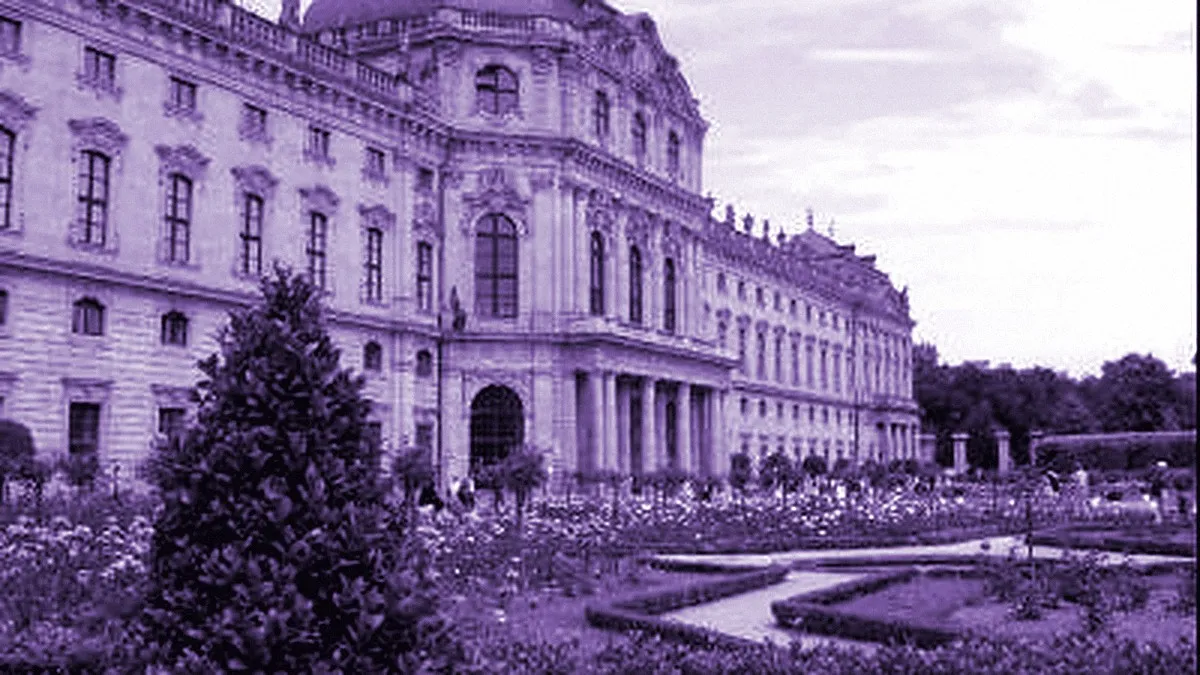
Things to Do in Würzburg: What to See in Bavaria’s Historic City
The best things to do in Würzburg include visiting the Würzburg Residence, exploring the old town’s churches and market square, crossing the Old Main Bridge and climbing to Marienberg Fortress. The city combines Romanesque and Gothic heritage with grand Baroque architecture, museums and a setting shaped by the Main River. Neywo’s free audio guide for Würzburg brings 126 narrated places to life as you explore.
Würzburg is in Bavaria, in southern Germany. Its compact centre makes it well suited to a Würzburg self-guided walking tour, with major sights spread between the Residence, the market square, the river and the fortress above the Main.
What to see in Würzburg
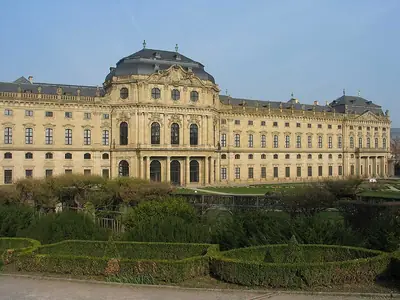
Würzburg Residence
The Würzburg Residence is the city’s essential Baroque landmark and has been a UNESCO World Heritage site since 1981. Built between 1720 and 1744, it was the official seat of the Prince-Bishops of Würzburg, who ruled both church and state in the Holy Roman Empire.
Inside, the grand staircase rises without visible support beneath a vast fresco by Giovanni Battista Tiepolo and his son Domenico. The painting represents the four continents: Europe, America, Asia and Africa. The state rooms add further highlights, including the delicately decorated White Hall, the Imperial Hall, the Mirror Cabinet and the Court Chapel.
The palace stands alongside the Court Gardens and Residence Square, making this one of the best starting points for discovering Würzburg.
Würzburg Cathedral and the Schönborn Chapel
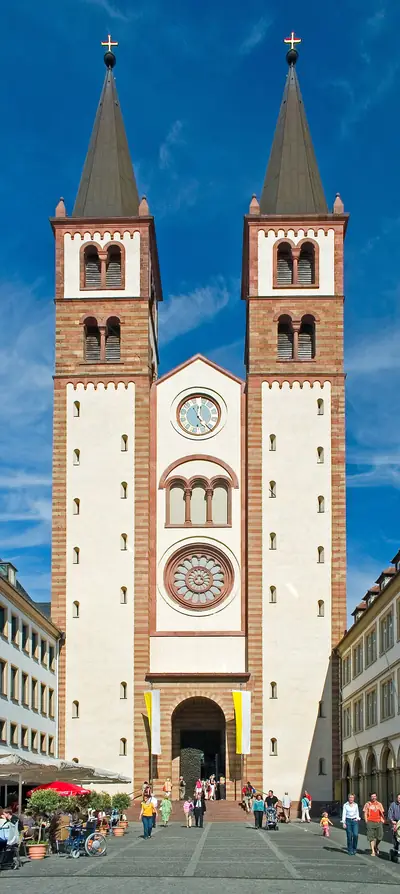
A short walk west of the Residence brings you to Würzburg Cathedral, the seat of the Bishop of Würzburg and a traditional burial place for the city’s Prince-Bishops. More than a hundred metres long, it is the fourth-largest Romanesque church in Germany.
The cathedral was built in the eleventh century during the Salian period. Its dedication changed over time: it was first dedicated to the Saviour, then to the Apostle Andreas, and in 1967 to the Franconian martyrs Kilian, Kolonat and Totnan.
The building was severely damaged by bombs in March 1945. Its present appearance reflects careful post-war reconstruction, while the Romanesque interior retains later additions such as the Schönborn Chapel, created by Balthasar Neumann between 1721 and 1736.
Neumünster and Würzburg’s churches
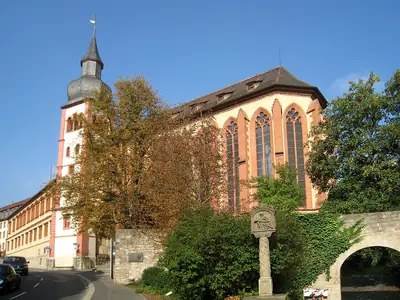
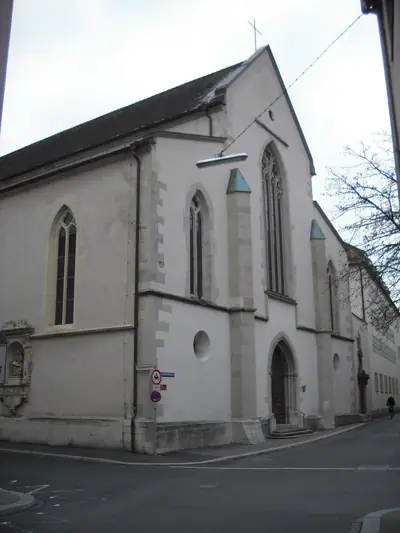
Würzburg’s religious heritage extends well beyond the cathedral. The Franciscan Church of the Holy Cross, or Franziskanerkirche Heilig Kreuz, belongs to a monastery complex whose history in the city began in 1221. It was the first Franciscan foundation north of the Alps and was established to serve the city’s spiritual and social needs.
St. Stephan has played a central role in Würzburg’s Protestant life for more than two centuries. A collegiate foundation stood on the site from 1014, and the church later became the city’s first lasting Protestant congregation. War destroyed almost everything in 1945; the present hall church was built between 1949 and 1955 and consecrated in 1952.
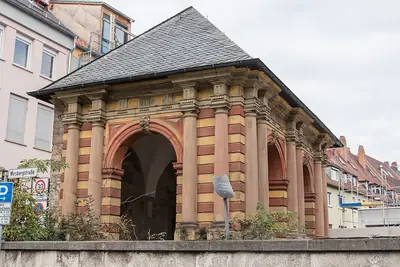
Other protected religious buildings reveal different chapters of Würzburg’s history. The Gartenpavillon belonged to the former Augustinian monastery, while the Deutschhauskirche is a registered cultural heritage monument. In the Zellerau district, the Himmelspforten Monastery is a convent of the Discalced Carmelites, and the Holy Cross Parish Church is another protected Bavarian cultural monument.
Marienkapelle and the Market Square
The Marienkapelle stands on the north side of Lower Market Square. Although its size and appearance are closer to those of a church, it is officially a chapel because it never received parish rights.
Citizens began building this Gothic landmark in 1377 on the ruins of a synagogue, and construction took a hundred years. Its design combines a basilica and a hall church, with three aisles and octagonal pillars. Three carved portals tell biblical stories: the southern Bridal Portal shows Adam and Eve and the Coronation of the Virgin, the western Golden Portal depicts the Last Judgment, and the northern portal represents the Annunciation.
A gilded Madonna rises 72 metres above the market square. Nearby, the Marktbrunnen is another protected Bavarian cultural heritage monument.
Falkenhaus
On the market square, the Falkenhaus is immediately recognisable by its three Rococo gables and richly decorated stucco façade. The building now houses Würzburg’s tourist information centre and central library.
Its history reaches back to 1338, when it served as a residence for the cathedral priest. It later became the Zum Falken inn, and in the nineteenth century it was Würzburg’s only venue for concerts and dances. The bombing of 16 March 1945 left it a burned-out shell, but the building was reconstructed and its Rococo façade restored.
Old Main Bridge and the historic ship landing
The Old Main Bridge is one of Würzburg’s most atmospheric places to pause beside the river. The bridge is associated with monumental stone saints and connects the old town with the route towards Marienberg Fortress.
Along the river, the Schiffsanlegeplatz is the city’s historic ship landing place. It is also known as the Alter Kranen, or old crane, and the Ochsenschanze. The site is listed as a protected cultural heritage monument in Bavaria.
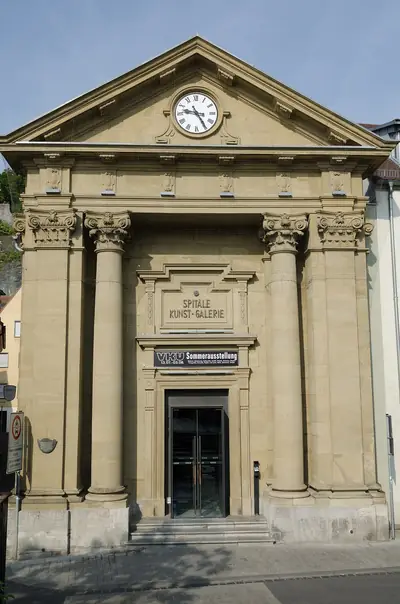
The nearby Spitäle has a different kind of double life. Originally a court hospital church, it is now an exhibition hall. Its name recalls the hospital complex to which it once belonged, while its current use brings art and cultural exhibitions into the former church.
Marienberg Fortress
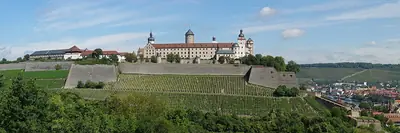
Marienberg Fortress is Würzburg’s defining landmark, standing 100 metres above the Main River. For almost 500 years, the Prince-Bishops ruled their territory from this hill before moving to the Residence in the city centre.
The site is much older than the fortress itself. Archaeologists have found traces of a Bronze Age stronghold, and a church was built here in the eighth century. The present Saint Mary’s Church, or Marienkirche, stands on those ancient foundations and has roots reaching back to the early eleventh century.
Most of the fortress visible today dates from the Renaissance and Baroque periods, between the sixteenth and eighteenth centuries. Swedish forces under Gustavus Adolphus captured it in 1631 during the Thirty Years’ War, after which it was rebuilt as a grand Baroque residence. The complex also includes the Fürstenbaumuseum and the Lower Franconian Museum.
A self-guided way to explore Würzburg
A free walking tour in Würzburg can show you the main sights without a group, but Neywo offers a more flexible alternative. Its Würzburg audio guide narrates the story of each place as you reach it, at your own pace, with no group and no schedule.
The app includes five walking tours:
- Prince-Bishops’ Würzburg: Palace, Cathedral and a Minstrel’s Grave — 1.11 km, 101 minutes and 11 narrated stops.
- Market Square to the Old Bridge: Rococo Gables and Twelve Stone Saints — 1.84 km, 94 minutes and 10 narrated stops.
- Fortress and Pilgrims’ Hill: Marienberg to the Käppele — 3.36 km, 109 minutes and 9 narrated stops.
- X-Rays, Hospitals and Wine: Würzburg’s Scientific and Civic Side — 2.47 km, 82 minutes and 9 narrated stops.
- Friars, Nuns and Scholars: Würzburg’s Quiet Convent Quarter — 1.26 km, 54 minutes and 6 narrated stops.
There is also one bus route, Line 7: Old Town Churches, the Main Bridge and the Fortress Foot, covering 4.6 km in 20 minutes with 7 narrated stops. For cyclists, the Röntgen Ride: Station Square to the Harbour Museum covers 1.5 km in 8 minutes and includes 5 stops.
Download Neywo and explore Würzburg
Download Neywo to explore Würzburg with 126 narrated places and seven routes: five walks, one bus route and one bike route. Stories play automatically as you reach each place, so you can discover the Residence, cathedral, market square, Old Main Bridge and Marienberg Fortress at your own pace. The narration is available in 11 languages, with no group and no schedule.
Places with an audio guide in Würzburg
8 places in Würzburg with a Neywo audio guide. Each one starts telling its story as you reach it.
Self-guided tours in Würzburg
7 tours in Würzburg, free in the Neywo app. Each stop tells its story as you reach it.
- Bike ride
Röntgen Ride: Station Square to the Harbour Museum
A short ride on the Main-Werra cycle route through the north of the old town. Start at Berliner Platz, pass the lab where Röntgen discovered X-rays and the Center for the History of Psychology, and end at the converted harbour granary that now houses the city art museum.
Berliner Platz · Universelles Leben · Universitätsgebäude · Zentrums für Geschichte der Psychologie · Museum im Kulturspeicher Würzburg
Open this tour: Röntgen Ride: Station Square to the Harbour Museum - Bus ride
Line 7: Old Town Churches, the Main Bridge and the Fortress Foot
A city line that runs from the Martin Luther church south-east of the centre across the Main past the Siebold monument and the Ludwigsbrücke, then along the river through the old town to the Spitäle, the Deutschhaus church and the Heilig Kreuz parish church. A cheap way to hop between the districts and the western bank.
Martin Luther Church · Siebold-Denkmal (Würzburg) · Brücke · Pfarrkirche · Spitäle · Kloster …
Open this tour: Line 7: Old Town Churches, the Main Bridge and the Fortress Foot - Walk
Prince-Bishops' Würzburg: Palace, Cathedral and a Minstrel's Grave
Start at Balthasar Neumann's UNESCO-listed Residence, where the prince-bishops lived in baroque splendour, then walk west to the Romanesque cathedral, the Schönborn family chapel and the Neumünster, where the poet Walther von der Vogelweide is said to lie. The route now also takes in the Court Garden, the Martin von Wagner Museum, the Residence square and the Cathedral Treasury.
Würzburg Residence with the Court Gardens and Residence Square · Würzburg Residence · Martin von Wagner Museum · Schlosskirche · Residenzplatz · Brunnen …
Open this tour: Prince-Bishops' Würzburg: Palace, Cathedral and a Minstrel's Grave - Walk
Market Square to the Old Bridge: Rococo Gables and Twelve Stone Saints
Würzburg's medieval heart in a short walk: the rebuilt Rococo Falkenhaus, the Gothic Marienkapelle with its gilded Madonna, the Town Hall, and the old bridge lined with saints that leads toward the fortress.
Wohnhaus · Marienkapelle, Würzburg · Marktbrunnen · Town Hall (Würzburg) · Stadttor · Laufbrunnen …
Open this tour: Market Square to the Old Bridge: Rococo Gables and Twelve Stone Saints - Walk
Fortress and Pilgrims' Hill: Marienberg to the Käppele
Climb from the oldest monastery church in the city to the fortress that looked down on Würzburg for centuries, and finish at Neumann's twin-towered Käppele, reached by the longest Stations of the Cross staircase in Germany. Along the way it passes the Fürstenbaumuseum and the Museum für Franken inside the fortress, the old watchtower and the Jagdzeughaus.
Gartenpavillon · Pfarrkirche · Wachturm Tellsteige · Jagdzeughaus · Marienkirche, Würzburg · Marienberg Fortress …
Open this tour: Fortress and Pilgrims' Hill: Marienberg to the Käppele - Walk
X-Rays, Hospitals and Wine: Würzburg's Scientific and Civic Side
Visit the lab where Röntgen discovered X-rays in 1895, then follow the charitable foundations that still fund the city through wine. Stop at the Juliusspital, the baroque Stift Haug and the Bürgerspital, and end at the theatre. Stops now include the old customs office on the Main, the Augustinerkirche and the Center for the History of Psychology.
Museum im Kulturspeicher Würzburg · Zollamt · Zentrums für Geschichte der Psychologie · Universitätsgebäude · Juliusspital foundation Würzburg · Augustinerkirche …
Open this tour: X-Rays, Hospitals and Wine: Würzburg's Scientific and Civic Side - Walk
Friars, Nuns and Scholars: Würzburg's Quiet Convent Quarter
A slow loop through the old town's religious heart: the Antonite and Franciscan houses founded in the 13th century, the Baroque Carmelite church, the Renaissance Neubaukirche of the university and the former convent of St. Agnes. Pull up a pew in the quiet churches the guidebooks hurry past.
Antoniterkirche · Franziskanerkirche (Würzburg) · Karmelitenkirche · Universität · Agnetenkloster Würzburg · Sankt Stephan
Open this tour: Friars, Nuns and Scholars: Würzburg's Quiet Convent Quarter
Walk Würzburg with Neywo
Neywo turns Würzburg into a self-guided audio tour. Stories arrive as you reach the place they belong to, and the route reshapes when you wander off it.


More in Bavaria
Elsewhere in Germany
- FrankfurtHesse
- IdsteinHesse
- Rüdesheim am RheinHesse
- BinzMecklenburg-Western Pomerania
- RostockMecklenburg-Western Pomerania
- SchwerinMecklenburg-Western Pomerania
- AachenNorth Rhine-Westphalia
- AnholtNorth Rhine-Westphalia
- BonnNorth Rhine-Westphalia
- CologneNorth Rhine-Westphalia
- DuisburgNorth Rhine-Westphalia
- DüsseldorfNorth Rhine-Westphalia