Toruń, Poland: Self-Guided Walking Tour
Things to Do in Toruń: Fortresses, Churches and Riverside History
Toruń is a historic Polish city shaped by the Vistula River, medieval heritage and an extensive 19th-century fortress system. The city’s most distinctive sights include Dybów Castle, the ruins and defensive works around the old center, neo-Gothic churches and a remarkable series of forts. Neywo has a free audio guide for Toruń with 112 narrated places, available in 11 languages.
What to See in Toruń
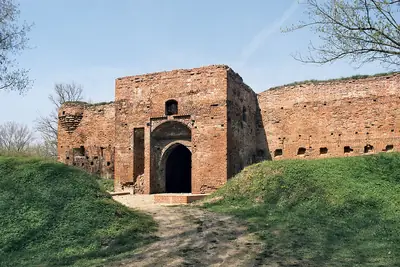
Dybów Castle
On the left bank of the Vistula, directly across from Toruń’s Old Town, Dybów Castle is one of the city’s most evocative medieval sites. The striking ruin is recognized as a national Object of Cultural Heritage. Its position on the southern bank of the river made it a strategic counterpart to Toruń, facing the city from the opposite shore.
The castle offers a different view of Toruń’s historic landscape: instead of looking out from the Old Town, visitors can see the medieval city across the water.
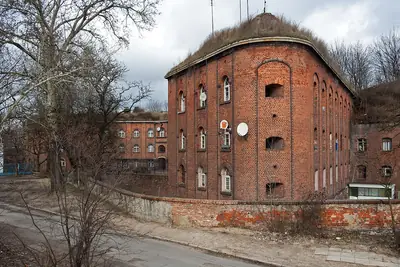
Fort Jakuba
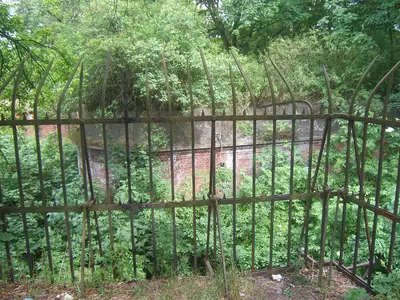
Fort Jakuba was one of the earliest defensive structures in the Toruń Fortress complex. Construction began around 1828 and was officially completed in 1833, although finishing work reportedly continued until 1840. Built at the same time as the Przyczółek Mostowy, it was designed as an independent citadel open on the city side.
The fort extended for 300 metres. At its center stood a three-story, three-winged barracks redoubt, protected from the east by an embankment more than 30 metres thick. After Toruń became part of Poland in 1920, the fort lost its military importance. Its moats were filled, much of the surrounding earthwork was leveled and several structures were demolished.
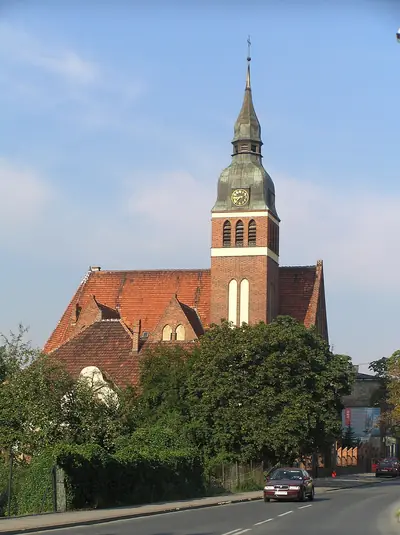
Church of Our Lady of Victory
Along Podgórna Street, the Church of Our Lady of Victory stands out for its neo-Gothic design. Pointed arches, tall windows, a steep roof and vertical lines give the building the characteristic upward movement of 19th-century Gothic revival architecture.
The church was originally dedicated to Saint George. It is now part of the parish of Our Lady of Victory, remains an active place of worship and is protected as a heritage site.
Toruń Railway Fort
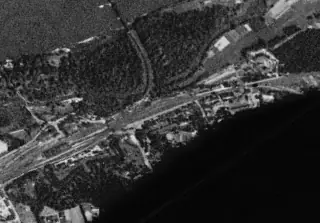
Also known as Fort XVI, the Railway Fort was built between 1863 and 1866 to defend the railway bridge and the Toruń–Warsaw railway line. Its role explains its unusual location and design within the wider Toruń Fortress.
The fort is especially distinctive because it is the only hexagonal fort in the city. Three concrete positions were added in 1912, reflecting changes in military technology and defensive requirements. After 1920, its equipment was removed by German troops. The Vistula Flotilla occupied the site between 1922 and 1925, after which it was handed over to the 63rd Toruń Infantry Regiment.
Fort II
Fort II was the main artillery fort of the Toruń Fortress complex. Covering just under four hectares, it formed an important part of the defensive ring around the city. Its scale gives an impression of the engineering and military planning behind Toruń’s fortifications.
Fort IV
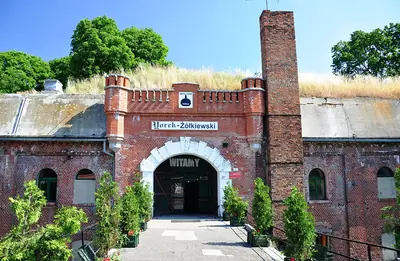
Built by the Prussians in the 1880s, Fort IV was originally named after the Prussian field marshal Ludwig Yorck von Wartenburg and was known as Fort II. In 1926, it was renamed in honor of the Polish military commander Stanisław Żółkiewski.
The fort covers about 13.5 hectares and stands along Chrobrego Street. Its size makes it one of the larger structures in the fortress system, and a useful stop for understanding how extensively the city was fortified.
Fort V
Fort V stands on Polna Street in the Wrzosy district, about four and a half kilometres north of the main square. It is the fifth fort in the system of fifteen forts that made up the Toruń Fortress and belongs to its outer ring.
The fort covers about 4.26 hectares. It was originally known as Fort III Scharnhorst and now carries the name of Jan Karol Chodkiewicz, a Polish military commander.
Fort XI
Along Poznańska Street, Fort XI covers just over four hectares. Its changing names reflect the political history of Toruń: it was originally known as Fort V, later as Grosser Kurfürst, and from 1920 as Fort XI Stefana Batorego, named for King Stephen Báthory.
Fort VII
Fort VII is one of the most impressive military structures in Toruń. It stands in the Bielany district on Polna Street, about four and a half kilometres from the Old Town Market Square. As the main artillery fort of the outer defensive ring, it was one of fifteen forts protecting the city.
The fort covers 4.2 hectares. It was originally called Fort IV and also bore the name Friedrich der Grosse. Since 1920, it has been named after Tadeusz Kościuszko.
Fort XIII
Fort XIII was the main artillery fort of the entire Toruń Fortress system. Located along Okólna Street, it covers just over five hectares, with large earthworks and defensive structures still shaping the surrounding landscape.
The fort was originally dedicated to Winrich von Kniprode, a Grand Master of the Teutonic Order. After 1920, it was renamed in honor of the Polish military figure Karol Kniaziewicz.
Fort XV
In the Rudak district, on Rypińska Street, Fort XV is the largest artillery fort in the Toruń Fortress complex. It stands roughly four and a half kilometres from the Old Town center.
The structure was originally built under the name Fort VII Hermann von Salza. It was later renamed Fort XV Henryk Dąbrowski.
Fort I
Fort I is an armored fort built between 1888 and 1894 as part of the Toruń Fortress. Its original name was Fort Ia König Wilhelm I, reflecting its German-era origins.
From 1920 onward, it was renamed in honor of Jan III Sobieski, the Polish king. The fort is a reminder of the successive political and military identities that shaped Toruń’s defensive architecture.
Fort III
Fort III is an intermediate infantry fort on Skłodowskiej-Curie Street. Originally known as Werk L’Estocq, it now bears the name of Stanisław Jabłonowski.
Its position within the fortress network shows that Toruń’s defenses were not made up only of large artillery forts. Smaller and intermediate structures also formed part of the system.
Fort IX
Fort IX was one of the artillery forts in Toruń’s defensive ring. It was originally built under the name Zwischenfort IVc and later renamed after Heinrich von Plauen.
From 1920 onward, it took its current name, honoring Bolesław Chrobry, or Boleslaus the Brave. Like the other forts, it offers a glimpse into the 19th-century military engineering that surrounded the city.
Fort X
Also called the Coastal Battery, Fort X is an intermediate fort built in the form of an infantry shelter. It stands along Przy Grobli Street and was originally known by the German name Batterie Grünthalmühle.
Its name and structure point to the complex history of Toruń Fortress, where military installations changed roles and names as the city passed between different political contexts.
Explore Toruń with Neywo
A Toruń self-guided walking tour is a flexible way to discover the city’s landmarks and fortifications without joining a group. Neywo’s free Toruń audio guide includes 112 narrated places, with narration available in 11 languages.
The app tells the story of each place as you reach it, at your own pace, with no group and no schedule. Download Neywo and explore Toruń independently, moving from the Vistula and Dybów Castle to the churches and the forts of the Toruń Fortress.
Toruń is one destination within Poland, and it can also be combined with a wider journey through cities such as Warsaw or Poznań.
Places with an audio guide in Toruń
8 places in Toruń with a Neywo audio guide. Each one starts telling its story as you reach it.
Walk Toruń with Neywo
Neywo turns Toruń into a self-guided audio tour. Stories arrive as you reach the place they belong to, and the route reshapes when you wander off it.

