Things to Do in Żagań, Poland: Walking Guide
Things to do in Żagań, Poland: what to see and explore
Looking for things to do in Żagań? This town in western Poland brings together a former ducal residence, distinctive churches, railway history, and the powerful story of the Second World War prisoner-of-war camps. It is also the setting for two remarkable self-guided walks, making it easy to explore the town’s layered past at your own pace. Neywo offers a free audio guide for Żagań with 15 narrated places.
What to see in Żagań
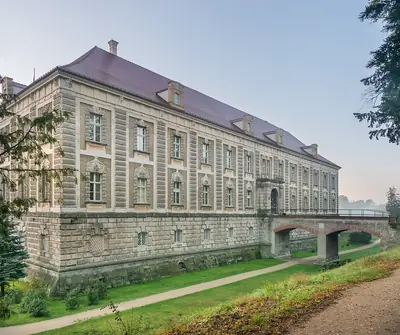
Castle in Żagań
The Castle in Żagań, known locally as Pałac Książęcy, is also called the Ducal Palace, Lobkowitz Palace, or Schloss Sagan. It was the seat of the Duchy of Sagan, a distinct principality ruled by its own dukes. The palace and its setting provide an introduction to Żagań’s political and architectural history.
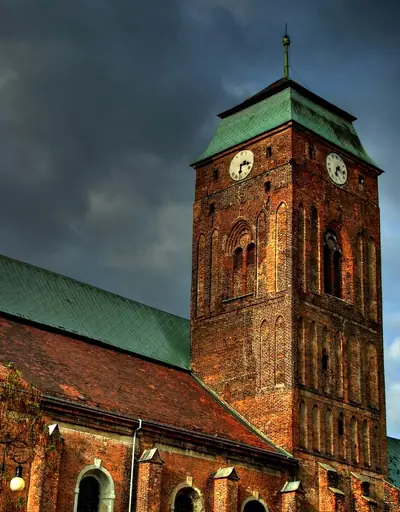
Assumption of the Blessed Virgin Mary Church
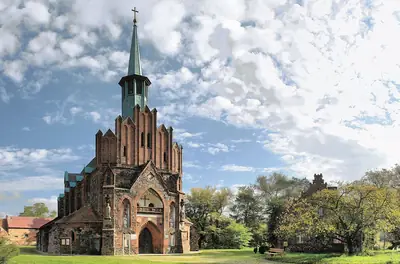
The Church of the Assumption of the Blessed Virgin Mary is one of Silesia’s most distinctive sacred buildings and the region’s only surviving true pseudobasilica. Its Gothic form developed during the fourteenth and fifteenth centuries.
The church appears from the outside to have a high central nave and lower side aisles. Inside, however, there is no clerestory—the upper level of windows normally used to illuminate the nave. The side aisles rise almost as high as the center, creating a broad and unified interior.
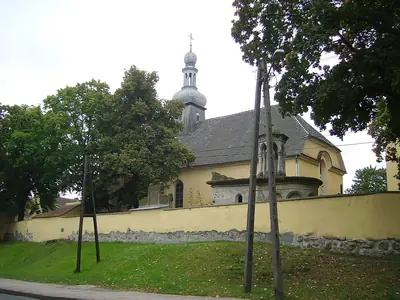
Church of the Visitation
The Church of the Visitation stands on ground that has been used as a cemetery since the sixteenth century. Although its origins are Gothic, later renovation gave the building much of its present Baroque appearance.
Inside, the high altar dates from 1600. Beside the church is an eighteen-metre bell tower containing four bells, while the building’s long history reflects the many changes Żagań has experienced.
Holy Sepulchre Chapel
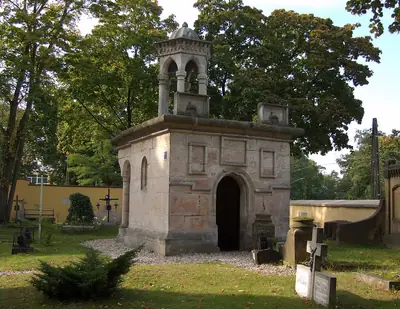
Beside the Church of the Visitation is the Holy Sepulchre Chapel, a replica of the Holy Sepulchre in Jerusalem. It was built to match the medieval appearance of the original and was the first structure of its kind in Silesia.
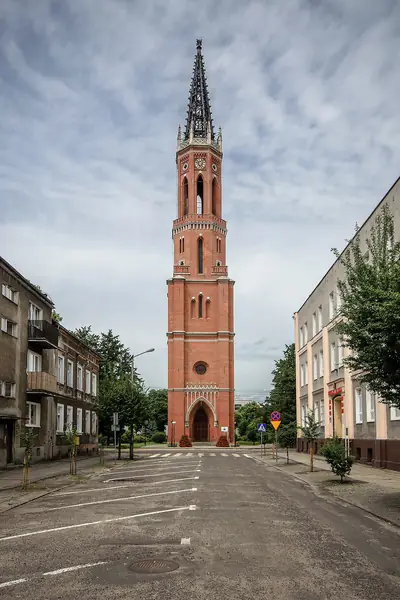
Protestant church and its tower
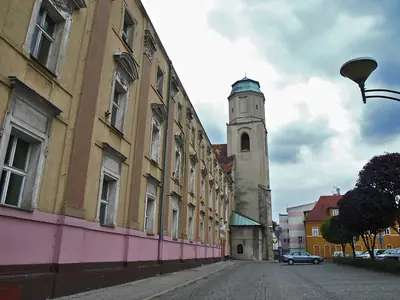
The seventy-metre neo-Gothic tower is the surviving part of the former Holy Trinity Church. Built in 1709, the church was one of six Silesian Churches of Grace permitted after the Altranstädt Convention.
The church survived the Second World War with only minor damage, but its nave was deliberately demolished in 1965. The tower contains the burial chapel of the Dukes of Courland and the Dukes of Żagań. Since 2004, it has been open as a viewing platform overlooking the town and surrounding landscape.
Courthouse
The former Ducal Chamber Palace, now associated with the courthouse, stands on the border between the Silesian-Lusatian Lowland and the Trzebnicki Ridge. In 1786, the Duchy of Żagań and the palace were sold to Peter Biron, the last Duke of Courland, who became Duke of Żagań and held the title until his death in 1800.
Saints Peter and Paul Church
The Church of Saints Peter and Paul is a Roman Catholic filial church. It belongs to the parish of the Assumption of the Blessed Virgin Mary and lies within the Żagań deanery of the Zielona Góra-Gorzów diocese.
Holy Cross Church
The Holy Cross Church is tucked into the northeastern corner of the Castle Park. It is a filial church belonging to the nearby parish of Saint Joseph rather than an independent parish church.
Museum of Prisoner of War Camps
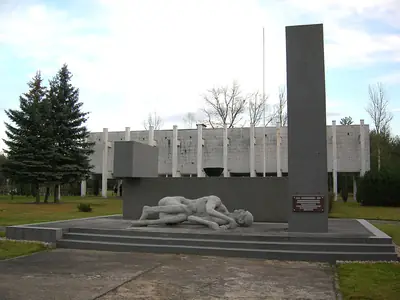
The Museum of Prisoner of War Camps was established in 1971 on the site of two Second World War camps: Stalag VIIIC for army personnel and Stalag Luft 3 Sagan for captured airmen. Its exhibitions remember the suffering of the prisoners while also highlighting their ingenuity and resistance.
The museum focuses particularly on the escape attempts that became legendary, including the Great Escape. A replica of Barrack 104 shows the cramped conditions in which prisoners lived and planned escapes.
Stalag Luft III
Today, the former site of Stalag Luft III lies in a quiet pine forest. The camp was established in March 1942 outside Sagan, now Żagań, for Allied airmen captured during the Second World War. Its location was selected partly because the deep, loose sand made tunnelling difficult.
The camp was surrounded by high barbed-wire fencing, and the barracks were raised above the ground so guards could watch for digging. Microphones were also buried around the perimeter to detect underground activity. Despite these precautions, prisoners organised escape attempts, including the famous Great Escape associated with the site.
Synagogue of Sagan
Nothing remains of the Synagogue of Sagan itself, but the site marks an important part of the town’s Jewish history. The synagogue was inaugurated in 1857 after an old fortress tower on the city meadow was converted into a place of worship.
The building served as the spiritual centre of Sagan’s Jewish community for more than seventy years. Its last religious service took place in 1930. On the night of 9 November 1938, it was set on fire during the November pogroms and destroyed.
PKP Ok1-198
On platform one stands the steam locomotive PKP Ok1-198, a standard-gauge 4-6-0 engine from the Prussian P8 series. Built by Berliner Maschinenbau in Wildau in 1919, it later joined the Polish State Railways and worked in several parts of the country.
The locomotive ran in Żagań for a couple of years in the mid-1970s. Its final regular service ended in 1980, and after a period in storage it returned to Żagań in 1990. Restoration followed in 1993, and the engine was moved to the platform in 2012.
Explore Żagań with a self-guided walking tour
Neywo has two walking tours in Żagań, each following a different thread through the town.
The Dukes of Sagan: Palace, Towers and Tombs covers 2.7 km in 114 minutes and has nine narrated stops. It includes the Castle, Courthouse, Saints Peter and Paul Church, the former Synagogue of Sagan, Holy Spirit Church, the Protestant church, the Assumption of the Blessed Virgin Mary Church, the Church of the Visitation, and the Holy Sepulchre Chapel.
Sagan and the Great Escape covers 4.66 km in 102 minutes and has five narrated stops. Its route connects the Holy Cross Church, Castle, PKP Ok1-198, Stalag Luft III, and the Museum of Prisoner of War Camps.
Download Neywo and explore Żagań at your own pace
Download Neywo to explore Żagań with two walking tours, covering 2.7 km and 4.66 km, with durations of 114 and 102 minutes. Together, they include 14 tour stops, while the Żagań audio guide contains 15 narrated places in total. Narration is available in 11 languages.
The app tells the story of each place as you reach it. You choose your pace, with no group and no schedule—an easy way to follow a Żagań self-guided walking tour while discovering this distinctive corner of Poland.
Places with an audio guide in Żagań
8 places in Żagań with a Neywo audio guide. Each one starts telling its story as you reach it.
Self-guided tours in Żagań
2 tours in Żagań, free in the Neywo app. Each stop tells its story as you reach it.
- Walk
The Dukes of Sagan: Palace, Towers and Tombs
Follow the dukes of Sagan from the Ducal Palace between the Bóbr and the Czerna Wielka through the old town. You pass the former Ducal Chamber, a tower that outlived its church, a pseudobasilica holding Piast tombs, and end on the hill at a rare replica of the Holy Sepulchre.
Castle in Żagań · Courthouse in Żagań · Saints Peter and Paul church in Żagań · Synagogue of Sagan · Holy Spirit church in Żagań · Protestant church in Żagań …
Open this tour: The Dukes of Sagan: Palace, Towers and Tombs - Walk
Sagan and the Great Escape
Start in the Castle Park, then walk south to the station platform where a restored Prussian steam locomotive stands, and on into the pine forest of Stalag Luft III, scene of the Great Escape. The route ends at the museum with its replica Barrack 104. A long walk, mostly flat, with a lot of history.
Holy Cross church in Żagań · Castle in Żagań · PKP Ok1-198 · Stalag Luft III · Museum of Prisoner of War Camps in Żagań
Open this tour: Sagan and the Great Escape
Walk Żagań with Neywo
Neywo turns Żagań into a self-guided audio tour. Stories arrive as you reach the place they belong to, and the route reshapes when you wander off it.

