What to See in Tarragona, Spain: Free Audio Guide
Things to Do in Tarragona: Roman Heritage, Cathedral History and Mediterranean Views
Tarragona is a historic coastal city in Catalonia, built around the remains of Roman Tarraco and shaped by centuries of religious, military and civic history. The best things to do in Tarragona include exploring its Roman archaeological sites, walking through the medieval Part Alta, visiting museums and enjoying views over the Mediterranean. Neywo has a free audio guide for Tarragona with 77 narrated places, available in 11 languages.
Tarragona is an especially rewarding destination for travellers interested in ancient history. It was one of the most important cities in Roman Hispania, and its archaeological heritage is recognized as a UNESCO World Heritage Site. At the same time, the city remains a living Catalan centre, with museums, markets, churches, public squares and a seafront that is easy to explore on foot.
What to see in Tarragona
Roman Tarraco and its archaeological heritage
Tarragona began as Tarraco in 218 BC, when the Roman brothers Gnaeus and Publius Cornelius Scipio established a settlement beside an Iberian hilltop town. It later became the capital of Hispania Tarraconensis and one of the most important Roman cities on the Iberian Peninsula.
The archaeological site known as Colonia Iulia Urbs Triumphalis Tarraco is not a single monument but a city layered beneath modern Tarragona. Its remains explain how Rome established a political, military and cultural centre in Hispania.
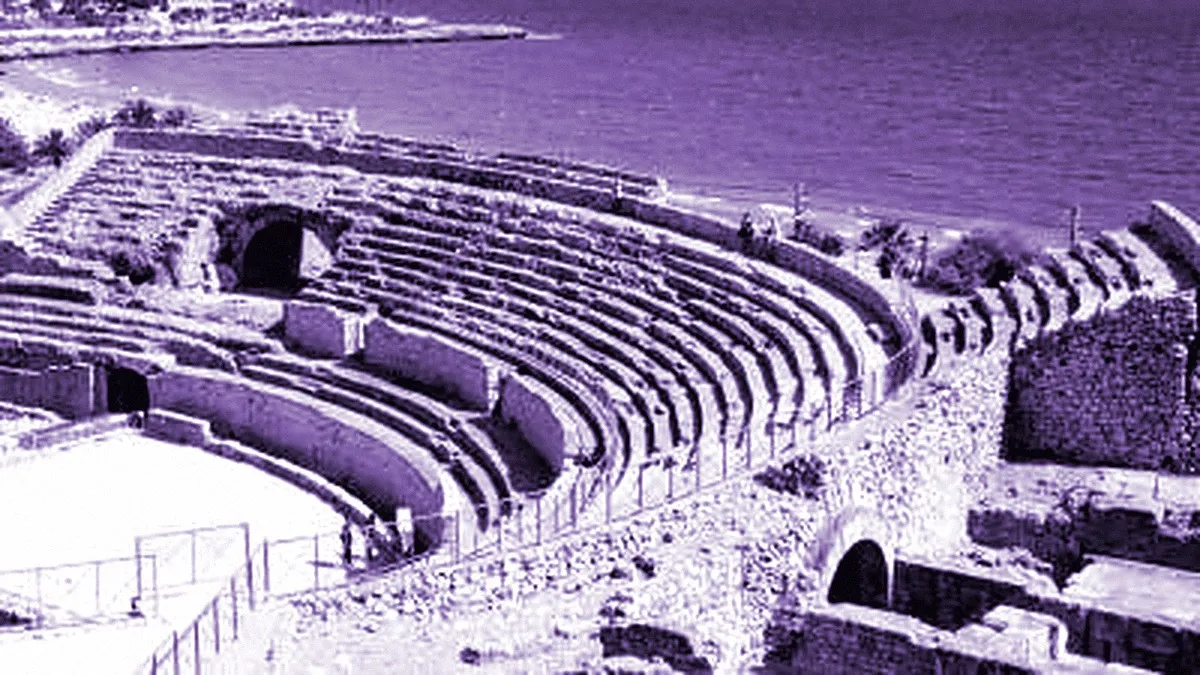
Tarragona Amphitheatre
The Tarragona Amphitheatre is one of the city’s defining Roman monuments. Its position near the Mediterranean links the ancient city directly to the coast, while its history recalls the public spectacles and religious life of Roman Tarraco. It is one of the essential stops for anyone deciding what to see in Tarragona.
The amphitheatre is also connected with the city’s early Christian history. Bishop Fructuosus and his deacons Augurius and Eulogius were martyred here in 259.
Roman circus and the provincial forum
The Roman circus of Tarraco was part of the monumental heart of the ancient city. Its presence helps visitors understand the scale and organization of Roman Tarragona, where public entertainment and civic life occupied grand architectural spaces.
The provincial forum of Tarraco reveals another aspect of the city’s importance. Together with the circus and the other archaeological remains, it shows how Tarragona developed as the capital of a vast Roman province.
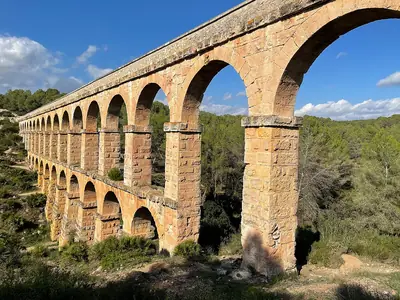
Les Ferreres Aqueduct, or Pont del Diable
Outside the city centre, the Les Ferreres Aqueduct is one of the best-preserved Roman structures in Catalonia. Also known locally as the Pont del Diable, it formed part of an aqueduct system that carried water from the Francolí River to Tarraco.
The system stretched about 25 kilometres and was built in the first century. The surviving aqueduct has two tiers of stone arches and reaches around 90 feet in height, while roughly 711 feet of the original structure remain. A particularly distinctive feature is the possibility of walking along the water channel at the top, crossing the valley for more than 200 metres.
The aqueduct continued supplying Tarragona with water until the 18th century, giving the monument an unusually long practical history.
National Archaeological Museum of Tarragona
The National Archaeological Museum of Tarragona, or MNAT, is the oldest archaeological museum in Catalonia. Its collections preserve the history of Tarraco through objects and remains from the Roman and Early Christian periods.
The museum began in the 19th century as a Provincial Museum. It also includes a library and is dedicated to recovering, preserving, researching and sharing the heritage of Roman Tarragona and its surrounding area. In 1962, it was declared a historic-artistic monument.
Tarragona Cathedral
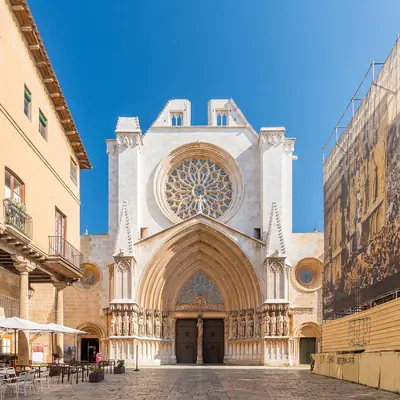
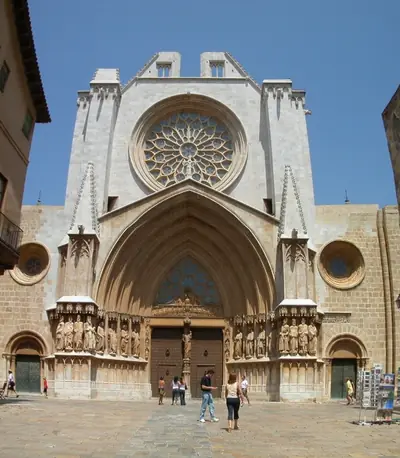
The Metropolitan and Primatial Cathedral Basilica of St. Tecla, commonly known as Tarragona Cathedral, stands at the highest point of the city. Its Gothic architecture dominates the historic centre, but the site’s history goes back much further.
Before the cathedral, the location was occupied by a Roman temple dedicated to Emperor Augustus, dating to 19 AD. A Visigothic cathedral and later a Moorish mosque also stood here. The cathedral therefore represents several distinct stages of Tarragona’s history in one place.
Museo Diocesano de Tarragona
The Museo Diocesano de Tarragona is located within the cathedral complex and is run by the Archdiocese of Tarragona. Its collection reflects the religious art and history associated with the archdiocese, making it a natural continuation of a visit to the cathedral.
Casa Castellarnau
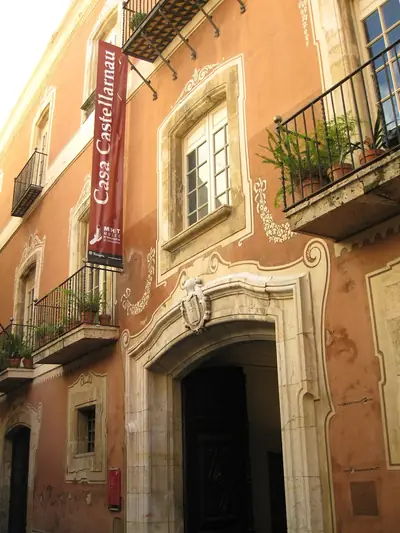
Casa Castellarnau is a historic mansion on Carrer dels Cavallers in the heart of Tarragona. Today, it serves as the central headquarters of the Museum of History of Tarragona and is recognized as a site of local cultural interest.
The house was built at the beginning of the 15th century and later belonged to influential local families. Emperor Charles I stayed there during a visit to Tarragona in 1542. Its pointed arches, Gothic columns, capitals, courtyard and vaulted staircase preserve the character of its medieval origins, while later changes reflect the 18th and 19th centuries.
Casa Canals
Casa Canals is an example of eclectic architecture and is also recognized as a site of local cultural interest. Its façade combines different architectural influences, giving the building a distinctive place among Tarragona’s historic houses.
Museu d’Art Modern de Tarragona
The Museu d’Art Modern de Tarragona is located in the historic Part Alta district. Created in 1976, it promotes the study and understanding of modern and contemporary art while preserving the city’s artistic heritage.
The museum occupies three joined 18th-century houses, renovated by architect Jaume Mutlló and inaugurated in their restored form in 1991. Alongside its exhibition galleries, it has a library, documentation centre and photographic archive. One of its principal works is the Tapís de Tarragona, created by Joan Miró with Josep Royo.
Tamarit Castle
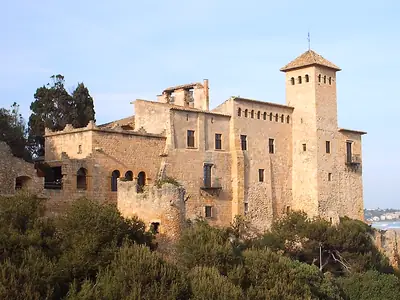
Castell de Tamarit stands on a promontory beside the Mediterranean, between Tamarit beach and Cala Jovera. Its walls enclose the old walled village of Tamarit, creating a complex in which the village and castle are closely intertwined.
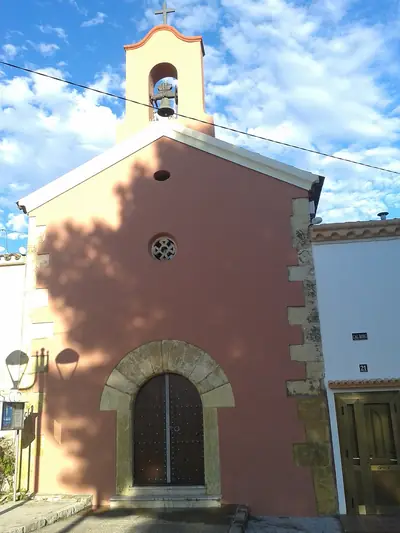
Romanesque, Gothic and Renaissance elements appear throughout the site. Inside the walls are manor houses, an abbey under the Archbishopric of Tarragona and the Romanesque church of the Assumption of the Virgin Mary. Two of the original four gates still survive: the Gate of the Mora and the Gate of the Cross.
In the Middle Ages, Tamarit’s port was among the ten most important in Catalonia, and ships departed from here for the Conquest of Majorca.
Ferran Castle
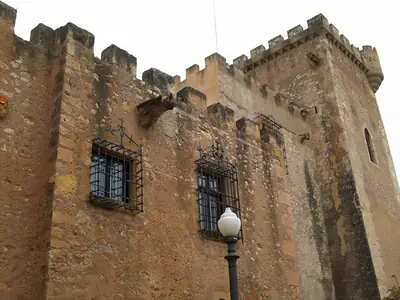
Castell de Ferran is a fortified residence in the countryside between Tamarit and Altafulla. Its history began in the 11th century, when it served as a watchtower within the territory of Tamarit Castle. The tower is documented as early as 1197.
The present complex combines fortified sections with Gothic-Renaissance construction and later historicist remodeling. A lateral crenellated tower topped by an angular sentry box is one of its most noticeable features.
Fortí de Sant Jordi and Fortí de la Reina
Tarragona’s seafront also preserves reminders of military history. Fortí de Sant Jordi is a coastal bastion built by the British during the War of the Spanish Succession to defend the coastline around Miracle Beach.
Fortí de la Reina stands at the tip of the Miracle headland. This 18th-century fortification was built during the same war, with a position chosen to watch over the coast.
Monnars and its historic towers
The village of Monnars contains several buildings listed as part of Catalonia’s architectural heritage. Sant Cosme i Sant Damià de Monnars is recognized as a site of local cultural interest, while Torre de Monnars, also called Ca Madró de Monnars, appears in Catalonia’s Architectural Heritage Inventory.
Torre d’en Seguer, also known as Torre d’en Segur, is another historic tower recognized in the same inventory.
Discover Tarragona at your own pace with Neywo
A Tarragona self-guided walking tour with Neywo is a simple way to connect the city’s monuments as you explore. Tarragona has four walking tours and one bus route, covering routes from 1.27 to 2.41 km and lasting from 25 to 92 minutes. Together, they include 51 narrated stops.
The walks include a 1.99 km route through Roman Tarraco, an 80-minute tour of the Part Alta, a 2.41 km exploration of Rambla Nova, and a 1.27 km seafront walk focused on the Roman amphitheatre and coastal forts. The bus route covers 5.9 km in 25 minutes and includes eight stops.
Download Neywo and explore Tarragona with its free Tarragona audio guide. The app tells the story of each place as you reach it, at your own pace, with no group and no schedule. After Tarragona, you can continue exploring Catalonia, discover nearby Reus or visit Salou.
Places with an audio guide in Tarragona
8 places in Tarragona with a Neywo audio guide. Each one starts telling its story as you reach it.
Self-guided tours in Tarragona
5 tours in Tarragona, free in the Neywo app. Each stop tells its story as you reach it.
- Bus ride
Line 21: Rambla Nova and the Sea Balcony
A daily city bus loop from the railway station along the old walls and the Rambla Nova. Ride it for the sea balcony, the museum quarter, the human-tower monument and the Heroes of 1811 without a single climb.
Balcó del Mediterrani · Torre de les Monges · National Archaeological Museum of Tarragona · Casa Canals de Tarragona · Plaça de la Imperial Tàrraco · Monument als castellers (Tarragona) …
Open this tour: Line 21: Rambla Nova and the Sea Balcony - Walk
Tarraco: Emperor Augustus's Capital by the Sea
Walk the stage of Rome's biggest Iberian provincial capital, from the clifftop balcony to the amphitheatre where martyrs died and the circus where 24,000 cheered chariots. Climb the praetorium tower, trace the provincial forum on the ground and finish at the cathedral built over Augustus's temple. Along the way you pass the national archaeological museum, a medieval Jewish building made from reused Roman brick and the Jesuit church of Sant Agusti.
Balcó del Mediterrani · Tarragona Amphitheatre · Roman circus of Tárraco · Torre de les Monges · Castell del Rei · Provincial forum of Tarraco …
Open this tour: Tarraco: Emperor Augustus's Capital by the Sea - Walk
Archbishops, Prisoners and Merchant Palaces in the Part Alta
Wander the medieval lanes around the cathedral, where archbishops lived in a fortress that was dynamited and a captured French king was kept prisoner. See the noble palaces, a Roman-wall tower and Casa Castellarnau, where an emperor slept in 1542. Extra stops take you to the old law courts built around a Roman tower, a medieval tower, the modern art museum and a chapel built into the Roman wall.
Casa Castellarnau · Plaça del Pallol · Antic Jutjat de Tarragona · Cal Sefus (Tarragona) · Portal del Roser · Castell del Paborde …
Open this tour: Archbishops, Prisoners and Merchant Palaces in the Part Alta - Walk
Rambla Nova: Human Towers, Markets and Modernisme
Stroll Tarragona's grand boulevard from the old bullring to the modernist theatre. Meet the bronze human tower, the Roman forum sunk below the street, the market with its dancing clock and Jujol's ship-shaped theatre. Churches, theatres and the colonial forum fill out the route.
Tarraco Arena Plaça · Colonial forum of Tarraco · Mercat Central · Monument als castellers (Tarragona) · Casa de la Punxa · Monument als herois de 1811 …
Open this tour: Rambla Nova: Human Towers, Markets and Modernisme - Walk
Sea, Forts and Roman Stone: Tarragona's Seafront
Leave the Balco del Mediterrani for the Roman amphitheatre above the shore, then follow the coast to two forts built by the British during the War of the Spanish Succession. A short, flat walk with the sea beside you.
Balcó del Mediterrani · Tarragona Amphitheatre · Fortí de Sant Jordi · Fortí de la Reina
Open this tour: Sea, Forts and Roman Stone: Tarragona's Seafront
Walk Tarragona with Neywo
Neywo turns Tarragona into a self-guided audio tour. Stories arrive as you reach the place they belong to, and the route reshapes when you wander off it.

